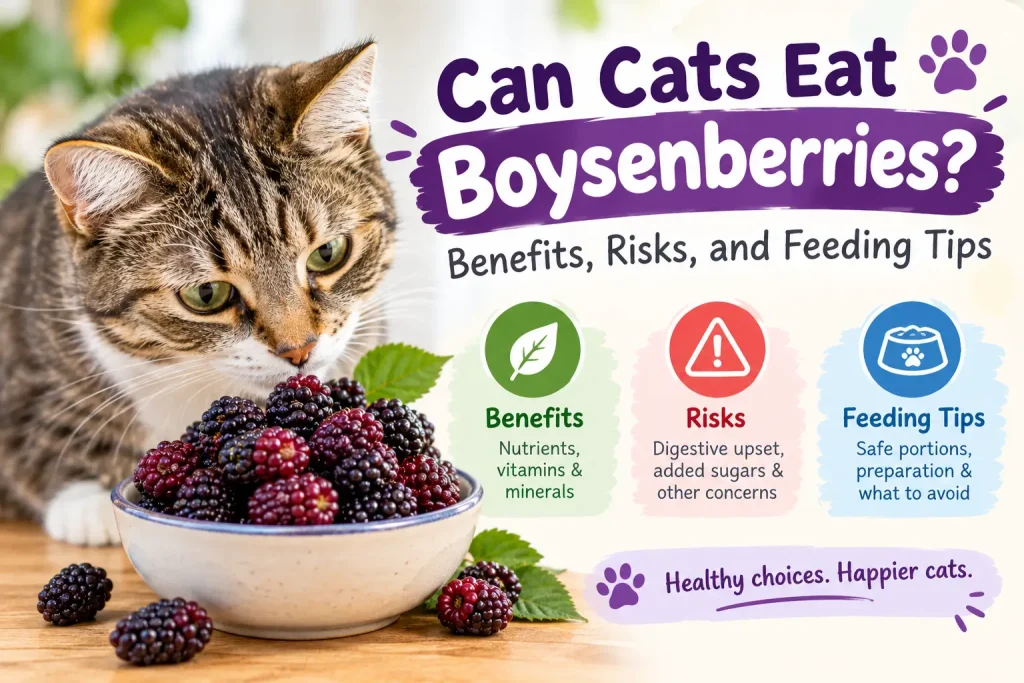
Can cats eat boysenberries? Yes, in tiny amounts. Plain boysenberries are not known to be toxic to cats, and a single berry is usually a low-concern exposure. Cats do not need fruit, though. They are obligate carnivores, so their bodies depend on nutrients found in animal tissue.
The bigger risks come from quantity and preparation. Several berries can upset a small stomach. Jam, pie, and syrup add sugar, fat, and other ingredients that do not belong in a cat’s diet. This guide covers fresh and frozen berries, seeds, kittens, portions, and what to do if your cat helps itself.
Can cats eat boysenberries?
Yes, a small piece of plain, fresh boysenberry is generally considered low risk for healthy adult cats. Boysenberries are not a necessary food, and they should never replace complete cat food. Skip jam, pie, syrup, and sweetened products.
What Are Boysenberries?
A boysenberry is a hybrid berry in the Rubus family. It is believed to come from a cross involving the Pacific blackberry, the red raspberry, and the loganberry. Some sources also name the dewberry as a parent. Horticulturist Rudolph Boysen created the cross in the early 1920s. Walter Knott later grew the plants and sold the berries at his family’s roadside stand, which grew into Knott’s Berry Farm.
The fruit is large, deep purple to maroon, and juicy. The flavor is sweet and tart, like a blend of blackberry and raspberry. Each berry is made of many tiny segments called drupelets, and each segment holds a small seed.
People eat them fresh, frozen, or baked into pies. They also turn up in jam, syrup, yogurt, smoothies, and candy. That range matters because a plain berry and a sugary pie are very different foods for a cat.
Can Cats Eat Boysenberries?
Answer: Yes, but only a small amount of the plain fruit.
Explanation: Boysenberries are not known to be poisonous to cats. Their relatives in the Rubus group, such as raspberries and blackberries, are not listed as toxic by the main pet poison sources. Still, there is very little research on boysenberries and cats specifically. Safety here is based on the plant family, not on feeding studies.
Practical advice: Treat the berry as a rare extra. Offer one small piece and watch how your cat responds.
There is a gap between “can tolerate a small amount” and “should eat regularly.” Many cats handle a nibble without trouble. That does not make boysenberries a recommended food. Cats rely on nutrients found only in animal products. Fruit adds no required nutrients to their diet.
Individual cats also differ. One cat may ignore a berry. Another may get loose stool from a single piece.
Are Boysenberries Toxic to Cats?
Answer: No toxicity has been established for the ripe fruit, but evidence is limited.
Explanation: The ASPCA lists Creeping Rubus as non-toxic to cats, dogs, and horses. I did not find Boysenberry listed by name on that page. Other plant-safety sites apply the same non-toxic rating to the wider Rubus group. That is a reasonable inference. It is not the same as a feeding study.
“Not toxic” also does not mean “safe in any amount.” Even harmless foods can cause stomach upset when a cat eats too much. Fiber and natural sugar can loosen stool in a small body.
Also Read: Can Cats Eat Redcurrants? Safety, Risks and Feeding Tips
Potential Benefits of Boysenberries for Cats
Boysenberries are nutritious for people. They are rich in vitamin C, fiber, and anthocyanins, the plant pigments that give the fruit its dark color. They also contain manganese, vitamin K, and folate, plus a good amount of water. Cats have different needs. Their bodies make their own vitamin C, so they do not need berries for it. Fiber is not required either. Complete cat food already supplies the nutrients a cat needs.
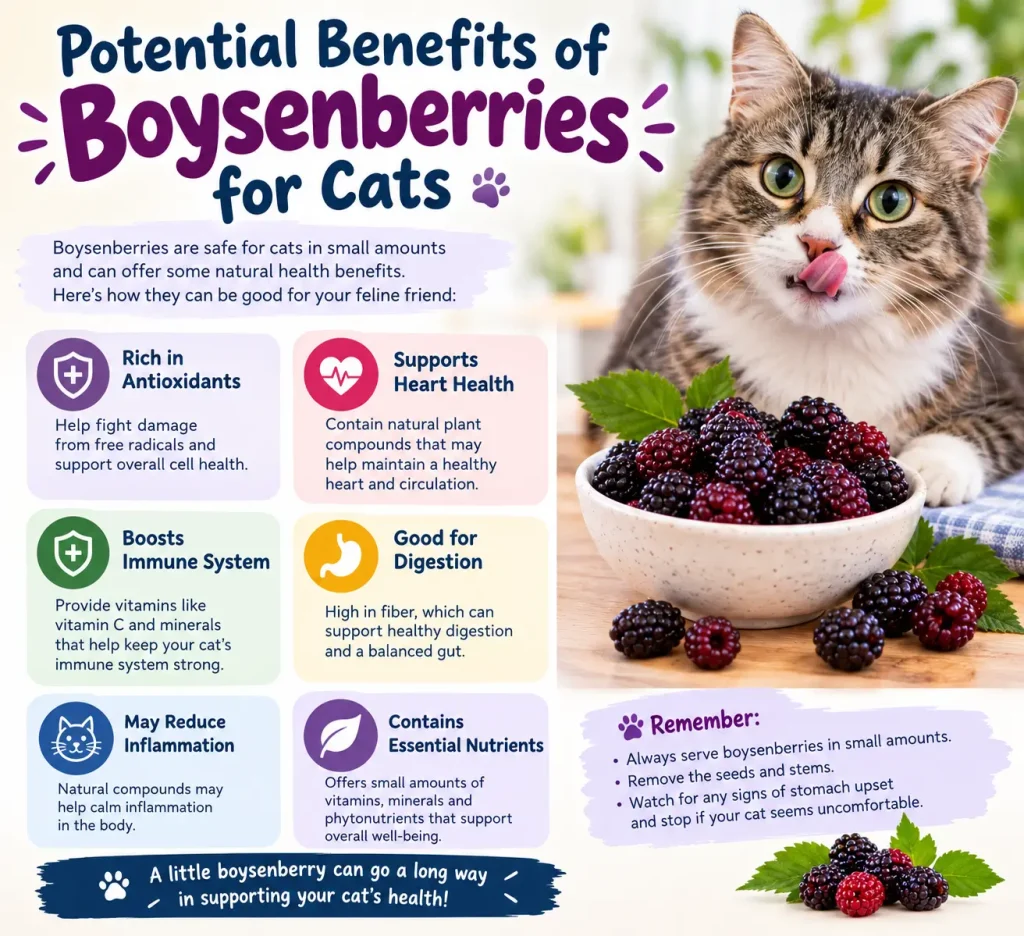
At best, a boysenberry offers a tiny bit of water and fiber. Some owners like it as a novelty treat. That is a fine reason to share one.
Boysenberries do not cure disease, detox the body, or replace supplements. They are also not a superfood for cats. Human health claims about antioxidants do not automatically apply to felines.
Can Cats Eat Fresh Boysenberries?
Answer: Yes, if your cat is healthy and the berry is plain.
Explanation: Fresh fruit is the simplest form. It has no added sugar or fat. The texture is soft, which makes it easier to manage than frozen fruit.
Practical advice: Follow these steps.
- Rinse the berry well under running water.
- Throw away any moldy or mushy fruit.
- Cut off a piece the size of a pea.
- Mash it if your cat is small or eats fast.
- Offer it by hand or on a clean plate.
- Watch your cat for the next 24 hours.
Many cats will sniff it and walk away. That is normal. Cats have few sweet taste receptors, so fruit often does not interest them. Some also dislike the wet, seedy texture. Never force a cat to eat it.
Can Cats Eat Frozen Boysenberries?
Answer: Only plain frozen berries, and only after thawing.
Explanation: Frozen boysenberries are fine as an ingredient. A hard, icy berry is another matter. It can be tough to chew and could become a choking hazard for a small cat. Cold fruit can also upset a sensitive stomach. Some pet sources advise avoiding frozen berries unless they are thawed and softened.
Practical advice:
- Check the bag. Choose berries only, with no added sugar or syrup.
- Thaw a small portion in the fridge.
- Mash it into a soft pulp.
- Offer a tiny taste.
Avoid frozen yogurt, sorbet, ice cream, and sweetened fruit bars. These contain sugar, dairy, or both. Many adult cats do not digest dairy well.
Must Read : Can Cats Eat Mustard Greens? Benefits, Risks and Safe Alternatives
Can Cats Eat Boysenberry Seeds?
Answer: A few tiny seeds are normal. Large amounts are not ideal.
Explanation: Boysenberries have many small seeds spread across the fruit. A cat that eats a piece of berry will swallow some of them. I found no reliable evidence that these seeds are toxic. I also found no solid evidence that a small number cause blockages.
That is not a reason to feed handfuls. A large mass of whole berries and seeds is hard for a small digestive system to handle. It could lead to stomach upset.
Practical advice: Mash the fruit and keep the portion small. If your cat swallowed a lot of berries and now vomits repeatedly, strains, or stops eating, call your veterinarian.
Can Cats Eat Boysenberry Leaves or Stems?
Answer: It is best to avoid them.
Explanation: Fruit safety does not automatically cover the rest of the plant. Some plant-safety sites report that the Rubus group is non-toxic to cats and note that fibrous leaves can cause mild stomach upset if a pet gorges. Those sites are not the final word on boysenberry plants.
Thorny canes can scratch the mouth and paws. Unripe fruit may be harder to digest. Garden plants may also carry pesticide or fertilizer residue.
Practical advice: If your cat chews on a garden plant, remove it and watch for vomiting or drooling. Call your veterinarian if you see symptoms. Always mention any sprays used on the plant.
Can Kittens Eat Boysenberries?
Answer: Kittens do not need them, so skip them.
Explanation: Kittens grow fast. They need calorie-dense, complete kitten food to build bones, muscles, and organs. Their digestive systems are still maturing. A new food can upset their stomachs more easily.
That does not mean every kitten will react badly. It means there is nothing to gain and a small chance of trouble.
Practical advice: Wait until your kitten is older. Ask your veterinarian before adding any fruit. Keep kitten food as the main source of nutrition.
How Many Boysenberries Can Cats Eat?
Answer: No official serving size exists, so keep it very small.
Explanation: A cat weighs a fraction of what a person does. A few berries that seem tiny to you are a big load for a cat. Cornell Feline Health Center suggests treats should not exceed 10 to 15 percent of a cat’s daily calories. Berries should fall far below that limit.
| Situation | General Guidance |
|---|---|
| Tiny taste | Usually a lower-concern exposure |
| Small occasional portion | Keep very limited |
| Several berries | May cause digestive upset |
| Large quantity | Monitor closely and contact a veterinarian if concerned |
| Cat with health issues | Ask a veterinarian before introducing new foods |
These are general educational guidelines, not veterinary prescriptions. Cats with diabetes, kidney disease, or a sensitive stomach should get a vet’s approval first.
Can Cats Eat Boysenberries Every Day?
Answer: No. Daily fruit is unnecessary.
Explanation: Boysenberries contain natural sugar and fiber. Cats need very little of either. Cats are built for a diet that is mostly animal protein, moderate fat, and very low carbohydrate. Daily fruit adds sugar and calories without adding anything useful. It can also loosen stool over time.
Practical advice: Think of boysenberries as an occasional novelty. Once a week is plenty, and many cats do fine without any. Fresh water and a complete, balanced cat food should make up the rest of the diet.
Can Cats Eat Boysenberry Jam?
Answer: Generally no.
Explanation: Boysenberry jam is not the same as fresh fruit. Jam is cooked with a lot of sugar, and some brands use pectin, lemon juice, spices, or other fruits. Some sugar-free versions use sweeteners. Check labels for xylitol, which is dangerous for pets.
I would not assume every jar contains a toxic ingredient. Many are simply sugar, fruit, and pectin. Even so, a sticky sweet spread has no place in a cat’s diet. It adds sugar and calories, and it can upset the stomach.
Practical advice: If your cat licks a small smear, watch for vomiting or loose stool. If the jar was sugar-free, read the ingredient list and call your veterinarian or poison hotline right away.
Can Cats Eat Boysenberry Pie or Desserts?
Answer: No. Desserts add risks that plain fruit does not.
Explanation: The boysenberry may be the least worrying part of a pie. The risk comes from what surrounds it. Pastry brings fat and refined flour. Butter and cream can cause stomach upset or worse. Sugar adds empty calories. Some desserts contain chocolate, alcohol, or artificial sweeteners, and these can be harmful.
Practical advice: Keep desserts out of reach. If your cat ate some, check the recipe or package. Note any chocolate, raisins, alcohol, or sweeteners, and call your veterinarian if any are present.
Risks of Feeding Boysenberries to Cats
Most risks are mild and avoidable. Here are eight to know.
- Digestive upset. Fiber and sugar can irritate a sensitive stomach. This is the most common issue with new foods.
- Diarrhea. Too many berries can loosen stool. A single soft stool is usually minor, but ongoing diarrhea needs a vet’s attention.
- Vomiting. A cat may throw up if it eats berries quickly or in quantity. Once is rarely an emergency.
- Excess sugar. Blueberry guidance notes that sugar can raise blood sugar and affect weight. The same logic applies to boysenberries. This matters most for diabetic or overweight cats.
- Too much fruit. Even healthy foods become a problem in large amounts. Extra fruit adds calories that cats do not need.
- Choking risk. Whole, hard, or frozen berries can be hard to chew. Mashing or cutting reduces the risk.
- Unsafe processed products. Jam, pie, yogurt, and candy may contain sugar, dairy, chocolate, or sweeteners. The label matters more than the flavor name.
- Replacing real food. A cat that fills up on fruit may eat less of its balanced diet. That can shortchange key nutrients like taurine.
What Happens If a Cat Eats Too Many Boysenberries?
Answer: Most cats get mild stomach upset.
Explanation: Possible signs include:
- Vomiting
- Loose stool or diarrhea
- Gas
- Belly discomfort
- Less interest in food
What you see depends on how much your cat ate, how sensitive its stomach is, whether the berries had other ingredients, and whether it has an existing health condition. I cannot diagnose your cat, and these signs can have other causes.
Practical advice: Offer fresh water and watch closely. Call your veterinarian if symptoms are severe, last more than a day, or your cat seems weak.
What Should You Do If Your Cat Eats Boysenberries?
Stay calm and work through this checklist.
- Identify the food. Was it fresh berries or a processed product?
- Estimate the amount. One berry is different from half a punnet.
- Read the label. Check any package for sweeteners, chocolate, alcohol, or raisins.
- Look for red flags. Sugar-free items need extra attention.
- Monitor your cat. Watch for vomiting, diarrhea, low energy, or hiding.
- Call your veterinarian. Do this if a large amount was eaten or symptoms appear.
Do not try to make your cat vomit unless a veterinary professional tells you to. It can cause harm.
Boysenberries vs Other Berries for Cats
| Berry | Main Consideration for Cats |
|---|---|
| Boysenberry | Little cat-specific research. Plain fruit in tiny amounts is considered low risk. |
| Blackberry | Close relative. Seedy and juicy, so keep portions small. |
| Raspberry | Pet Poison Helpline and the ASPCA do not list raspberries as toxic. Small portions only. |
| Strawberry | Remove leaves and stems. Cut into small pieces. |
| Blueberry | Purina’s nutritionist calls blueberries an acceptable treat. Cut or mash to prevent choking. |
| Cranberry | Very tart. Dried or sweetened versions often contain added sugar. waldosfriends |
No berry is a required food for cats. Preparation and portion size matter more than which berry you pick.
Fresh Boysenberries vs Processed Boysenberry Foods
| Food | General Consideration |
|---|---|
| Fresh boysenberry | Small amount only |
| Frozen plain boysenberry | Thaw and offer carefully |
| Boysenberry jam | Generally avoid |
| Boysenberry pie | Avoid |
| Boysenberry yogurt | Check ingredients |
| Boysenberry syrup | Avoid |
| Boysenberry candy | Avoid |
Flavor names can mislead. A product labeled “boysenberry” may contain little real fruit. What matters is the ingredient list. Look for sugar, dairy, sweeteners, alcohol, or chocolate.
Safe Fruits for Cats
Fruit is optional for cats. If you want to offer a treat, a few options are generally considered low risk in small portions.
- Blueberries: Cut or mash first.
- Watermelon: Seedless and rind removed.
- Cantaloupe: Small cubes. Many cats find the smell interesting.
- Banana: A tiny slice. It is sugary and starchy.
Keep fruit plain and fresh. Offer a bite or two. Fruit should never take the place of a meal.
Fruits Cats Should Avoid
Some fruits and fruit products are a problem.
- Grapes and raisins: Linked to kidney failure in dogs. Evidence is less clear in cats, but vets advise avoiding them.
- Cherries: The pits, stems, and leaves contain cyanide compounds.
- Citrus: The oils and peel can upset the stomach.
- Dried fruit with additives: Often loaded with sugar, and raisins carry the grape concern.
Also skip any fruit product with chocolate, alcohol, artificial sweeteners, or lots of added sugar. These are not appropriate for cats.
Should You Give Your Cat Boysenberries?
Use this simple framework. It is general educational guidance, not a diagnostic tool.
Lower concern
- Plain fresh boysenberry
- Very small amount
- Healthy cat
- No symptoms
Use caution
- Several berries
- Frozen whole berries
- A cat with a sensitive stomach
- A past upset from new foods
Avoid
- Jam
- Pie
- Syrup
- Candy
- Desserts
- Anything with unsafe ingredients
Contact a veterinarian
- A large quantity was eaten
- Severe or ongoing vomiting
- Significant diarrhea
- Weakness
- Any concerning symptoms
- The product had a potentially toxic ingredient
Frequently Asked Questions
Can cats eat fresh boysenberries?
Yes, if the berry is plain and ripe. Rinse it, remove any spoiled fruit, and offer a pea-sized piece. Mash it if your cat is small. Watch for stomach upset over the next day. Many cats simply refuse fruit, and that is fine.
Can cats eat frozen boysenberries?
Plain frozen boysenberries are acceptable only after thawing. Hard frozen berries are difficult to chew and may pose a choking risk. Mash a small portion and offer a taste. Avoid sweetened frozen berries, frozen yogurt, and other frozen desserts.
How many boysenberries can cats eat?
No official serving size exists for cats. A reasonable approach is one or two small pieces, offered rarely. Several berries may upset the stomach. Cornell Feline Health Center suggests keeping all treats to a small share of daily calories. Ask your vet if your cat has health issues.
Can cats eat boysenberry jam?
Generally no. Jam contains lots of sugar and may include pectin, lemon juice, spices, or sweeteners. A small lick is unlikely to be an emergency in most cases. Check the label for xylitol or other sweeteners, and call your vet if the jam was sugar-free.
What happens if a cat eats too many boysenberries?
Most cats develop mild stomach upset, such as vomiting, loose stool, gas, or lower appetite. Severity depends on the amount eaten, other ingredients, and your cat’s health. Offer water and monitor closely. Call your veterinarian for severe, repeated, or lasting symptoms.
Are boysenberries good for cats?
Not really. Boysenberries offer water, fiber, and vitamins that people value, but cats do not need them. Complete cat food already provides what a cat needs. A tiny taste can be a fun treat, yet boysenberries are not a health food for cats.
What berries can cats eat?
Cats can usually have tiny portions of plain blueberries, raspberries, blackberries, and strawberries. Cut or mash them, and serve them rarely. Avoid sweetened, dried, or processed berry products. No berry is required, so check with your vet if your cat has health problems.
Key Takeaways
- A small amount of plain, fresh boysenberry is generally considered low risk for healthy adult cats.
- Boysenberries are not known to be toxic, but research specific to cats is limited.
- Cats are obligate carnivores and do not need fruit.
- Keep portions to a bite or two, offered rarely.
- Fresh and plain is very different from jam, pie, syrup, or candy.
- Seeds in the fruit are not known to be toxic. Large amounts of whole berries are still unwise.
- Kittens should stay with complete kitten food.
- Call your veterinarian for large amounts, repeated vomiting, heavy diarrhea, weakness, or any product with a risky ingredient.
Final Thoughts
A single plain boysenberry is a small thing. A slice of sweet boysenberry pie is a different story. The fruit itself is rarely the problem. The sugar, dairy, and other ingredients around it usually are.
If you want to share a berry, keep it fresh, plain, and tiny. Watch how your cat reacts. If your cat ignores it, that is a fine outcome.
Your cat’s health comes from a complete and balanced cat food, fresh water, and regular vet checkups. Berries are only a playful extra, and nothing more.