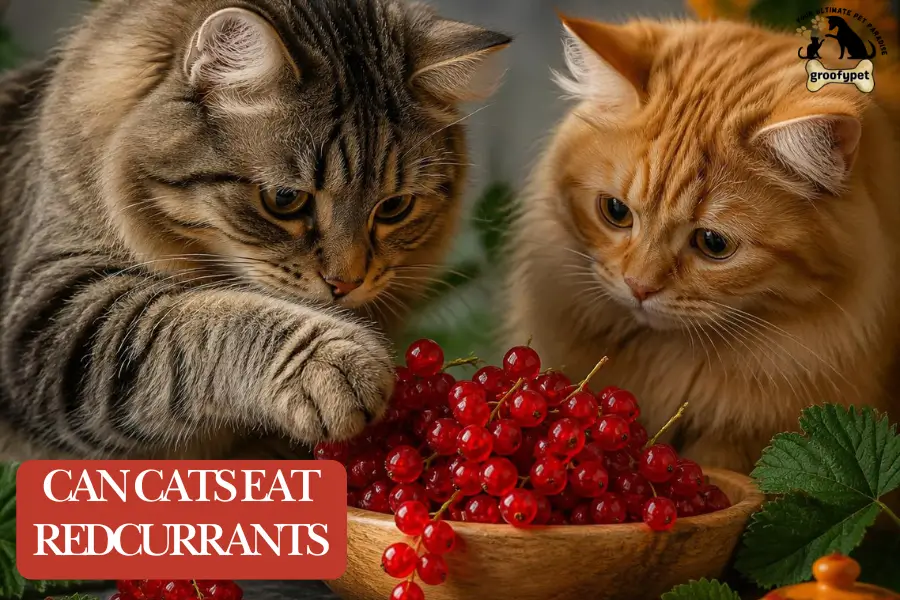
Most veterinary sources, including the ASPCA, do not list redcurrants (Ribes rubrum) as toxic to cats. A small taste of fresh, plain redcurrant is unlikely to harm most cats. That said, redcurrants are not part of a cat’s natural diet, evidence specific to cats is limited, and some cats may still get an upset stomach. Cats are obligate carnivores, so their main nutrition should always come from a complete and balanced cat food, not fruit.
Redcurrants often get lumped in with grapes, raisins, and Zante currants, which are known to be dangerous to dogs and possibly cats. That mix-up causes a lot of confusing advice online. This guide sorts out the difference and gives you a clear, honest answer about fresh redcurrants, cooked redcurrants, redcurrant jam, jelly, sauce, leaves, and more.
Can Cats Eat Redcurrants?
Cats can likely eat a very small amount of fresh, plain redcurrant without serious harm, based on current veterinary evidence. Redcurrants (Ribes rubrum) are not on the ASPCA’s list of toxic plants for cats.
However, cats do not need redcurrants, some cats may have mild digestive upset, and processed redcurrant products like jam or sauce can carry separate risks from added sugar, spices, or other ingredients.
Here is what we actually know:
- Toxicity status: No major veterinary poison-control resource classifies true redcurrants as a confirmed cat toxin. The ASPCA’s toxic plant list for cats does not include redcurrant or the genus Ribes.
- Digestive tolerance: Any new food, including fruit, can cause vomiting, diarrhea, or a temporary loss of appetite in a cat that is not used to it.
- Species relevance: Most published toxicity data on currants focuses on dogs. Far less research exists specifically for cats, so caution and moderation still matter.
- Nutritional value: A cat’s body is built to run on animal protein and fat, not fruit sugars and plant fiber, so redcurrants offer little nutritional benefit to a cat even when they are not dangerous.
Because the evidence points toward “generally low risk in small amounts” rather than “provably safe” or “clearly toxic,” the most responsible approach is moderation, close observation, and a call to your veterinarian if your cat reacts poorly or eats a large quantity.
What Are Redcurrants?
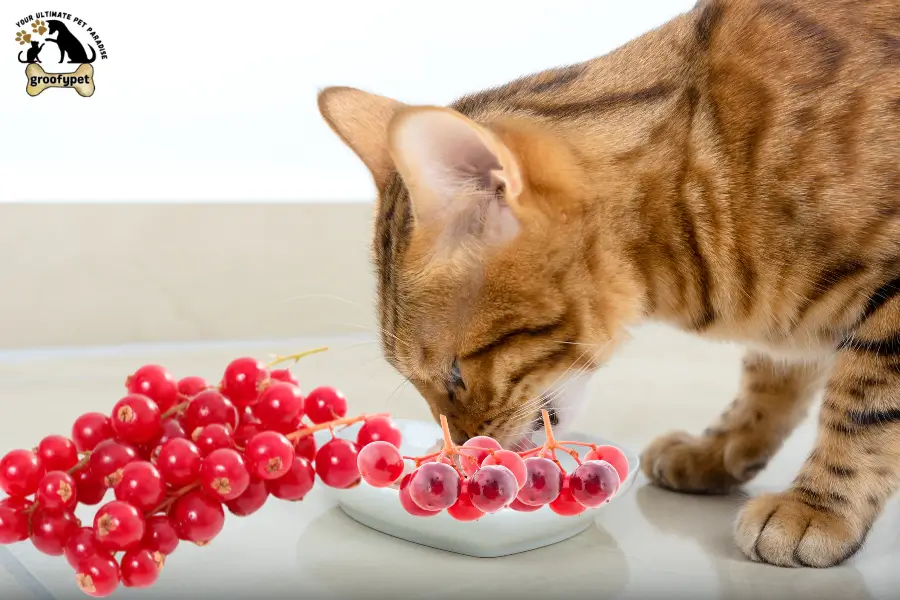
Redcurrants are small, round, translucent red berries that grow in clusters on a shrub. They have a tart, slightly sour flavor with a mild sweetness, which is why people usually cook them into jams, jellies, sauces, and desserts rather than eating large amounts raw.
A few quick facts about the fruit:
- Redcurrants belong to the Ribes genus, in the Grossulariaceae family, alongside blackcurrants and white currants.
- They are native to parts of western Europe and are widely grown in gardens across the UK, Europe, and North America.
- Each berry is roughly the size of a small pea, with a thin, edible skin and tiny seeds inside.
- They are often confused with “currants” sold in the baking aisle, which are actually a completely different fruit: dried grapes.
Understanding this distinction between fresh redcurrant berries and dried baking currants is the single most important step in figuring out what is actually safe for your cat.
Are Redcurrants Toxic to Cats?
This is the question most cat owners really want answered, so let’s be direct about it.
There is not enough reliable evidence to classify true redcurrants as a proven cat toxin. True currants, including red, black, and white currants, come from the genus Ribes. Reputable poison-control sources describe this group as not considered toxic, though eating a large amount of any plant material can still cause stomach upset in cats or dogs simply from fiber and volume.
This is very different from:
- Grapes and raisins – Confirmed to cause kidney damage and acute kidney failure in dogs, with cats considered at similar or unknown risk. These come from the grape plant, Vitis vinifera, an entirely different species from redcurrants.
- Zante currants (dried currants) – Despite the name, these are not currants at all. They are small dried grapes, sometimes called Corinth or Champagne grapes, and they carry the same toxicity concerns as raisins.
- Blackcurrants and white currants – Close botanical relatives of the redcurrant, generally placed in the same “likely low risk” category.
Some pet blogs and forum posts describe redcurrants as poisonous to cats. In most cases, those articles are borrowing symptoms and warnings that actually apply to grape and raisin toxicity, then applying them to redcurrants without solid evidence. That is a common and understandable mix-up, since all of these fruits get called “currants” in everyday language, but it is not the same as documented toxicity.
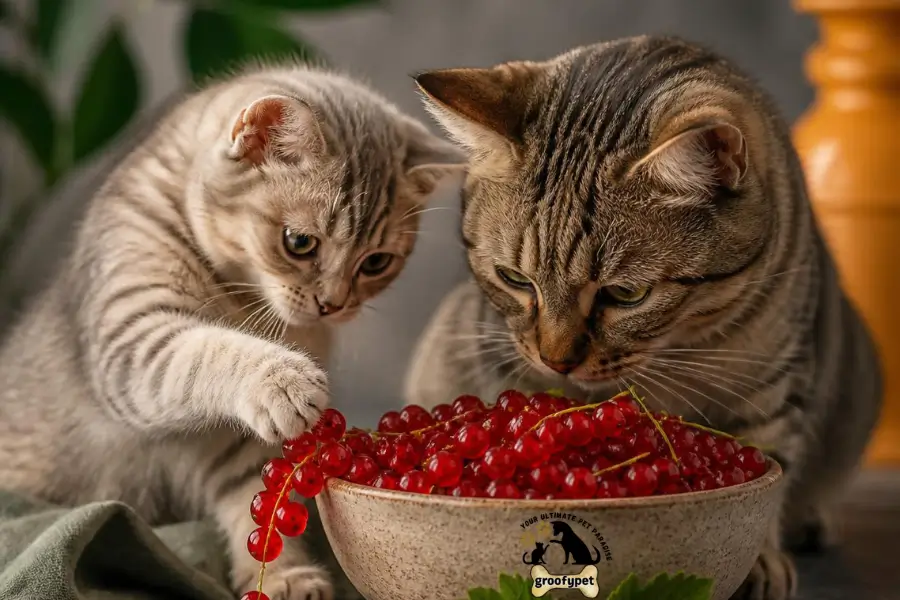
The honest summary: redcurrants sit in a “probably fine in small amounts, not proven safe, not proven dangerous” gray zone, while grapes, raisins, and Zante currants sit firmly in the “avoid entirely” category.
Can Cats Eat Fresh Redcurrants?
A cat that steals a fresh redcurrant off the counter or grazes on a garden bush is unlikely to suffer serious harm from one or two berries. If you want to offer fresh redcurrant intentionally, keep it simple:
- Wash the berries thoroughly to remove dirt, pesticide residue, or garden chemicals.
- Remove any stems before offering the fruit.
- Offer only a very small amount, such as a single berry cut into smaller pieces.
- Watch your cat for the next several hours for vomiting, diarrhea, or reduced appetite.
- Remember that every cat has different digestive tolerance, so what one cat handles easily might upset another.
There is no universally agreed “safe number” of redcurrants for a cat. A tiny taste is a reasonable starting point, not a green light to make fruit a regular snack.
Can Cats Eat Cooked Redcurrants?
Plain, cooked redcurrant with nothing added is closer in risk profile to the fresh fruit. Cooking softens the berry and breaks down some of the fiber, which may make it slightly easier for a cat to digest.
The real concern is what gets cooked in with the fruit. Recipes for stewed or cooked redcurrants often include:
- Added sugar or syrup
- Artificial sweeteners
- Cinnamon, cloves, or other spices
- Butter or cream
- Other fruits, such as grapes or raisins, in mixed compotes
None of these additions are things a cat’s diet needs, and some, like certain artificial sweeteners, can be genuinely dangerous. Plain fruit and a finished dessert recipe are two very different foods, even if redcurrant is the star ingredient in both.
Can Cats Eat Redcurrant Seeds?
Redcurrant seeds are tiny, soft, and embedded inside the flesh of each berry. There is no established toxicity concern connected specifically to redcurrant seeds in cats.
The more realistic issue is texture and digestion rather than poisoning:
- The seeds are small enough that most cats will swallow them without noticing.
- In large quantities, seeds and skins add extra fiber that an obligate carnivore’s gut is not built to process efficiently.
- There is no evidence that redcurrant seeds contain a toxic compound the way some other fruit pits and seeds do.
It is not accurate to claim all fruit seeds are dangerous. Redcurrant seeds fall into the “not known to be toxic, but not necessary and best in small amounts” category.
Can Cats Eat Redcurrant Skin?
The skin of a redcurrant is thin, edible, and not associated with any known toxin. The practical considerations are the same ones that apply to any fresh produce:
- Washing – Rinse berries well to remove dirt and any pesticide or fungicide residue that may sit on the skin.
- Texture – The skin is soft enough that most cats can chew and swallow it without difficulty.
- Digestibility – Skins add fiber, which is fine in tiny amounts but not something a cat’s diet is designed around.
- Pesticide residue – This is a bigger practical risk than the skin itself, especially with store-bought or non-organic fruit.
There is no evidence supporting the idea that redcurrant skin is poisonous to cats.
Can Cats Eat Redcurrant Leaves and Stems?
Redcurrant leaves and stems are a separate question from the berries themselves, and the evidence here is even thinner. Reliable sources do not identify redcurrant leaves as a documented toxin for cats, but that is different from confirming they are safe.
As a simple precaution:
- Remove stems from any redcurrant fruit before offering it to your cat.
- Discourage your cat from chewing on redcurrant bushes or garden plants generally.
- Treat plant material other than the ripe fruit as unnecessary, rather than claiming it is dangerous without proof.
If your cat has access to a redcurrant bush in the garden and shows interest in the leaves, it is reasonable to gently redirect that behavior, both because the leaves offer no nutritional value and because plant identification mistakes happen easily in a mixed garden bed.
Can Kittens Eat Redcurrants?
Kittens are not simply small adult cats. Their bodies are going through rapid growth, and their digestive systems are more sensitive to anything outside a consistent diet.
Key points for kitten owners:
- Kittens need complete, age-appropriate kitten food to support healthy growth. Fruit treats offer no benefit toward that goal.
- A kitten’s digestive tract can react more strongly to unfamiliar foods than an adult cat’s.
- Treats of any kind, including fruit, should make up only a small fraction of a kitten’s diet, if they are offered at all.
- Because reliable evidence on redcurrants and cats is already limited, it makes sense to be extra cautious with a young or medically vulnerable kitten.
If you are unsure, ask your veterinarian before offering redcurrants, or any new food, to a kitten.
How Many Redcurrants Can Cats Eat?
There is no medically established dosage for redcurrants in cats, so any number presented as a precise, safe amount would be misleading. Instead, think in terms of a cautious starting point and your individual cat’s reaction.
| Cat | Practical Approach |
|---|---|
| Small cat | Start with a tiny piece of one berry |
| Average adult cat | A very small amount, such as one whole berry |
| Large adult cat | Still only a small amount, not a handful |
| Kitten | Avoid unless a veterinarian approves it |
This table reflects a conservative, common-sense approach rather than a scientifically confirmed dosage. If your cat shows any digestive upset after a small amount, do not offer redcurrants again.
Can Cats Eat Redcurrants Every Day?
No, cats do not need redcurrants as part of their daily diet, and offering them daily is not recommended.
- Nutritional priorities: A cat’s diet should be built around complete and balanced cat food that meets feline-specific nutrient needs, not fruit.
- Extra calories: Daily fruit treats add calories a cat does not need, especially for cats prone to weight gain.
- Digestive tolerance: Repeated exposure does not make a cat “used to” fruit in a meaningful nutritional sense, and daily intake raises the chance of loose stool or stomach upset over time.
- Treat moderation: General feeding guidance for treats of any kind suggests keeping them to a small percentage of total daily calories.
An occasional, small taste is a very different scenario from a daily habit.
Can Cats Eat Redcurrant Jam?
Redcurrant jam is not the same food as fresh redcurrant fruit, and it should not be treated as an equivalent treat.
Typical redcurrant jam contains:
- A large amount of added sugar
- Sometimes artificial sweeteners, which can range from unnecessary to genuinely dangerous depending on the product
- Preservatives
- Occasionally spices or other fruit blended in
- Artificial colors or flavorings in some commercial brands
Not every jar of jam is identical, so always check the ingredient label before assuming a product is fine. If a jam contains xylitol or any other artificial sweetener, do not offer it to your cat under any circumstances. In general, redcurrant jam offers no nutritional benefit to a cat and is best avoided or offered in only a token-sized taste, if at all.
Can Cats Eat Redcurrant Jelly?
Redcurrant jelly is typically even more processed than jam, since it is made by straining out the fruit solids and cooking the juice down with a significant amount of sugar.
Key differences from fresh fruit:
- Jelly usually contains more added sugar per spoonful than jam or fresh fruit.
- Some jelly recipes include sweeteners or preservatives not found in the fresh berry.
- A very small serving size only makes sense as an occasional taste, not a treat.
- Sugar itself is not a poison to a cat, but it offers no nutritional value and can contribute to unwanted weight gain over time.
Because of the concentrated sugar content and the added ingredients, redcurrant jelly is best avoided as a cat treat.
Can Cats Eat Redcurrant Sauce?
Redcurrant sauce, often served alongside meats like lamb or game, is a different food entirely from plain fruit and should be assessed on its own ingredient list.
Watch for these common additions in savory redcurrant sauces:
- Sugar or sweeteners
- Salt
- Onion or garlic, both of which are toxic to cats
- Additional spices
- Wine, brandy, or other alcohol
- Other blended fruits
Never assume that a human recipe for redcurrant sauce is automatically cat-safe just because redcurrant is a listed ingredient. Onion and garlic in particular are common in savory sauces and are genuinely dangerous to cats, regardless of how small the amount seems.
Also Read : Can Cats Eat Radishes? Risks, Benefits and Vet Tips!
Possible Benefits of Redcurrants for Cats
To keep this balanced, redcurrants do contain some naturally occurring nutrients:
- Water content, which contributes a small amount to hydration
- Fiber, which in tiny amounts is not harmful
- Vitamin C, though cats can synthesize their own and do not require dietary sources the way humans do
- Antioxidant compounds, present in many berries
That said, cats have very different nutritional requirements from humans. They do not need fruit to meet their essential nutrient needs, and there is no strong evidence that redcurrants prevent disease or meaningfully improve a cat’s health. Any benefit is minor at best and should not be used to justify regular feeding.
Possible Risks of Redcurrants for Cats
| Potential Concern | Explanation |
|---|---|
| Digestive upset | Some cats may react poorly to an unfamiliar fruit |
| Vomiting | Possible after eating an unsuitable amount or an unfamiliar food |
| Diarrhea | Sudden dietary changes can cause loose stool |
| Choking | Whole berries may be awkward for some cats to chew and swallow |
| Processed-food ingredients | Jam, jelly, and sauce can contain sugar, sweeteners, onion, or garlic |
| Uncertain toxicity | Limited species-specific evidence should not be mistaken for proof of safety |
Each of these risks is manageable with common sense: offer only plain, fresh fruit in small amounts, skip processed redcurrant products, and watch your cat’s reaction.
Must Read : Can Cats Eat Beets?Benefits and Risks Before You Feed!
What Happens If a Cat Eats Redcurrants?
If your cat has already eaten redcurrants, a few questions will help you judge the situation:
- How many berries did the cat eat?
- Were they fresh, or part of a jam, jelly, or sauce?
- Did the food contain other ingredients, such as onion, garlic, sweeteners, or alcohol?
- Is the cat showing any symptoms right now?
- Is the cat a kitten, senior, or a cat with an existing health condition?
Watch for these possible signs, keeping in mind they can have many causes beyond redcurrants specifically:
- Vomiting
- Diarrhea
- Drooling
- Loss of appetite
- Lethargy
- Abdominal discomfort
A single small berry rarely causes anything beyond mild, short-lived stomach upset, if any reaction occurs at all. A processed product with added ingredients, or a large quantity of fruit, is a different situation and deserves closer attention.
What Should I Do If My Cat Eats Redcurrants?
Your response should match the situation:
- Small amount of plain fresh fruit: Monitor your cat over the next several hours and avoid offering more unusual foods for the rest of the day.
- Large amount of fresh fruit: Contact your veterinarian for guidance, since species-specific safety evidence for cats remains limited.
- A processed product, such as jam, jelly, or sauce: Check the ingredient list closely for sugar, sweeteners, onion, garlic, or alcohol before deciding whether to call your vet.
- A product containing a known toxic ingredient (onion, garlic, xylitol, alcohol): Contact your veterinarian or an animal poison control hotline promptly.
- Your cat develops concerning symptoms: Seek veterinary advice rather than waiting to see if things improve on their own.
Do not induce vomiting at home unless a veterinary professional specifically instructs you to do so.
When Should You Call a Veterinarian?
Reach out to your veterinarian if your cat shows any of the following after eating redcurrants or a redcurrant product:
- Repeated vomiting
- Persistent diarrhea
- Severe lethargy
- Loss of appetite lasting more than a few hours
- Difficulty breathing
- Tremors
- Seizures
- Collapse
- Significant abdominal pain
- Suspected ingestion of onion, garlic, xylitol, or alcohol
- Any concerning symptom in a kitten
These signs warrant a professional evaluation rather than a guess at home.
Redcurrant Safety Quick Guide
| Redcurrant Form | Cat Safety | Key Point |
|---|---|---|
| Fresh redcurrants | Likely low risk in a small amount | Not listed as toxic by the ASPCA; evidence for cats is still limited |
| Cooked plain redcurrants | Likely low risk in a small amount | Avoid recipes with sugar, spices, or sweeteners |
| Redcurrant seeds | No known specific toxicity | Fine in the small amounts naturally found in the fruit |
| Leaves | Not confirmed toxic, but not confirmed safe | Avoid unnecessary plant material as a precaution |
| Stems | Remove before feeding | Not needed as food and offer no benefit |
| Redcurrant jam | Avoid or offer only a token taste | Check the label for sweeteners and added sugar |
| Redcurrant jelly | Best avoided | Typically high in added sugar |
| Redcurrant sauce | Avoid unless ingredients are fully verified | May contain onion, garlic, or alcohol |
Redcurrants vs Other “Currants”
The word “currant” causes more confusion than almost any other fruit term in pet-safety discussions. Here is a clear breakdown:
- Redcurrants – True currants from the genus Ribes, generally considered low risk for cats in small amounts.
- Blackcurrants – A close relative of redcurrant, also in the Ribes genus, with a similar low-risk profile.
- White currants – A pale-colored variety of the same Ribes species as redcurrants, not a separate risk category.
- Zante currants (dried currants) – Not currants at all. These are small dried grapes, and they carry the same toxicity concerns as raisins.
- Grapes and raisins – Confirmed to be dangerous to dogs, with cats considered at similar or unclear risk. Entirely different plant genus (Vitis) from true currants.
Treating all “currants” as identical is where most of the confusing and contradictory advice online comes from. True currants and dried grape currants are not the same food, and they do not share the same risk profile.
Frequently Asked Questions
Can cats eat redcurrant leaves?
This is not well studied, so it is safer to remove stems and discourage cats from chewing on the plant as a precaution.
Can cats eat redcurrant jelly?
It is best avoided, since jelly typically contains more concentrated sugar than fresh fruit or jam.
What happens if my cat eats redcurrants?
A small amount of plain fruit rarely causes more than mild, temporary stomach upset, if any reaction happens at all.
What should I do if my cat eats a lot of redcurrants?
Contact your veterinarian for guidance, especially if the fruit was part of a processed product or your cat shows any symptoms.
Are redcurrants the same as raisins?
No. Redcurrants come from the Ribes genus, while raisins come from grapes (Vitis vinifera). They are unrelated fruits with different safety profiles.
Conclusion
So, can cats eat redcurrants? Based on current veterinary evidence, a small amount of fresh, plain redcurrant is unlikely to seriously harm most cats, and true redcurrants are not listed as a toxic plant by the ASPCA. At the same time, redcurrants are not a necessary or beneficial part of a cat’s diet, and species-specific research remains limited.
The bigger risk usually comes from confusion with other “currants.” Grapes, raisins, and Zante currants are a completely different matter and should never be given to a cat. Processed redcurrant products, including jam, jelly, and sauce, can introduce sugar, sweeteners, onion, garlic, or alcohol that have nothing to do with the fresh fruit itself.
If your cat eats a large amount of redcurrant fruit, gets into a processed redcurrant product, or shows any concerning symptoms like repeated vomiting, lethargy, or loss of appetite, contact your veterinarian promptly. When in doubt, a complete and balanced cat food should always remain the foundation of your cat’s diet, with any fruit treated as an occasional, small extra rather than a staple.
Can Cats Eat Pomegranate Seeds? The Ultimate Guide to Pet Safety!
can cats eat chorizo? life saving guide 2026 for caring cat parents!