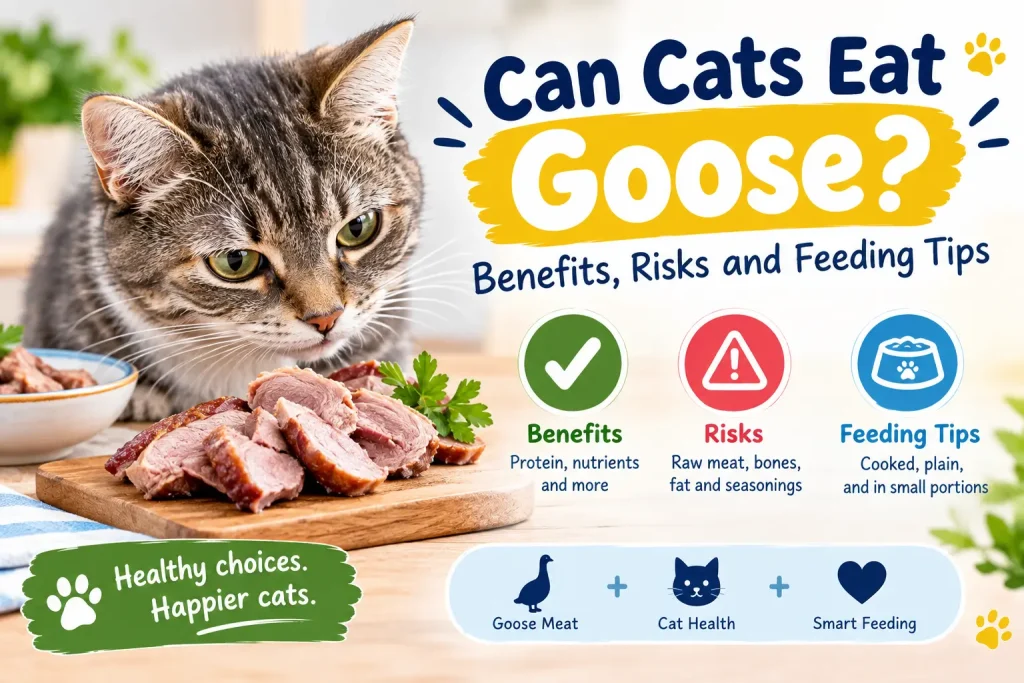
Yes, cats can eat goose in small amounts, but only when it is plain, fully cooked, boneless, and unseasoned. A tiny piece of lean goose meat can work as an occasional treat. Raw goose, cooked bones, fatty skin, gravy, stuffing, and anything cooked with onion or garlic are not safe choices. Goose should never replace complete and balanced cat food. This guide separates goose meat from the rest of a holiday plate because the difference matters.
Cats can eat a small piece of plain, fully cooked, boneless goose meat as an occasional treat. Avoid raw goose, bones, fatty skin, gravy, stuffing, and seasonings, especially onion and garlic. Treats should stay small, and complete cat food should remain the main diet.
What Is Goose Meat?
Goose is a dark, rich poultry meat. Common cuts include breast, legs, and thighs. The skin is thick, and geese carry a lot of fat under it.
Cuts differ in what they offer a cat:
- Breast meat: leaner once the skin is removed.
- Leg and thigh meat: darker and often fattier.
- Skin and fat: very rich and calorie-dense.
- Liver and organs: nutrient-dense and not suited to casual feeding.
USDA-based figures show how big the gap is. Roasted goose meat without skin has roughly 238 calories and 12.7 grams of fat per 100 grams. With the skin, roasted goose rises to about 305 calories and 21.9 grams of fat per 100 grams. Treat these as approximate, since cuts and cooking methods vary.
Can Cats Eat Goose?
Yes, in small amounts, if the meat is plain, fully cooked, and free of bones. Think of it as a treat, not a meal.
Cats are obligate carnivores. They need animal-source nutrients, so cooked poultry fits their biology better than many human foods. Plain goose meat could be an occasional treat for a cat that tolerates it.
That does not make goose a complete diet. Cats need specific nutrients in the right balance, and a single human food cannot supply them. Treats and extras should stay limited. A common veterinary guideline is that treats make up no more than about 10% of daily calories, though individual needs vary.
I would not call goose better than chicken or turkey. It is simply another cooked meat, with a higher fat load.
Is Goose Meat Safe for Cats?
Plain, fully cooked, unseasoned goose meat is generally considered lower risk in small amounts. The word “generally” matters here.
Four things shape the safety of goose meat:
- Cooking: meat should be cooked through, with no pink or undercooked spots.
- Portion: small pieces, not a full serving.
- Fat: darker cuts and skin can be too rich.
- Tolerance: some cats get loose stools or vomit after rich foods.
Food hygiene counts too. Wash your hands, boards, and knives after handling poultry. Refrigerate leftovers promptly, and do not feed meat that has sat out for hours.
“Safe” does not mean “feed freely.” A food can be safe in a pinch of meat and unsuitable in a handful.
Can Cats Eat Cooked Goose?
Yes, if it is plain, boneless, and cut small. This is the most useful form of goose for a cat owner to understand.
For a cat treat, follow these rules:
- Choose fully cooked meat with no seasoning, salt, butter, or sauce.
- Remove all bones, including small ones hidden in the meat.
- Trim off skin and visible fat.
- Cool the meat and cut it into pea-sized pieces.
- Offer a few pieces, then watch how your cat responds.
Plain cooked meat is not the same as a prepared dinner. A roast goose is often brushed with fat, stuffed, seasoned, and served with gravy. The meat itself may be fine. The dish around it often is not.
Can Cats Eat Raw Goose?
No. Raw or undercooked goose is not recommended for cats.
Raw poultry can carry bacteria such as Salmonella. Cornell researchers reported that commercial raw cat foods contained Salmonella, Cronobacter and E. coli, including some antibiotic-resistant strains. That study looked at commercial products, not goose specifically, but the food-safety principle carries over.
Cats can also shed bacteria without looking sick. A Cornell researcher noted that pets eating raw diets can shed pathogens without clinical signs, which puts the whole household at risk, especially young children. That includes older adults, pregnant people, and anyone with a weakened immune system.
Avian influenza is a further concern with raw bird meat. Cornell notes that chicken can carry avian influenza, which is deadly for cats. Geese are waterfowl and can be involved in bird flu, so raw goose is a poor idea. Cooking thoroughly changes the picture, which is why cooked meat is the only form worth discussing.
The risk is real, but I would not panic after one small raw exposure. Watch your cat and call your vet if you are worried.
Can Cats Eat Goose Skin?
Goose skin is best avoided. It is far fattier than lean meat, as the numbers above show.
High-fat human food can upset a cat’s stomach, causing vomiting or diarrhea. Cats also do not need skin to get essential nutrients. One source on cat food hazards notes that fat trimmings are not a safe way to supply the amino acids cats need from meat.
One lick of skin will not automatically cause serious illness, and I would not claim it does. But skin adds calories quickly and offers no real benefit. Skip it.
Can Cats Eat Goose Fat?
No. Goose fat is not a suitable cat treat. It is concentrated fat, and a small amount adds many calories.
Larger amounts can cause digestive upset. Cats gain nothing from goose fat that they cannot get from a balanced diet. Do not drizzle it over food, and do not let your cat lick the roasting tray. Drippings are often seasoned too.
Can Cats Eat Goose Bones?
Never give cooked goose bones to a cat.
Cooked bones can splinter and cause gastrointestinal obstruction or laceration. Bones can also cause choking. Bird bones are small and can break into sharp pieces. Remove every bone before offering goose meat. Check the meat by touch, not just by eye. Keep carcasses and bin bags where your cat cannot reach them.
If your cat swallowed a bone, call a vet for advice. What to do depends on the bone size, your cat’s size, and any symptoms. Do not try to make your cat vomit at home. Splinters can injure the throat on the way back up.
Can Cats Eat Goose Liver?
Not as a casual treat. Liver is nutritionally different from muscle meat and far more concentrated.
Cats need balanced nutrition, not repeated helpings of a nutrient-dense organ. Large or frequent amounts of liver can upset that balance. Some veterinary sources raise vitamin A as a concern with regular, heavy liver feeding. I could not find goose-specific guidance, so ask your vet if you want liver in your cat’s diet.
Goose pâté is a separate issue. It often contains salt, fat, onion, spices, or alcohol, so it is not a cat food.
Can Kittens Eat Goose?
A tiny plain taste is possible, but goose should not become part of a kitten’s regular diet.Kittens grow fast and need complete kitten food designed for that stage. Human food can crowd out balanced nutrition. Their stomachs may also be more easily upset.
If you want to offer a treat, keep it plain, cooked, boneless, and very small. Ask your vet first if your kitten has a sensitive stomach, a health condition, or a special diet.
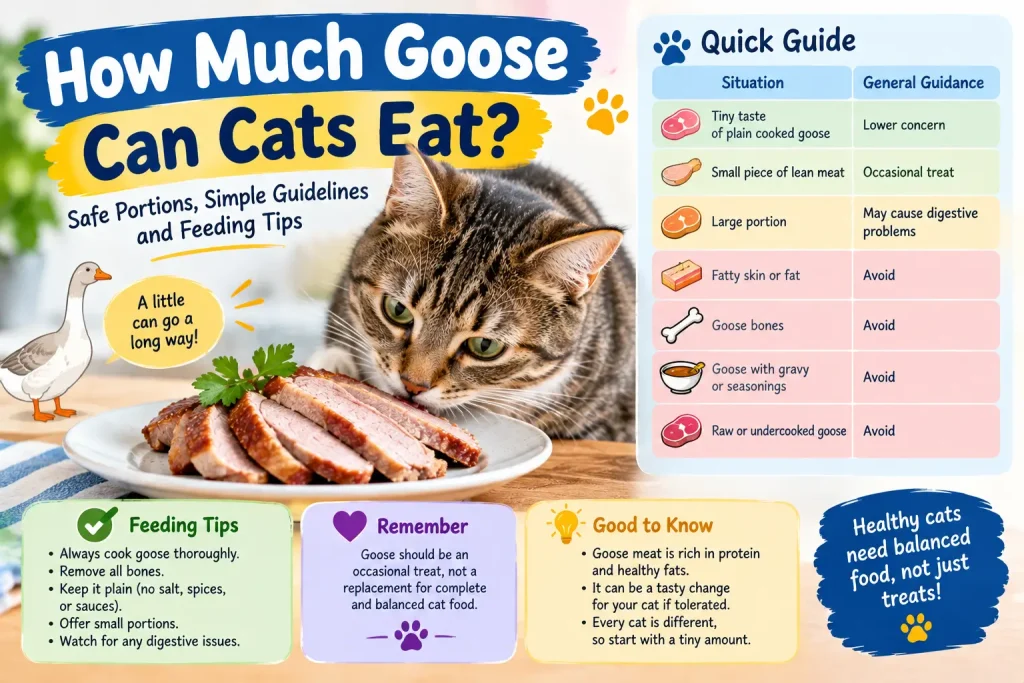
How Much Goose Can Cats Eat?
There is no universal serving size, and I will not invent one. The right amount depends on your cat’s size, weight, age, activity, health, and total daily calories. Other treats count toward the same limit.
| Situation | General Guidance |
|---|---|
| Tiny taste of plain cooked goose | Lower concern |
| Small piece of lean meat | Occasional treat |
| Large portion | May cause digestive problems |
| Fatty skin or fat | Avoid |
| Goose with bones | Avoid |
| Seasoned goose | Avoid |
| Raw goose | Avoid |
The 10% treat guideline is a ceiling, not a target. Many cats do better with much less, especially when the treat is rich. Your vet can help set a daily calorie number for your cat.
Is Goose Good for Cats?
It can be a fine occasional treat, but it is not essential.
Goose offers animal protein, amino acids, and energy. Cats need those nutrients. They also need many others in exact amounts, and complete cat foods are formulated to supply them.
Goose is not a superfood for cats. It is a rich meat that can fit into a treat budget when prepared plainly.
Benefits of Goose Meat for Cats
- Cooked goose meat contains protein, along with vitamins and minerals such as B vitamins, iron, zinc, and selenium.
- Roasted goose meat has about 29 grams of protein per 100 grams, based on USDA-derived data
- Protein and amino acids support the body’s normal functions, and cats need animal-source protein.
- Goose meat can also add variety to a cat’s treats.
Those are modest benefits. Potential nutritional value does not make goose necessary for cats. Goose does not prevent or treat disease, and I would be wary of anyone who says otherwise.
Risks of Feeding Goose to Cats
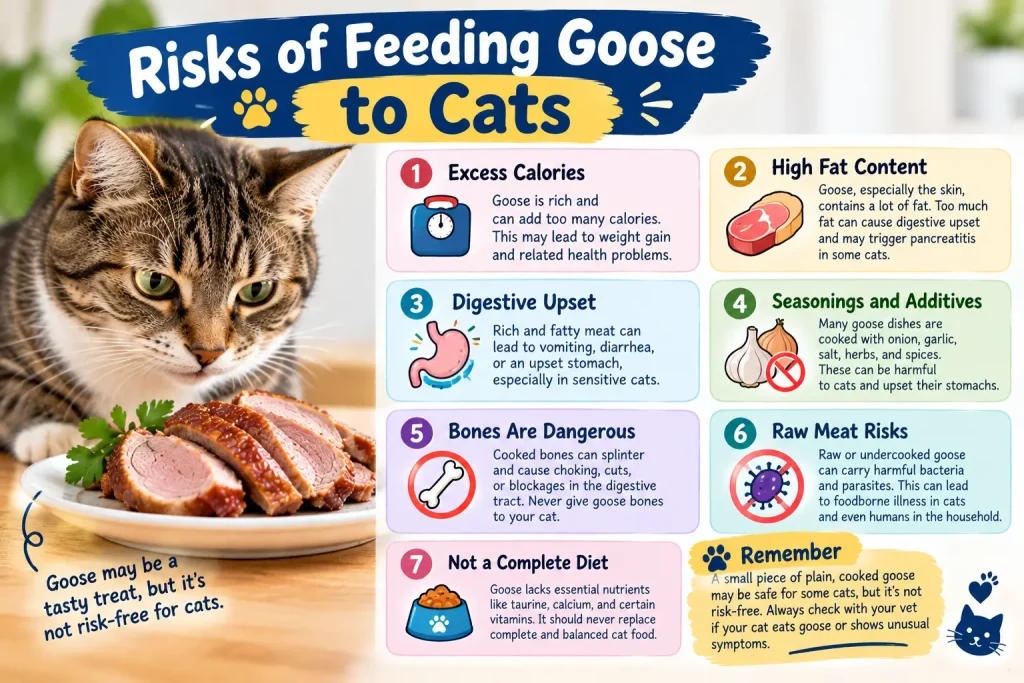
- Excess calories. Goose is energy-dense, and skin makes it more so. Extra calories can add up and contribute to weight gain.
- High fat. Rich meat, skin, and drippings can overload a cat’s digestion. Fat is the main reason goose is not an everyday food.
- Digestive upset. New or rich foods can cause vomiting or diarrhea. Some cats react to a tiny amount, while others cope well.
- Seasonings. Salt, herbs, spices, and sauces are common on cooked goose. Heavily salted or seasoned meat is not suitable for cats.
- Onion or garlic exposure. Onions and garlic can damage a cat’s red blood cells and cause anemia. ASPCA Poison Control notes that cats are much more sensitive than dogs, with roughly half the amount of garlic needed to cause hemolytic anemia.
- Bones. Bones can cause choking, blockages, or tears in the digestive tract. They are among the most serious goose risks.
- Raw meat pathogens. Raw or undercooked goose can carry bacteria that affect cats and people. Cooking thoroughly lowers that risk.
- Human food replacing balanced food. Too many extras can reduce appetite for complete cat food. Over time, that can unbalance the diet.
Can Cats Eat Roast Goose?
Only the plain meat, and only a small amount. A roast goose dinner is not one food. It is a plate of several foods, and most are wrong for a cat.
Plain roast goose meat does not equal a complete roast goose dinner.
| Part of Roast Goose | Cat Safety Consideration |
|---|---|
| Plain cooked meat | Small amount may be suitable |
| Skin | High-fat; avoid or minimize |
| Fat | Avoid |
| Cooked bones | Avoid |
| Gravy | Avoid |
| Stuffing | Avoid |
| Onion/garlic seasoning | Avoid |
| Very salty meat | Avoid |
| Raw/undercooked portions | Avoid |
If you want to share, take a small piece of inner meat before seasoning or sauce touches it. Cut it up and offer it away from the table. Do not feed from the carving plate.
Can Cats Eat Goose With Gravy?
No. It is better to skip goose gravy. Gravy is made from drippings and often includes other ingredients that are a problem for cats.Common culprits include salt, rich fat, onion, garlic, and seasonings. Broth, stock, and bouillon cubes may also contain onion or garlic. Not every gravy contains them, but you often cannot tell from the taste.
Check the ingredients if you are unsure. Even a gravy without alliums is still salty and fatty. There is no reason to add it to a cat’s meal.
Can Cats Eat Goose Stuffing?
No. Stuffing is not suitable for cats. It often contains onion, garlic, herbs, salt, butter, and other rich ingredients.
Onions and garlic as common in holiday casseroles, stuffing, mashed potatoes, and many other dishes. Not every stuffing recipe contains them, but most are rich anyway. Some also include dried fruit, nuts, or sausage, which add further risks. Keep stuffing out of reach, and do not offer it as a treat.
What If My Cat Eats Goose From the Dinner Table?
What you do depends on what the cat ate. Work out the food first, then the amount.
Tiny piece of plain meat. Usually no action is needed. Offer fresh water, keep the normal diet, and watch for stomach upset over the next day.
Skin or fat. Watch for vomiting, diarrhea, or low appetite. Rich foods can upset the stomach. Do not give more rich food, and call your vet if signs persist.
Seasoned goose. The ingredients matter. Check what was in the seasoning, rub, marinade, or sauce. If you cannot tell, treat it as possibly containing onion or garlic.
Swallowed bone. Call your vet promptly. Bones can injure the throat, stomach, or intestines, and the risk depends on the piece. Do not try to induce vomiting.
Raw or undercooked goose. Watch your cat for vomiting or diarrhea. Wash surfaces and hands well. Call your vet if your cat seems unwell, or if someone at home is vulnerable to infection.
Must Read : Can Cats Eat Wakame? Benefits, Risks, and Feeding Tips
Signs of a Problem After Eating Goose
Possible signs include:
- Vomiting
- Diarrhea
- Drooling
- Reduced appetite
- Abdominal discomfort or hiding
- Lethargy
- Difficulty breathing
- Choking or gagging
- Unusual behavior
These signs do not point to one cause, and I cannot diagnose from a list. Mild, short-lived upset may settle on its own. Severe, worsening, or persistent signs need veterinary attention. Pale gums, dark urine, trouble breathing, or repeated vomiting should be treated as urgent.
What to Do If Your Cat Ate Goose
- Find out which part your cat ate: meat, skin, fat, liver, or a dish.
- Estimate the amount. A nibble and a plateful are very different.
- Check if it was cooked or raw. Note any pink or undercooked areas.
- Look for bones. Count what is missing if you can.
- Check for seasoning such as salt, herbs, rubs, or marinades.
- Check for onion or garlic, including powders and stock.
- Monitor your cat for changes in behavior, appetite, or the litter box.
- Contact a veterinarian if the exposure was significant or symptoms develop.
Do not induce vomiting at home unless a vet tells you to.
Also Read : Can Cats Eat Pâté? Ingredients, Risks, and Safe Feeding Tips
Goose vs. Chicken vs. Turkey for Cats
| Meat | Main Consideration |
|---|---|
| Goose | Richer and often fattier |
| Chicken | Common lean protein option |
| Turkey | Can be suitable when plain and cooked |
| Processed poultry | Ingredients must be checked |
No meat is universally best. Preparation matters more than the bird. Plain, cooked, boneless meat is the goal for all poultry. Sausages, deli slices, nuggets, and pâté are processed, so read labels for salt, onion, garlic, and spices.
Safe or Avoid? Goose Foods at a Glance
| Goose Food | Cats? | Why |
|---|---|---|
| Plain cooked goose meat | Small amount | Lower risk if boneless and unseasoned |
| Goose breast meat | Small amount | Leaner once skin is removed |
| Goose skin | Avoid | High in fat |
| Goose fat | Avoid | Concentrated calories |
| Cooked goose bones | Avoid | Splinter and blockage risk |
| Raw goose | Avoid | Bacteria and pathogen risk |
| Goose liver | Avoid as a treat | Concentrated organ meat |
| Goose gravy | Avoid | Salt, fat, possible onion or garlic |
| Goose stuffing | Avoid | Often contains alliums and rich ingredients |
| Goose sausage | Avoid | Processed, salty, often seasoned |
| Goose pâté | Avoid | Rich, salty, and often seasoned |
Should You Give Your Cat Goose?
Lower concern
- Plain
- Fully cooked
- Boneless
- Unseasoned
- Small portion
Use caution
- Fatty meat
- Skin
- Large portion
- Cat has a sensitive stomach
- Cat has a medical condition
Avoid
- Raw goose
- Cooked bones
- Goose with onion or garlic
- Gravy
- Stuffing
- Processed goose products
Contact a veterinarian
- Bone swallowed
- Possible toxic ingredient
- Large amount eaten
- Severe symptoms
- Breathing difficulty
- Persistent vomiting
This is general educational guidance, not a diagnostic tool or a substitute for veterinary care.
Freuently Asked Questions
Can cats eat goose?
Yes, in small amounts. Plain, fully cooked, boneless, unseasoned goose meat can be an occasional treat for most healthy cats. It should never replace complete cat food. Raw goose, bones, fatty skin, gravy, stuffing, and anything seasoned with onion or garlic should be avoided.
Is goose meat safe for cats?
Plain, thoroughly cooked goose meat is generally lower risk in small portions. Safety depends on preparation. Bones, seasoning, rich skin, and raw meat change that picture. Introduce any new food slowly, and stop if your cat develops vomiting or diarrhea.
Can cats eat cooked goose?
Yes, if it is plain, boneless, and cut into small pieces. Remove skin and fat, and skip salt, sauces, and seasonings. Cooked goose from a holiday dinner is often seasoned, so check how it was prepared before sharing any with your cat.
Can cats eat raw goose?
No. Raw poultry can carry bacteria such as Salmonella, which can affect cats and people in your home. Cats can also carry bacteria without looking ill. Cooking goose thoroughly lowers the food-safety risk, which is why cooked meat is the only form worth offering.
Can cats eat goose skin?
It is best avoided. Goose skin is much fattier than lean meat, and rich food can cause vomiting or diarrhea in some cats. Cats do not need skin for nutrition. One small lick is unlikely to be a disaster, but there is no benefit.
Key Takeaways
- Cats can eat small amounts of plain, fully cooked, boneless goose meat as an occasional treat.
- Goose should never replace complete and balanced cat food.
- Raw or undercooked goose is not recommended because of bacteria and food-safety risks.
- Plain meat is very different from seasoned or sauced goose.
- Never give bones. Cooked bones can splinter and injure the digestive tract.
- Skin and fat are rich, calorie-dense, and best avoided.
- Kittens need complete kitten food. Goose should not be a regular part of their diet.
- Call a veterinarian if your cat swallows a bone, eats onion or garlic, or has severe or persistent symptoms.
Final Thoughts
Goose is not a forbidden food for cats, and it is not a health food either. It is a rich poultry meat that can work as a small, plain treat for cats that tolerate it.
The real question is not whether cats can eat goose. It is which part, and how it was cooked. A cat that steals a roast goose carcass is in a much riskier spot than a cat offered a pea-sized piece of plain breast meat. If your cat ate something questionable, work out the ingredients first. Then watch your cat closely, and call your vet if anything worries you.
A small piece of plain cooked goose meat is very different from a serving of rich roast goose with skin, bones, gravy, stuffing, or seasonings. Whatever you share, complete and balanced cat food should stay the foundation of your cat’s diet.