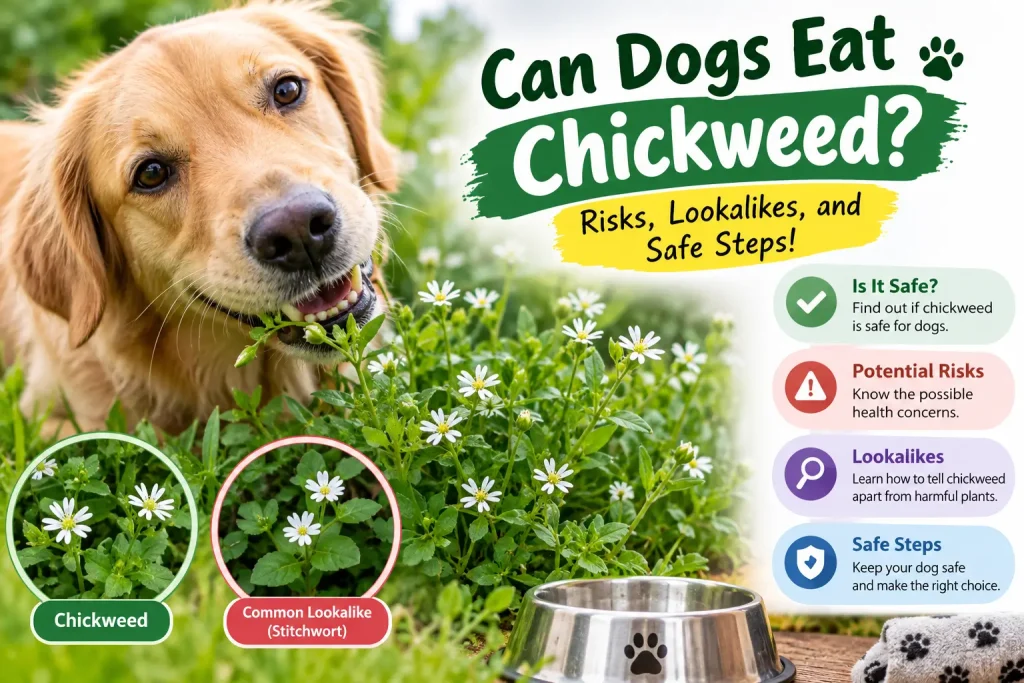
Yes, dogs can usually eat a small amount of chickweed without serious harm. Common chickweed (Stellaria media) is not known as a poisonous plant for dogs. But “not known to be toxic” does not mean “proven safe as a regular food.” Eating a lot of any plant can upset a dog’s stomach. The bigger risks often come from outdoors: a lookalike weed, a lawn treated with weed killer, or a patch soiled by animal waste. So the real answer to “can dogs eat chickweed?” depends on the plant, where it grew, and how much your dog ate.
Read This: Can Dogs Eat Escarole? Safety, Benefits, Risks & Serving Tips
Can dogs eat chickweed?
A small nibble of correctly identified, clean chickweed is unlikely to cause serious problems. It is not a food dogs need, and it should not become a regular part of the diet. Wild or chemically treated plants need extra caution.
What Is Chickweed?
Chickweed is a low, mat-forming annual with small white, star-like flowers. It grows in lawns and garden beds and spreads readily by seed. It also roots along its stems, so it can spread quickly. The plant is common in lawns, meadows, waste places, and open areas. That is exactly where dogs sniff, dig, and graze.
Many people call it a weed because it spreads fast and crowds out grass. Gardeners and foragers often see it differently. People eat it in salads. Cultivated vegetables, by contrast, are grown on purpose, in known soil, and handled for food.
The name itself causes confusion. “Chickweed” is also applied to several related plants, not only Stellaria media. Mouse-ear chickweed is one example. When this article says chickweed, it means common chickweed.
Can Dogs Eat Chickweed?
Small amounts are generally not expected to cause serious harm. Chickweed is still not a necessary or proven food for dogs.. They note that eating plants can occasionally cause mild stomach upset. That fits a broader point from the ASPCA: eating any plant material may cause vomiting or stomach upset in dogs and cats.
Dogs differ. One dog may nibble chickweed and feel fine. Another may get loose stools from the same bite. A dog with a sensitive stomach or a history of food reactions is more likely to react.
There is a difference between tolerating a plant and needing it. Dogs get their nutrition from complete and balanced dog food. Chickweed adds nothing they require. Treat it as an occasional outdoor curiosity, not an ingredient.
Is Chickweed Poisonous to Dogs?
Short answer: Chickweed is not recognized as a classic poisonous plant for dogs. The research behind that statement is thinner than most owners assume.
Here is what we can say with confidence. Chickweed contains saponins. These compounds can be toxic to some species, notably fish.
Here is what we could not confirm. We found no dedicated ASPCA listing for common chickweed. Most “chickweed is safe for dogs” statements online come from vet Q&A pages, herbal books, and pet blogs. Those are useful, but they are not controlled studies in dogs.
The phrase “not listed as toxic” means a plant has not been reported to cause serious problems. It does not mean researchers tested it as a dog food. Sources also disagree on benefits. Herbal sites promote chickweed as medicine, while veterinary sources simply say it is unlikely to be dangerous.
Environmental contamination changes the picture. A harmless plant can carry harmful residue.
What Happens If a Dog Eats Chickweed?
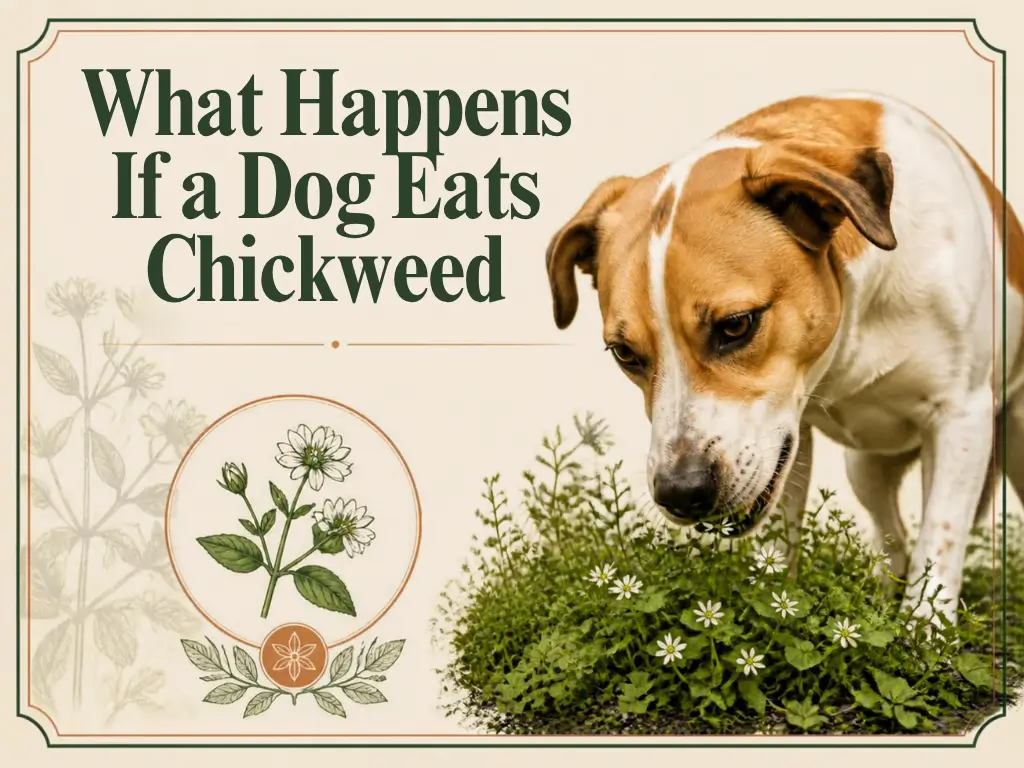
Short answer: Most dogs show nothing after a small nibble. Larger amounts may cause mild stomach upset.
Possible outcomes include:
- No visible reaction at all
- Soft stool or mild diarrhea
- Vomiting
- Drooling
- Reduced appetite
- Belly discomfort, such as restlessness or a tucked posture
Herbal references say chickweed can act as a laxative in large amounts and may cause diarrhea. That fits what many dogs do after any big plant meal.
These symptoms have many causes. A dog can vomit from a new treat, a stomach bug, or a lawn chemical. So the signs alone do not prove chickweed was the problem.
The amount matters. So does everything else on the plant: soil, dew, sprays, droppings. If symptoms appear, consider the whole outdoor context, not just the leaves.
Also Read : Can Dogs Eat Bilimbi? Safety, Benefits, Risks, and Feeding Guide
Dog Ate Chickweed: Should You Worry?
Short answer: Usually not for a small nibble. Worry rises with quantity, chemicals, uncertain identification, or symptoms.
- Small accidental nibble. Calmly stop the grazing. Offer fresh water and watch your dog for the next day. Keep meals normal. Most healthy dogs need nothing else.
- Large amount eaten. A big mouthful or repeated grazing raises the odds of stomach upset. Call your veterinarian for advice, especially for small dogs, puppies, seniors, or dogs with health conditions.
- Chickweed from a treated lawn. The concern shifts from the plant to the chemicals. Check when products were applied and read the label. Call your vet or a poison hotline if you think your dog swallowed a meaningful amount.
- Unknown plant mistaken for chickweed. If you are not sure, treat the plant as unknown. Take photos, note where it grew, and call a vet or poison hotline for guidance.
- Chickweed with vomiting or other symptoms. Repeated vomiting, diarrhea that lasts, weakness, or unusual behavior deserves a call to your vet. Do not wait for symptoms to “work themselves out” if your dog seems unwell.
Can Dogs Eat Chickweed From the Lawn?
Short answer: Only if the lawn is untreated and you are sure of the plant. A plant’s toxicity and its growing environment are separate questions.
Chickweed can be harmless while the lawn it grew in is not. Common lawn products include herbicides, pesticides, and fertilizers. Pet-safety articles note that these chemicals can cause vomiting, tremors, and seizures after contact or ingestion.
Product labels typically give re-entry guidance. The National Pesticide Information Center advises to keep pets away until sprays dry completely or for the time on the label, whichever is longer. Granular products usually need watering in first.
Other sources of contamination include:
- Weed killers used on nearby sidewalks or driveways
- Roadside runoff and de-icing products
- Animal waste, including droppings from other dogs, wildlife, or livestock
- Neighbor treatments that drifted across a fence
Not every lawn carries these hazards. Many are fine. But you cannot see residue, and “it looks clean” is not proof. If you do not know the lawn’s history, do not treat its weeds as a snack.
Can Dogs Eat Wild Chickweed?
Short answer: It carries more uncertainty than chickweed from a place you control. We do not recommend harvesting wild plants for your dog.
Wild plants raise several issues at once:
- Identification. You may be wrong about what you picked.
- Location. Parks, roadsides, and fields may be treated or polluted.
- Mixed patches. Chickweed often grows tangled with other weeds, so one handful may include several species.
- Animal waste. Wild areas attract dogs, birds, and wildlife.
Washing helps remove dirt and some surface residue. It cannot remove chemicals absorbed into the plant, and it cannot fix a misidentified weed. No reliable veterinary evidence supports feeding wild chickweed to dogs as a health practice, so there is little reason to take on the risk.
Can Dogs Eat Fresh Chickweed?
Short answer: A tiny, washed portion of correctly identified chickweed is unlikely to harm a healthy adult dog.
If your dog nibbles fresh chickweed, remove soil and rinse the leaves. Offer only a small pinch mixed into regular food, and only if you are sure of the plant and its source.
The stems are thin and stringy. Large amounts of fibrous greens can be hard to digest, which may cause loose stools. Dogs also chew plants unevenly, so a sudden salad may not break down well.
After any new plant, watch for the next 24 hours. Stop if you see vomiting, diarrhea, or low appetite. Do not serve large quantities, and do not treat it as a daily supplement.
Can Dogs Eat Cooked Chickweed?
Short answer: Plain, cooled chickweed in a tiny amount is unlikely to be a problem. Cooking does not make an uncertain plant safe.
Cooking softens the leaves and may make them easier to chew. It does not remove herbicides, confirm identification, or erase contamination. A misidentified weed is still misidentified after it is steamed.
If you cook it, keep it plain:
- No salt or butter
- No garlic or onion, which are harmful to dogs
- No spicy seasoning or sauces
- Cool it fully before serving
Serve it as a small topper, not a meal. The same rule applies: only use chickweed you can identify with confidence and that grew somewhere clean.
Can Puppies Eat Chickweed?
Short answer: It is best to avoid it. Puppies are more sensitive, and they do not need it.
Puppies have developing digestive systems. A new plant can bring on diarrhea or vomiting faster than in an adult dog. Their small bodies also lose fluid quickly, so even mild upset deserves attention.
Puppies also eat nearly everything outdoors. That makes lawn chemicals and lookalike plants more worrying. A complete puppy food provides the nutrition they need for growth.
If your puppy eats chickweed, watch closely. Contact your vet sooner rather than later if vomiting, diarrhea, or low energy appears.
Potential Benefits of Chickweed for Dogs
Short answer: Chickweed contains water, fiber, and plant compounds, but no strong dog-specific evidence shows it improves health.

Herbal and pet sites often list vitamins and minerals in chickweed, such as vitamin C, beta-carotene, calcium, potassium, magnesium, and zinc. They also mention flavonoids. Those lists tend to come from general plant references, not dog feeding studies.
Potential nutrition does not mean dogs need chickweed. A dog eating complete and balanced food already receives the nutrients it needs. A few leaves would add very little.
Claims about detoxing, calming inflammation, or boosting immunity lack strong evidence for dogs. This article does not make them. If you want to use an herb for a health concern, talk to your veterinarian first.
Risks of Chickweed for Dogs
Short answer: The main risks come from quantity, identification, and environment rather than from chickweed itself.
- Eating too much plant material. Large amounts of any plant can overwhelm a dog’s gut. Herbal sources note that too much chickweed acts as a laxative.
- Digestive upset. Vomiting, loose stools, or drooling can follow even a “safe” plant. Dogs with sensitive stomachs are more likely to react.
- Incorrect plant identification. A weed that looks like chickweed may be a different species. Some lookalikes cause more serious problems.
- Herbicide exposure. Weed killers are made to damage plants and can harm pets if swallowed or licked from paws. Treated areas should stay off-limits until dry.
- Pesticide exposure. Insecticides and snail baits can cause serious signs, including tremors. Residue may stay on or near plants.
- Fertilizer contamination. Some fertilizers upset the stomach. Others contain ingredients, such as iron, that raise greater concern.
- Roadside contamination. Plants near roads may collect vehicle fluids, de-icing products, and other pollutants.
- Individual sensitivity. Any dog can react to any plant. Allergic-type reactions are uncommon but possible.
How Much Chickweed Can Dogs Eat?
Short answer: No reliable, veterinary-backed serving size exists. Keep it to a nibble.
We found no trustworthy veterinary source that gives a gram-based amount for dogs, and this article does not invent one. Some herbal sites list tea or tincture doses, but those are not veterinary standards.
| Situation | General Guidance |
|---|---|
| Small accidental nibble | Monitor |
| Small amount of correctly identified clean plant | Avoid making it a regular food |
| Large amount | Contact veterinarian if concerned |
| Unknown plant | Seek advice if identification is uncertain |
| Chemically treated plant | Contact veterinarian if exposure is significant |
Complete and balanced dog food should remain the nutritional foundation. Anything extra is a treat, and treats should stay small.
How to Identify Chickweed Safely
Short answer: Look for the whole pattern, not one feature. If you are not sure, assume it is not chickweed.Reliable botanical sources describe common chickweed as a low, spreading annual with small white, star-shaped flowers, as noted earlier. It spreads by reseeding and by rooting at the stem nodes.
Look at:
- Leaves: small, oval, and paired along the stem
- Stems: thin and trailing, often forming a mat
- Flowers: tiny, white, and star-like
- Growth pattern: low carpet-like patches in cool, damp areas
Do not let your dog eat an unidentified wild plant simply because it looks like chickweed.
Chickweed Lookalikes: Why Identification Matters
Short answer: Several plants resemble chickweed. Some are harmless. Others are not.
Similar-looking plants can have very different safety profiles. Common names add to the confusion, because several species share the word “chickweed,” including mouse-ear chickweed. NC State Extension lists mouse-ear chickweeds as plants often confused with common chickweed.
One well-known lookalike is scarlet pimpernel. Foraging sources describe it as toxic, with pink to orange flowers where chickweed always has white ones. Those same sources say it can grow right beside chickweed patches.
Keep these points in mind:
- A photo alone may not be enough for a firm identification.
- Flowers help, but plants are not always in bloom.
- Mixed patches make it easy to grab the wrong plant.
- If identification is uncertain, stop your dog from eating it.
Chickweed vs Common Lawn Weeds
Short answer: Lawn weeds differ widely in safety. This table shows why identification comes first.
| Plant | Dog Safety Consideration |
|---|---|
| Chickweed | Not known to be toxic; limited dog-specific evidence; keep amounts small |
| Dandelion | Commonly described as low concern, but verify the species and growing site |
| Clover | Several plants share the name; check the exact species before assuming safety |
| Plantain | The name covers different plants (including a garden banana relative); confirm which one you have |
| Purslane | Listed by the ASPCA as toxic to dogs because of soluble calcium oxalates |
| Unknown lawn weed | Treat as unknown; prevent eating and seek advice if needed aspca |
This table does not call every plant safe. Only purslane has a clear toxic listing here. The others depend on exact species and location.
What to Do If Your Dog Eats an Unknown Weed
Short answer: Stop the eating, collect information, and call a professional if the plant or the symptoms worry you.
- Prevent further eating. Lead your dog away from the area.
- Identify the plant if possible. Compare it against trusted references.
- Photograph the plant. Capture leaves, stems, flowers, and the whole patch.
- Note where it was growing. Home garden, park, roadside, or neighbor’s yard all matter.
- Check for chemicals. Ask about recent lawn treatments nearby.
- Estimate how much was eaten. A nibble and a mouthful are different.
- Monitor for symptoms. Watch appetite, stool, energy, and behavior.
- Contact a veterinarian if the plant is unknown or symptoms develop.
Do not make your dog vomit unless a veterinarian tells you to. Some substances cause more harm coming back up, and the wrong method can hurt your dog.
When to Call a Veterinarian
Short answer: Call if symptoms are strong or lasting, if the plant is unknown, or if chemicals may be involved.
Warning signs include:
- Repeated vomiting
- Persistent diarrhea
- Severe weakness
- Difficulty breathing
- Tremors or seizures
- Excessive drooling
- Severe belly pain
- Collapse
- Significant changes in behavior
Also call if:
- A large amount was eaten
- The plant was unknown
- The plant may have been chemically treated
- The dog is very young, elderly, or has existing health problems
Should You Let Your Dog Eat Chickweed?
This is general educational guidance, not a veterinary triage tool.
Green: lower concern
- Correctly identified chickweed
- Very small exposure
- Clean growing environment
- No symptoms
Yellow: use caution
- Unknown amount
- Large amount eaten
- Mild digestive symptoms
- Uncertain plant identification
Red: contact a veterinarian
- Unknown potentially toxic plant
- Chemical exposure
- Severe symptoms
- Large ingestion
- Neurological signs, such as tremors or seizures
When in doubt, move up one color. A quick call costs less than guessing wrong.
Frequently Asked Questions
Can dogs eat wild chickweed?
Wild chickweed carries more uncertainty. You cannot easily confirm identification, chemical exposure, or contamination. Washing helps with dirt but not absorbed residue. There is no strong evidence that feeding wild plants benefits dogs, so it is best to skip it.
How much chickweed can a dog eat?
No veterinary-backed serving size exists. Keep it to a small nibble, and do not feed it daily. Large amounts may cause diarrhea or vomiting. Complete and balanced dog food should provide almost all of your dog’s nutrition.
Should I worry if my dog ate a weed?
Not always. If you know the weed is a low-concern plant and the amount was small, monitoring is often enough. Worry more if the plant is unknown, the area was treated, a large amount was eaten, or symptoms appear.
How can I tell chickweed from other weeds?
Look for low, trailing stems, small oval leaves, and tiny white star-like flowers. Check several features together. Lookalikes such as scarlet pimpernel have different flowers, and a photo may not be enough. If unsure, treat it as an unknown plant.
When should I call a vet after my dog eats a plant?
Call if your dog vomits repeatedly, has lasting diarrhea, seems weak, drools heavily, or shows tremors or breathing trouble. Also call if the plant is unknown, a large amount was eaten, or chemicals may be involved.
Key Takeaways
- Small amounts of correctly identified chickweed are generally not expected to cause serious harm.
- Chickweed is not known as a toxic plant for dogs, but dog-specific evidence is limited.
- A small accidental nibble usually needs only monitoring.
- Treated lawns, roadsides, and animal waste can make a harmless plant risky.
- Wild plants are easy to misidentify, so never assume a weed is chickweed.
- Puppies should avoid chickweed and stay on complete puppy food.
- Mild stomach upset is the most likely reaction; many other causes can look the same.
- Call a veterinarian for severe symptoms, large amounts, unknown plants, or chemical exposure.
Final Thoughts
When a dog grabs a mouthful of chickweed, the plant itself is often the smallest part of the story. The bigger questions are what the plant really was, where it grew, and what was sprayed or spilled nearby. The amount your dog ate matters too.
A single nibble of clean, correctly identified chickweed rarely calls for more than a watchful eye. Unknown weeds, treated lawns, and big mouthfuls deserve more care. Keep complete dog food as the foundation, and treat outdoor plants as occasional curiosities rather than a menu.
So, can dogs eat chickweed? In small amounts, usually yes. But the safest move is to know your plant, know your lawn, and call your vet when something feels off.