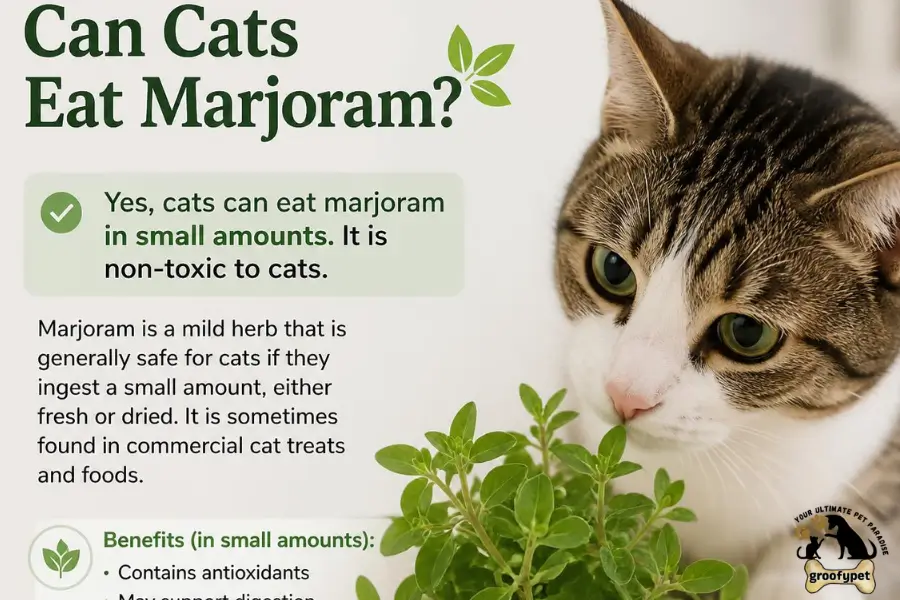
No, cats should not eat marjoram on purpose. The ASPCA lists marjoram (Origanum majorana) as toxic to cats and dogs. It names gastrointestinal irritants as the toxic principle and vomiting and diarrhea as the clinical signs. A quick lick or a nibble of one leaf is not a reason to panic. The listed effects are digestive upset, not organ damage.
If you enjoy cooking with fresh herbs, you may have wondered, can cats eat marjoram? This fragrant herb is commonly used in soups, sauces, meats, and other dishes, but that does not mean it is suitable for cats. According to the ASPCA, marjoram is toxic to cats and can cause digestive problems such as vomiting and diarrhea.
A small accidental taste may not always lead to serious problems, but it is still best to keep marjoram away from your cat. In this guide, we’ll look at why marjoram can be a problem, whether fresh and dried forms are different, the risks of marjoram essential oil, and what to do if your cat eats it. The careful approach is to treat marjoram as a herb your cat does not need and keep it out of reach. Marjoram essential oil is a separate and more serious concern.
This guide covers fresh and dried marjoram, kittens, seasoned food, and essential oil. It also explains what to do if your cat already ate some.
What Is Marjoram?
Marjoram is a perennial herb in the mint family (Lamiaceae). It comes from the Mediterranean region and western Asia. Its Latin name is Origanum majorana. You may also see it called sweet marjoram. The ASPCA lists knotted marjoram and pot marjoram as other common names.
The plant has small, soft, oval leaves and tiny flower clusters that look like little knots. It tastes sweeter and milder than oregano, its close relative. People use marjoram fresh or dried. Fresh leaves go into salads and sauces. Dried marjoram is a common seasoning for meats, soups, vegetables, and spice blends. Cats meet it in three main ways:
- A pot in the kitchen or herb garden
- A spice jar or seasoned dish on the counter
- Aromatherapy products such as diffusers and candles
Common names vary from place to place. Always check the Latin name when you look up a plant.
Can cats eat marjoram?
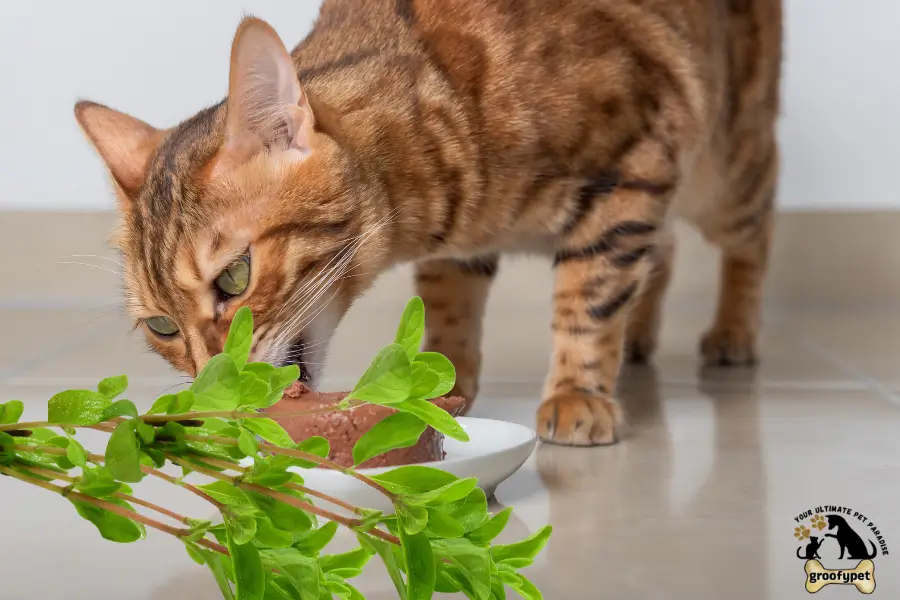
Cats should not be intentionally fed marjoram because the ASPCA lists it as toxic to cats. The main concern is irritation of the digestive tract after the herb is eaten. A small accidental taste may cause only mild stomach upset in some cats. Possible signs include vomiting, diarrhea, or changes in appetite. Keep fresh marjoram and containers of dried seasoning away from curious cats. If your cat eats a large amount, contact your veterinarian for advice.
Is marjoram toxic to cats?
Yes, the ASPCA lists marjoram as toxic to cats because it can irritate their digestive system. The reported signs include vomiting and diarrhea after exposure. However, there is no established published dose threshold that tells owners exactly how much causes problems.
This makes it difficult to predict the reaction from the amount alone. For that reason, it is safer to prevent cats from eating marjoram whenever possible. Contact your veterinarian if your cat develops symptoms after eating the herb.
Can cats eat dried marjoram?
Dried marjoram should also be kept away from cats rather than offered as a seasoning. Drying removes much of the water, leaving a more concentrated amount of plant material in a small pinch. A cat may also consume more dried herb from spilled seasoning than from a single fresh leaf.
Keep spice jars, packets, and containers securely closed and out of your cat’s reach. If your cat accidentally eats a small amount, monitor for vomiting or diarrhea. Contact your veterinarian if the cat ate a larger quantity or develops concerning symptoms.
Is marjoram essential oil safe for cats?
Marjoram essential oil should not be given to cats or applied directly to their skin or fur. Essential oils are highly concentrated compared with the original plant material. Cats can be particularly sensitive to certain essential oils because of how their bodies process them.
Avoid using marjoram oil as a home remedy or adding it to your cat’s food. Diffusing essential oils around cats can also create an exposure risk depending on the product and situation. If your cat licks, swallows, or has significant contact with essential oil, contact a veterinarian promptly.
What should I do if my cat eats marjoram?
First, remove the remaining marjoram or seasoning so your cat cannot eat more. Try to determine whether your cat ate fresh leaves, dried seasoning, or a concentrated product. Estimate the amount consumed and keep the packaging if the exposure involved a commercial product.
- Identify it. Was it a fresh leaf, dried spice, cooked food, extract, or oil?
- Estimate the amount. Check how much is missing from the plant, jar, or dish.
- Check other ingredients. Look for onion, garlic, nutmeg, salt, or fat if it came from human food.
- Remove leftovers. Take plant material or food away from your cat.
- Monitor your cat. Watch for vomiting, diarrhea, drooling, weakness, or behavior changes.
- Call for help if needed. Contact your veterinarian if the amount was large, the product was concentrated, or symptoms developed.
Watch your cat for vomiting, diarrhea, appetite changes, or other unusual behavior. Contact your veterinarian or an appropriate animal poison service if a large amount was eaten or symptoms appear. Do not make your cat vomit unless a veterinary professional specifically tells you to do so.
Is Marjoram Toxic to Cats?
The strongest source is the ASPCA plant database. Its listing says marjoram is toxic to cats and dogs. The toxic principle is gastrointestinal irritants. The clinical signs are vomiting and diarrhea. The ASPCA’s oregano page uses similar wording. It lists oregano as toxic to dogs, cats, and horses because of gastrointestinal irritants, with mild vomiting and diarrhea as signs.
Can Cats Eat Fresh Marjoram?
Fresh marjoram is not recommended. Cats are obligate carnivores. They get what they need from complete and balanced cat food. Herbs add nothing they require.
A cat that bites a leaf may drool or vomit. Some cats also get loose stools. The ASPCA lists vomiting and diarrhea as the signs. Many cats will simply walk away because of the strong smell.
If your cat nibbles a fresh plant:
- Remove any leaves from the mouth and move the plant out of reach.
- Offer fresh water.
- Watch your cat for the next several hours.
- Call your veterinarian if vomiting repeats, diarrhea continues, or your cat seems unwell.
Can Cats Eat Dried Marjoram?
Dried marjoram deserves the same caution. Drying removes water. A teaspoon of dried herb contains more plant material than a teaspoon of fresh leaves. There is no evidence that drying makes marjoram safer or more dangerous. No cat-specific source says either.
Real exposures usually look like this:
- A cat licks spilled seasoning off the counter
- A cat eats a bite of food that contains a pinch of marjoram
- A cat knocks over a spice jar and chews the contents
A small dusting in cooked food is a minor exposure. It is not a reason to feed the herb again. A spilled jar or a mouthful of seasoning is different. Note how much was eaten and call your veterinarian if the amount was large.
Can Kittens Eat Marjoram?
Kittens should not eat marjoram. No source sets a minimum safe age, so avoid inventing one.
Kittens are small, and a little plant material is a bigger share of their body weight. Their digestive systems are still developing. Vomiting and diarrhea can also dehydrate them faster than adult cats. They need complete kitten food for growth. Herbs cannot replace it.
Call your veterinarian for any kitten that eats marjoram and then vomits, has diarrhea, stops eating, or seems weak. If the exposure was an accidental lick and your kitten acts normal, watch closely and keep the plant out of reach. When in doubt, call.
Also Read : Is Alstroemeria Toxic to Cats? Symptoms, Risks & What to Do
Can Cats Eat Food Seasoned With Marjoram?
The marjoram may not be the biggest problem in the dish. Seasoned human food often has ingredients that are more dangerous to cats:
- Onions, garlic, chives, scallions, and leeks, which can damage red blood cells
- Nutmeg, which is toxic to cats
- Heavy salt
- Butter, oil and other fatty ingredients
- Spicy sauces
- Bones and sausage casings
A cat that steals a bite of plain roast chicken with a little marjoram faces a different risk than one that eats garlic butter with marjoram. Read the full ingredient list. Not every food with marjoram is dangerous. But cats should not eat human dishes as a habit.
If your cat ate a seasoned dish, tell your veterinarian every ingredient. Onions and garlic can cause delayed problems. A cat may look fine at first.
Is Marjoram Essential Oil Safe for Cats?
No. Do not give marjoram essential oil to cats. Do not put it on their skin or diffuse it around them. Essential oils are highly concentrated. A drop holds far more plant compounds than a leaf. The Merck Veterinary Manual says cats and birds are at particular risk. It lists vomiting, breathing problems, seizures, and liver or kidney failure among the possible signs.
Cats also process some chemicals poorly. Pet Poison Helpline explains that cats lack a liver enzyme that helps break down certain compounds, including phenols found in some essential oils.
- Diffusers and candles. Active diffusers such as ultrasonic and nebulizing types matter here. They release microdroplets into the air. The droplets can settle on a cat’s fur and get absorbed through the skin or swallowed during grooming. That turns air exposure into ingestion.
- What is not known. The Pet Poison Helpline names specific oils that poison cats, such as tea tree, peppermint, eucalyptus, cinnamon, and pine. The pages I reviewed did not name marjoram oil on that list. The list is not complete, and absence from it does not prove marjoram oil is safe. Blends may also contain oils that are clearly dangerous.
- If your cat is exposed. Call your veterinarian or a poison hotline right away. VCA advises not to induce vomiting or give activated charcoal for essential oil exposure. It also advises bringing the product packaging to the clinic. Follow the professional’s advice on washing oil off fur.
Never use essential oils as a home remedy for a cat. This article does not give instructions for using them around cats.
Must Read : Can Cats Eat Spirulina? Benefits, Risks, and Safe Feeding Guide
Can Cats Eat Marjoram Leaves, Stems, or Flowers?
The ASPCA listing covers the plant as a whole. It does not separate leaves, stems, and flowers. No reliable source says one part is more poisonous than another. Do not assume any part is safe.
Other concerns depend on the plant part:
- Leaves are the part cats most often chew.
- Stems are tougher and harder to digest. A large amount could upset the stomach.
- Flowers are small, but the same caution applies.
A cat that chews a lot of any plant can vomit from fiber and volume alone. This is separate from marjoram’s own irritants.
Does Marjoram Have Any Benefits for Cats?
There is no good evidence that marjoram helps cats. Some pet blogs claim it fights infection, calms anxiety, or improves appetite. Those claims usually come from lab tests or human studies. They do not show a benefit in cats. They also ignore the ASPCA’s toxicity listing.
Do not use marjoram to treat infections, digestive problems, or stress. Do not use it to boost immunity. It cannot replace veterinary care. If your cat has a health concern, a veterinarian can suggest safe options. Cats need protein, taurine, and other nutrients from complete cat food. Herbs are not part of that need.
Possible Risks of Marjoram for Cats
The realistic risks match what the ASPCA lists.
- Vomiting and diarrhea are the main signs.
- Drooling can happen when a cat tastes something unpleasant. This sign is described by some pet health sources but is not in the ASPCA listing.
- Reduced appetite may follow stomach upset.
- Large amounts of plant material can cause trouble on their own.
- Essential oil and extracts carry more serious risks than the herb.
- Other ingredients in seasoned food can be more dangerous than marjoram.
Most cats with mild digestive upset recover. But dehydration can occur if vomiting or diarrhea continues. That is why symptoms deserve attention.
How Much Marjoram Can a Cat Eat?
There is no verified serving size. Cats do not need marjoram, so no amount counts as a recommended serving.
Think about exposure in two groups:
- Accidental small exposure: a lick, a leaf, or a dusting of seasoning. Watch your cat and keep the source out of reach.
- Intentional repeated feeding: avoid this. It means regular contact with an ASPCA-listed irritant for no nutritional reason.
If a cat eats a lot of marjoram, or the source was concentrated, call your veterinarian or a poison hotline. Do not wait to see what happens.
Do not induce vomiting unless a veterinary professional tells you to. The Pet Poison Helpline also says not to give home antidotes. Do not give charcoal, milk, or oils at home unless a professional says so.
Signs That Your Cat May Need Veterinary Care
Call a veterinarian promptly if you see:
- Repeated vomiting
- Diarrhea that lasts more than a day or two
- Excessive drooling
- Severe lethargy or weakness
- Refusal to eat
- Abdominal pain such as crying when touched or a hunched posture
Seek urgent or emergency care for:
- Difficulty breathing
- Tremors or seizures
- Wobbling or trouble standing
- Collapse
Tremors, seizures, and breathing trouble are not the typical ASPCA signs for marjoram itself. They can appear with essential oil exposure or other toxins. Do not try to diagnose poisoning from symptoms alone. Your veterinarian can check hydration and rule out other causes. Treatment is usually supportive. For heavy vomiting or diarrhea, a veterinarian may give fluids.
Quick Safety Table
| Marjoram Exposure | What Cat Owners Should Know |
|---|---|
| Fresh marjoram | Listed by the ASPCA as a gastrointestinal irritant. Avoid on purpose. A nibble may cause vomiting or diarrhea. |
| Dried marjoram | No evidence that drying changes risk. It packs more plant material by weight than fresh leaves. |
| Small accidental bite | Remove it, watch your cat and call your vet if symptoms appear. |
| Large amount | Call your veterinarian or a poison hotline promptly. |
| Food seasoned with marjoram | Check every ingredient. Onion, garlic, nutmeg, salt and fat may be the bigger problem. |
| Marjoram extract | More concentrated than the herb. No cat specific data found. Avoid and call a professional after exposure. |
| Marjoram essential oil | Cats are at particular risk from essential oils. Do not give, apply or diffuse. Call a professional after exposure. |
| Marjoram plant | Keep pots out of reach. Large amounts of plant material can cause vomiting even without a specific toxin. |
Marjoram vs Other Herbs
Never assume a safe herb tells you anything about another herb. Lamiaceae, the mint family, includes both cat-safe and cat unsafe plants. Chemistry differs by species.
| Herb | ASPCA Status Per Sources Reviewed | Note |
|---|---|---|
| Marjoram | Toxic to cats | Gastrointestinal irritants, vomiting and diarrhea |
| Oregano | Toxic to cats | Same principle and signs on the ASPCA page |
| Basil | Not toxic | Listed as non toxic, but still not a snack |
| Rosemary | Not toxic | Listed as non toxic in ASPCA based lists |
| Thyme (true thyme) | Not toxic | Some plants called thyme are not true thyme, so check the Latin name |
| Mint and parsley | Varies | Species matter and sources disagree, so check the exact plant |
Sources for basil, rosemary, and thyme: basil and English thyme are on the ASPCA non-toxic list alongside rosemary, and a public pet safe plant brochure based on the ASPCA list includes rosemary, sage and thyme. Non-toxic does not mean unlimited. Any plant can upset a stomach if a cat eats too much.
If you want a cat-friendly green treat, choose cat grass or catnip. Catnip is a Lamiaceae herb that many cats enjoy. Give it in small amounts.
Frequently Asked Questions
Can cats eat marjoram?
Not on purpose. The ASPCA lists it as toxic to cats. Accidental small tastes usually cause mild digestive upset at most.
Is marjoram toxic to cats?
Yes, per the ASPCA. The toxic principle is gastrointestinal irritants. The listed signs are vomiting and diarrhea.
Can cats eat fresh marjoram?
It is not recommended. Fresh leaves can irritate the stomach. Cats do not need herbs in their diet.
Can cats eat dried marjoram?
Avoid it. Dried herb is more concentrated by weight. Keep spice jars closed and stored where cats cannot reach.
Can kittens eat marjoram?
No. Kittens are small and can dehydrate quickly from vomiting or diarrhea. Call your vet if a kitten eats some and shows symptoms.
Can cats eat food seasoned with marjoram?
A small taste of plain cooked food is usually a minor exposure. Check the other ingredients for onion, garlic, nutmeg, salt and fat.
Is marjoram essential oil safe for cats?
No. Cats are at particular risk from essential oils. Do not give, apply, or diffuse marjoram oil around cats.
What happens if a cat eats marjoram?
Vomiting and diarrhea are the expected effects. Some cats also drool or lose their appetite. Many cats with a small exposure show no problems.
What should I do if my cat ate a lot of marjoram?
Call your veterinarian or a poison hotline right away. Bring the plant, jar, or product packaging if you can.
Do cats need herbs in their diet?
No. Complete and balanced cat food supplies what they need. Herbs are optional and can cause trouble.
What herbs are safe for cats?
Catnip and cat grass are common choices. Basil, rosemary, and true thyme are listed as non-toxic. Offer only small amounts and check the Latin name.
Conclusion
Marjoram is an herb your cat does not need. A small accidental taste usually leads to mild upset at most. But no verified safe serving exists, so avoid feeding it on purpose. Concentrated forms need more caution. Marjoram extract and essential oil are not the same as a pinch of culinary herb.
Cats are at particular risk from essential oils. Seasoned human food can also carry separate dangers, such as onion, garlic, and nutmeg. Keep herbs and spice jars out of reach. If your cat eats a large amount or any concentrated product, call your veterinarian or a poison hotline right away.
Can Cats Eat Slim Jims? A 2026 Guide for Worried Cat Owners!
Can Cats Eat Bean Sprouts? A Safe and Loving Guide for Worried Cat Owners!