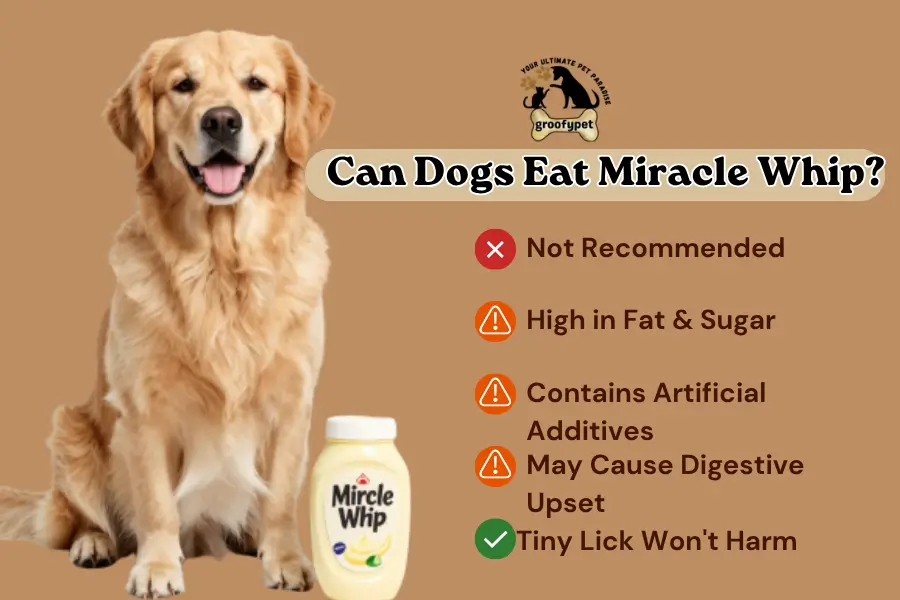
Can dogs eat Miracle Whip? In small, accidental amounts, Miracle Whip is not considered highly toxic to dogs. However, it is not a healthy or recommended food for dogs. It’s high in fat, sodium, sugar, and processed ingredients that offer little nutritional value.
A lick or a bite off a dropped sandwich usually isn’t an emergency, but regular feeding is not advised, and large amounts can trigger digestive upset or, in susceptible dogs, pancreatitis.
What Is Miracle Whip?
Miracle Whip is a tangy, semi-sweet sandwich spread and salad dressing produced by Kraft Foods. It’s often mistaken for mayonnaise since it shares a similar creamy texture and many of the same base ingredients but it’s technically a different product.
How it differs from mayonnaise:
- Miracle Whip contains less oil than traditional mayo
- It’s sweetened, giving it a distinct tangy-sweet flavor mayo doesn’t have
- It includes added spices, mustard flour, and preservatives not typically found in basic mayonnaise
Common ingredients in Miracle
Whip includes water, soybean oil, eggs, vinegar, high fructose corn syrup or sugar, modified corn starch, mustard flour, salt, paprika, garlic (often as dried garlic or garlic powder), and preservatives such as potassium sorbate.
People use Miracle Whip as a sandwich spread, a base for salad dressings, and a mix-in for potato salad, chicken salad, tuna salad, and egg salad all common ways a dog might accidentally get a taste of it.
Can Dogs Eat Miracle Whip?
The direct answer: dogs can technically eat a small amount of Miracle Whip without it being an emergency, but they shouldn’t. Veterinary nutrition guidance generally treats condiments like Miracle Whip as “foods to avoid” rather than safe treats, mainly because of their fat, sodium, and sugar content rather than any single toxic ingredient.
A few important distinctions:
- Small accidental amounts (a lick, a small taste off a plate) — usually not a health concern for a healthy adult dog
- Regular or intentional feeding — not recommended, since the empty calories and additives add up over time
- Veterinary recommendation — most vets advise treating Miracle Whip the same way as other processed condiments: fine as a rare accident but not appropriate as a treat
- Why it isn’t a healthy treat — it provides no real nutritional benefit to a dog and displaces healthier treat options
Is Miracle Whip Safe for Dogs?
Whether Miracle Whip is “safe” really depends on quantity and frequency. Let’s break down the ingredients that matter most:
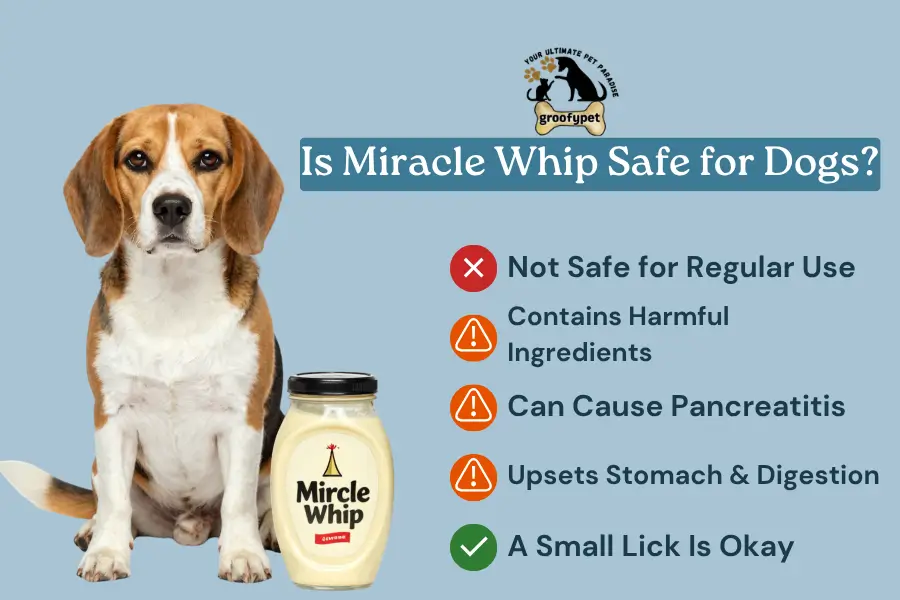
- Fat content – Miracle Whip has less fat than full mayonnaise, but it’s still a fat-based condiment. Diets high in fat are linked to obesity and pancreatitis risk in dogs.
- Sodium content – Salt is a routine ingredient, and dogs with heart or kidney conditions should have their sodium intake limited.
- Sugar – Miracle Whip contains added sugar (often high-fructose corn syrup), which offers no nutritional value to dogs and can contribute to weight gain over time.
- Vinegar – Generally tolerated in small amounts, though some dogs have sensitive stomachs that react to acidic ingredients.
- Egg ingredients – Cooked/processed egg is not toxic, but raw egg components in some formulations carry a small salmonella risk.
- Spices and seasonings – Mustard flour and paprika are usually mild in the amounts present, but flavoured or “spicy” varieties may include more concentrated seasonings.
- Preservatives – Potassium sorbate and similar preservatives are generally recognised as low-risk in small amounts but aren’t something dogs need in their diet.
- Artificial flavours – Not typically dangerous in the small quantities found in a lick of Miracle Whip, but they add zero nutritional value.
Bottom line: none of these ingredients are classified as acutely toxic to dogs on their own, but together they make Miracle Whip a food better avoided as a regular part of your dog’s diet.
Nutritional Profile of Miracle Whip
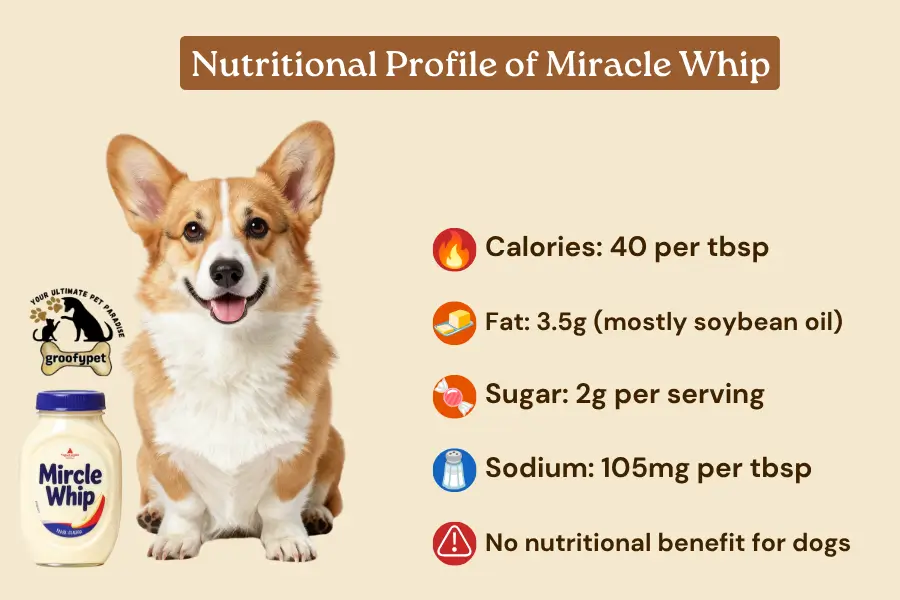
| Nutrient | Approx. Amount (per tbsp) | Effect on Dogs |
|---|---|---|
| Calories | ~35–40 kcal | Empty calories with no nutritional benefit |
| Total Fat | ~3.5g | Contributes to weight gain; risk factor for pancreatitis |
| Saturated Fat | ~0.5g | Can strain digestion in fat-sensitive dogs |
| Sodium | ~90–100mg | Can be problematic for dogs with heart/kidney disease |
| Sugar | ~2g | No nutritional value; may contribute to weight gain |
| Carbohydrates | ~2–3g | Unnecessary in a dog’s diet |
| Protein | <1g | Negligible nutritional contribution |
This profile makes Miracle Whip a food that offers calories, fat, sodium, and sugar without any of the protein, vitamins, or minerals a dog actually needs, which is the core reason vets don’t recommend it as a treat.
Potential Risks of Feeding Miracle Whip
- Digestive upset — vomiting, diarrhea, or gas, especially after larger amounts
- Excess calories and weight gain — repeated small servings add up quickly relative to a dog’s daily caloric needs
- Pancreatitis risk — high-fat foods are a known trigger in dogs prone to this condition, particularly certain breeds and overweight dogs
- High sodium intake — a concern for dogs with existing heart disease or kidney disease, where sodium restriction is often part of their management plan
- Dogs with pre-existing conditions — dogs with pancreatitis history, obesity, diabetes, or kidney/heart disease should avoid Miracle Whip entirely, not just in moderation
Can Puppies Eat Miracle Whip?
Puppies have more sensitive digestive systems than adult dogs and are generally more reactive to high-fat, high-sugar, or unfamiliar foods. Their smaller body size also means even a modest amount of Miracle Whip represents a proportionally larger dose of fat and sodium.
Veterinary guidance typically recommends keeping puppies away from processed condiments altogether and sticking to age-appropriate puppy food and vet-approved treats instead.
- Not usually toxic in small amounts.
- Contains small amounts of protein from eggs.
- Provides quick energy from fat.
- A tiny lick rarely causes serious problems.
- Can make medication more appealing if approved by a vet.
- High in fat, which may cause pancreatitis.
- High in sodium and added sugar.
- Can upset the stomach and cause diarrhea.
- Offers little nutritional value for dogs.
- Some varieties may contain harmful seasonings like onion
Miracle Whip vs Mayonnaise for Dogs
| Feature | Miracle Whip | Mayonnaise |
|---|---|---|
| Fat | Lower than mayo, still notable | Higher fat content |
| Sugar | Contains added sugar/HFCS | Typically unsweetened |
| Sodium | Moderate | Moderate to high |
| Calories | Slightly lower per serving | Slightly higher per serving |
| Overall recommendation | Not recommended as a treat | Not recommended as a treat |
Neither product is a good choice for dogs. Miracle Whip’s added sugar arguably makes it a slightly worse choice than plain mayonnaise, but the difference is minor — both should be treated as “avoid, not a treat” condiments.
Can Dogs Eat Foods Made With Miracle Whip?
This is often more important than the spread itself, because dishes made with Miracle Whip frequently include other ingredients that are genuinely dangerous for dogs:
- Potato salad — may contain onions, chives, or excess salt
- Chicken salad — watch for grapes, raisins, or onions sometimes mixed in
- Tuna salad — tuna itself is fine in small amounts, but mercury content means it shouldn’t be a regular food; watch for added onion or celery salt
- Egg salad — generally the lowest-risk option, but still not a treat
- Sandwiches — check for garlic aioli, bacon, or onion-based spreads
- Burgers — condiments and toppings like caramelized onions, bacon, or specialty sauces are a bigger concern than the burger itself
Important: ingredients like onions, garlic, grapes, raisins, bacon (high sodium/fat), or anything containing xylitol pose a far greater risk to your dog than the Miracle Whip itself. Always check what else went into the dish before assuming it’s a low-risk situation.
What Happens If My Dog Eats Miracle Whip?
Most dogs that eat a small amount show no symptoms at all. If symptoms do appear, they’re typically mild and short-lived:
- Vomiting
- Loose stool or diarrhea
- Gas
- Mild stomach discomfort
- Temporary loss of appetite
When to call your veterinarian:
- Your dog ate a large quantity (more than a taste or lick)
- Symptoms persist beyond 24 hours or worsen
- Your dog shows signs of lethargy, repeated vomiting, or abdominal pain
- The food also contained onions, garlic, grapes, raisins, chocolate, or xylitol
- Your dog has a history of pancreatitis, is a senior, or has an existing health condition
How Much Miracle Whip Is Too Much?
There is no official “safe serving size” for Miracle Whip, because it isn’t formulated or intended as dog food. The table below is a general risk guide, not a feeding recommendation.
| Dog Size | Small Accidental Taste | Large Amount |
|---|---|---|
| Toy dogs (under 10 lbs) | Usually low risk; monitor | Higher relative risk — contact vet |
| Small dogs (10–20 lbs) | Usually low risk; monitor | Monitor closely; call vet if symptoms appear |
| Medium dogs (20–50 lbs) | Typically minimal concern | Monitor; vet visit if symptoms develop |
| Large dogs (50–90 lbs) | Typically minimal concern | Lower relative risk, but still monitor |
| Giant breeds (90+ lbs) | Typically minimal concern | Lower relative risk, but still monitor for pancreatitis-prone individuals |
Smaller dogs face a proportionally higher exposure to fat, sugar, and sodium per teaspoon of Miracle Whip than larger dogs, so extra caution is warranted for toy and small breeds.
What Should You Do If Your Dog Eats Miracle Whip?
- Estimate the amount eaten. A lick is very different from an entire jar.
- Check the ingredient label if you have access to it, especially for flavoured or reduced-sugar versions.
- Look for high-risk additions in the dish: onions, garlic, raisins, grapes, chocolate, or xylitol.
- Monitor your dog for the next 24 hours for vomiting, diarrhoea, or lethargy.
- Contact your veterinarian if a large amount was consumed, symptoms develop, or the food contains any of the toxic ingredients above.
Healthier Alternatives to Miracle Whip
| Food | Safe for Dogs | Benefits |
|---|---|---|
| Plain cooked chicken (no seasoning) | Yes | High-quality protein source |
| Plain Greek yogurt (if tolerated) | Yes, in moderation | Probiotics: watch for lactose sensitivity |
| Pumpkin puree (unsweetened) | Yes | Supports digestion; fiber source |
| Mashed sweet potato | Yes | Vitamins, fiber, low fat |
| Unsalted peanut butter (xylitol-free) | Yes, in moderation | Protein and healthy fat: always check label for xylitol |
| Cottage cheese (small amounts) | Yes, in moderation | Protein and calcium; watch for lactose sensitivity |
These options provide actual nutritional value, unlike Miracle Whip, and are a better way to reward or share food with your dog.
Human Condiment Dogs Should Avoid
| Condiment | Recommendation |
|---|---|
| Miracle Whip | Avoid regular feeding; small accidental amounts usually low-risk |
| Mayonnaise | Avoid regular feeding; it has a similar risk profile to Miracle Whip |
| Ketchup | Avoid: contains sugar and sometimes onion powder |
| Mustard | Avoid; can cause GI upset. some varieties contain harmful spices |
| Barbecue sauce | Avoid high sugar and sodium; often contains onion/garlic |
| Hot sauce | Avoid: can cause GI irritation |
| Ranch dressing | Avoid; high fat, often contains garlic and onion powder |
| Garlic aioli | Avoid entirely; garlic is toxic to dogs |
As a general rule, condiments add fat, sugar, sodium, or seasonings without any nutritional benefit for dogs, and several common ones contain ingredients that are genuinely toxic. When in doubt, skip the condiment.
Frequently Asked Questions
Can dogs eat Miracle Whip safely?
A small accidental taste is usually not harmful for a healthy adult dog, but Miracle Whip is not a food dogs should eat regularly or intentionally.
Is Miracle Whip toxic to dogs?
No, Miracle Whip is not classified as toxic to dogs. It’s a concern due to fat, sugar, and sodium content, not because it contains a poisonous ingredient.
What happens if my dog licks Miracle Whip?
Most dogs show no reaction to a small lick. In sensitive dogs, mild stomach upset such as gas or soft stool is possible.
Can puppies eat Miracle Whip?
It’s best avoided. Puppies have more sensitive digestive systems and are more vulnerable to the fat and sugar.
Is mayonnaise safer than Miracle Whip?
Not meaningfully. Mayonnaise has more fat but no added sugar; both should be treated as foods to avoid rather than treats.
Can dogs eat potato salad with Miracle Whip?
Only if it contains no onions, excess salt, or other harmful additions, and even then, it’s not a recommended treat.
Can dogs eat tuna salad made with Miracle Whip?
In small amounts, plain tuna salad without onion or excessive seasoning is generally lower risk, but tuna’s mercury content means it shouldn’t be a frequent food.
Should I call my veterinarian if my dog eats Miracle Whip?
Call your vet if your dog ate a large amount or shows symptoms like repeated vomiting or lethargy or if the food contained onions, garlic, grapes, raisins, chocolate, or xylitol.
Final Verdict
So can dogs eat Miracle Whip? Miracle Whip is not considered highly toxic to dogs in small, accidental amounts, but it is not a healthy food and should not become part of your dog’s regular diet. Its high fat, sodium, sugar, and processed ingredients make it a poor nutritional choice, offering no real benefit and some potential downsides, including digestive upset and pancreatitis risk in susceptible dogs.
If your dog eats a small amount, simply monitor them for digestive upset over the next 24 hours. Seek veterinary advice if a large quantity was consumed, symptoms develop, or the dish also contained toxic ingredients like onions, garlic, grapes, raisins, or xylitol. For treats, stick to dog-friendly options like plain cooked chicken, pumpkin puree, or unsalted peanut butter instead.
Can Dogs Eat Collard Greens? Benefits, Side Effects, and Safe Portions
Can Dogs Eat Sauerkraut? Benefits, Risks, and Safe Alternatives