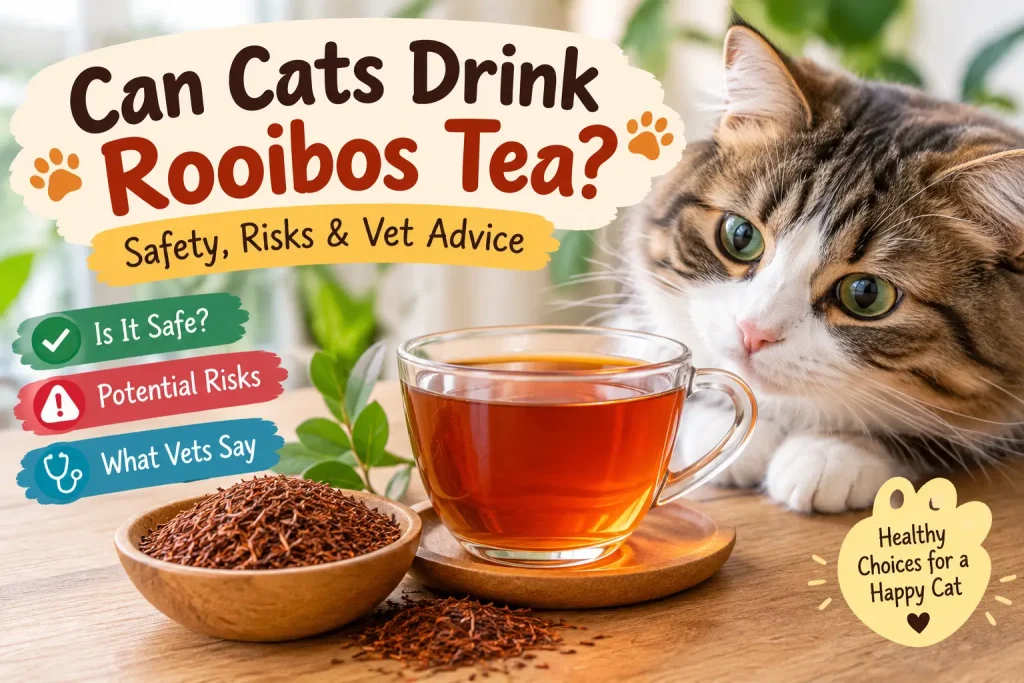
Pure rooibos tea is naturally caffeine-free, but nobody has shown that it is safe for cats. We found no feline-specific safety studies. Fresh water is the best everyday drink. If your cat lapped a little plain, cooled tea, check the ingredients, watch your cat, and call a vet if you are unsure.
Quick Safety Verdict
- Drink: Pure rooibos tea (red bush tea).
- Main concern: Not enough evidence to establish safety in cats. Blends and flavored teas add further concerns.
- Best everyday choice: Fresh, clean water.
- If already consumed: Check the ingredient list and estimate the amount. Then seek veterinary advice when appropriate.
This verdict reflects the limits of the evidence. It is not a veterinary approval or a safety rating.
Can Cats Drink Rooibos Tea Safely?
Short answer: Possibly in tiny accidental amounts, but there is no good reason to offer it on purpose, and the evidence is too thin to call it safe. Rooibos is an herbal tea, not a true tea. It comes from a different plant than black or green tea, so it does not naturally contain caffeine. That matters because caffeine is a known hazard for pets.
In our research, we did not find a study testing rooibos in cats. We also did not find a clear listing for it in ASPCA’s toxic plant database. A missing warning is not the same as a safety guarantee.
Accidental lick vs. regular feeding
A few laps of plain, cooled tea is a very different situation from giving tea daily. Daily use creates repeated exposure that nobody has studied in cats. A strong or concentrated brew is also different from a weak cup. We cannot give a “safe amount,” and nobody should invent one. Since cats get everything they need from water and a balanced diet, there is no benefit that justifies the guesswork.
What Is Rooibos Tea?
Rooibos is a caffeine-free herbal tea made from the leaves of the South African shrub Aspalathus linearis. The plant grows in South Africa’s Cederberg region. Producers usually ferment and dry the leaves, which turns them reddish-brown. This is why the drink is also called red bush tea or red tea.
Here is how it compares with other teas:
- Pure rooibos has one ingredient: rooibos leaves. It has no caffeine and is low in tannins.
- Black and green tea come from Camellia sinensis and naturally contain caffeine.
- Flavored blends may add fruit, spices, vanilla, essential oils, or real tea leaves.
People often praise rooibos for its antioxidants. Those claims come from human and laboratory research. They do not show that rooibos helps cats.
Is Rooibos Tea Toxic to Cats?
We found no reliable report of rooibos poisoning in cats, but that is not proof of safety.
No reports may simply mean nobody has studied it, or that few cases get recorded. So we separate two things:
- Confirmed hazards: Caffeine is one. It also warns that eating tea bags can cause serious toxicity in dogs or cats.
- Unstudied risks: Plain rooibos falls here. We simply do not know how cats respond to repeated or large amounts.
The product matters as much as the plant. A tea that says “rooibos” may also contain black tea, essential oils, sweeteners, or flavorings. Each one changes the risk. Read the full label, not just the front of the box.
Potential Risks of Rooibos Tea for Cats
The list below mixes confirmed hazards with general precautions. Not every item has been proven for rooibos.
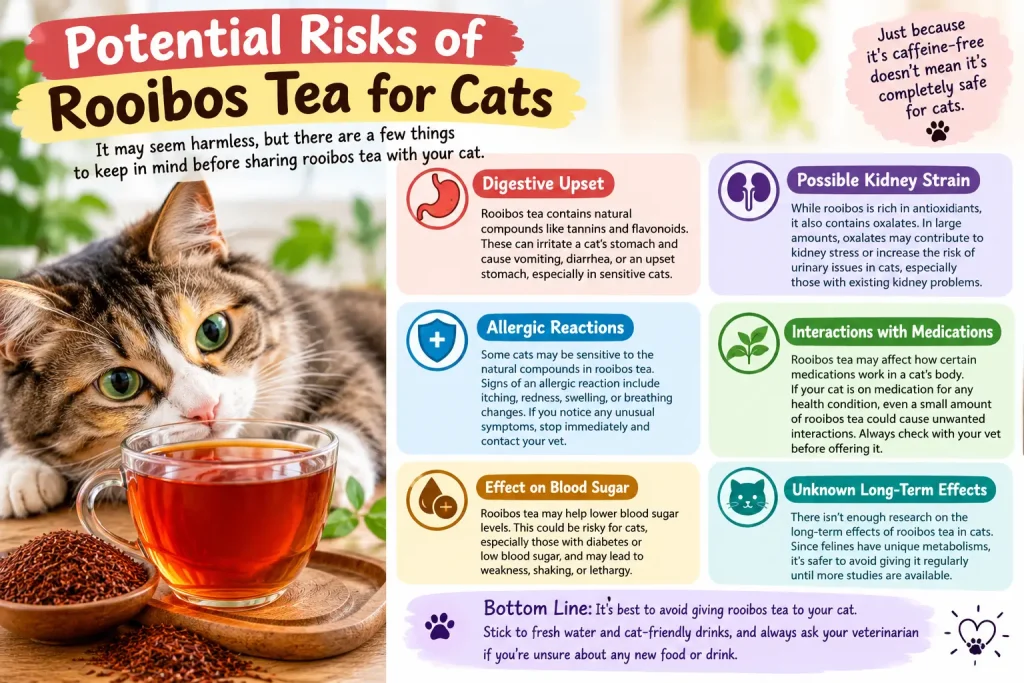
- Uncertain feline safety. Research on cats is missing. This is a gap in knowledge, not a confirmed danger.
- Stomach upset. Any new food or drink can cause vomiting or diarrhea in a sensitive cat. This is a general precaution, not a documented rooibos effect.
- Added ingredients. Flavored blends need their own review. The extra ingredients may be the real problem.
- Caffeine blending. Pure rooibos has no caffeine. A blend with black tea, green tea, or other caffeine sources is a different product. Caffeine is an established hazard for cats.
- Sweeteners and additives. Cats do not need sweet drinks. Xylitol is a well-known danger for dogs, and cat data is less clear, so it is best to keep all sweeteners away from cats.
- Concentrated preparations. Extracts, supplements, and very strong brews are not like ordinary tea. That uncertainty is even greater for cats.
- Reduced water intake. A cat that fills up on tea may drink less water. Hydration should never be traded for a novelty drink.
Can Kittens Drink Rooibos Tea?
No. Kittens should not be given rooibos tea. There is no evidence that it is safe for them, and they have no need for it.Young kittens depend on their mother’s milk. If the mother is not available, a veterinarian can recommend a suitable kitten milk replacer and a feeding plan. Cow’s milk and homemade drinks are not good substitutes.
Once kittens begin eating solid food, they need a complete kitten diet and fresh water. Kittens are small, so even a minor mistake can matter more. Any new drink should be cleared with your vet first.
Also Read : Can Cats Eat Marjoram? Toxicity, Symptoms, and Safety Tips
What If My Cat Already Drank Rooibos Tea?
Most cats that lick a little plain tea will be fine, but check the details. Here is a practical plan:
- Remove the tea and any tea bags or loose leaves. Chewed bags and dry leaves are a bigger concern than a few laps.
- Read the ingredient list and packaging. Keep the box or take a photo.
- Estimate how much your cat drank and when. Even a rough guess helps.
- Note anything extra. Look for black or green tea, flavorings, sweeteners, essential oils, or concentrated ingredients.
- Watch your cat for the next several hours. Look for changes in behavior, appetite, or the litter box.
- Call a vet if you are unsure. This is especially important if your cat drank a lot, ate leaves or bags, had a concentrated product, or has health problems.
Call your veterinarian or a poison hotline right away if the product contains a known hazard such as caffeine.Warning signs to watch for include repeated vomiting, diarrhea, marked tiredness, tremors, restlessness or unusual agitation, a racing heartbeat, or collapse.
Do not make your cat vomit and do not try home remedies unless a veterinary professional tells you to. Some methods are unsafe and can make things worse.
Can Cats Benefit From Rooibos Tea?
There is no evidence that drinking rooibos benefits cats. Here is how common claims hold up:
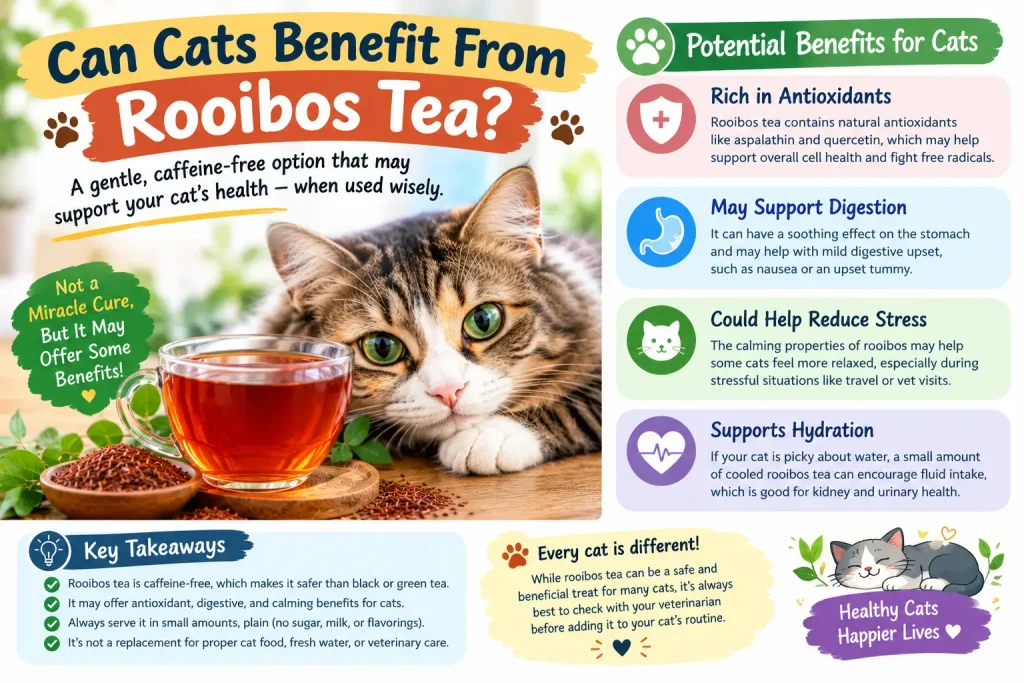
- Antioxidants: Rooibos contains plant compounds such as aspalathin. Having antioxidants in a leaf is not the same as helping a cat’s health.
- Inflammation or relaxation: These claims come from human or lab studies. Nothing shows the same effect in cats.
- Digestion: Some people say rooibos soothes the stomach. No feline research supports this, and an unfamiliar drink may upset a cat’s stomach instead.
- Hydration: Water hydrates cats. Tea adds no proven advantage.
Those are individual opinions, not controlled studies. Even that article advises checking with your veterinarian first. Rooibos is not a treatment, supplement, or replacement for veterinary care.
Also Read : Can Cats Eat Jabuticaba? Benefits, Risks, and Safety Tips
Can Cats Drink Other Types of Tea?
Each tea needs its own assessment. Do not assume that all herbal teas are harmless or that all are toxic.
| Tea type | Key concern | Practical recommendation |
|---|---|---|
| Pure rooibos | No caffeine, but no feline safety studies | Do not offer on purpose; fresh water is better |
| Black tea | Contains caffeine, a known hazard for cats | Do not offer; keep bags and leaves out of reach |
| Green tea | Contains caffeine; decaf versions still vary | Do not offer |
| Chamomile tea | ASPCA lists chamomile plants as toxic to cats, with signs such as vomiting, diarrhea, and allergic reactions. | |
| Peppermint tea | Mint plants and essential oils can be a concern; we did not verify tea-specific data | Avoid unless a vet says otherwise |
| Ginger tea | We found no reliable feline-specific safety data | Uncertain; do not offer |
| Sweetened or flavored tea | Sweeteners, flavorings, or caffeine may be present | Avoid; check the full label |
What Can Cats Drink Instead of Rooibos Tea?
Cats get water from both drinking and food. Good options include:
- Fresh, clean water. This is the best everyday choice.
- A cat water fountain. Some cats drink more from moving water.
- Wet cat food. It is mostly water, so it adds moisture to the diet.
- A little plain water from a pet-food preparation, such as water from a plain, unseasoned pet-safe meal, only if it has no harmful ingredients. Ask your vet if you are unsure.
- Veterinary hydration support when a medical problem calls for it.
Contact a veterinarian if your cat drinks very little, suddenly drinks much more than usual, or seems dehydrated. Signs of dehydration in cats can include tiredness, dry gums, and reduced appetite.
How to Encourage Your Cat to Drink More Water
- Wash and refill bowls daily. Stale water and film turn many cats away.
- Keep water away from litter boxes. Cats often avoid drinking near where they go to the bathroom.
- Try ceramic, glass, or stainless steel. Some cats dislike plastic bowls.
- Offer several water stations around the home.
- Consider wet food if it suits your cat’s diet and your vet agrees.
- Track habits. Notice changes in drinking, urination, or litter box use.
A sudden increase or drop in drinking, or a change in urination, can signal an illness. Book a veterinary visit rather than waiting.
Pure Rooibos vs. Rooibos Blend
The ingredient list changes the risk.
| Product | What it contains | Extra concern |
|---|---|---|
| Pure rooibos | Rooibos leaves only | No feline safety studies |
| Rooibos with black or green tea | Rooibos plus caffeinated tea | Caffeine is a known hazard for cats |
| Flavored rooibos | Fruit, spices, vanilla, or “natural flavors” | Unknown ingredients and possible oils or sweeteners |
| Concentrated rooibos extract | Strong plant compounds, sometimes in supplements | Dose and strength are unclear for cats |
Ingredient Label Checklist
Before calling a vet or poison hotline, look for these on the label:
- Black tea, green tea, matcha, guarana, or yerba mate (caffeine sources)
- Essential oils such as peppermint, citrus, or tea tree
- Sweeteners, including sugar, honey, and sugar substitutes like xylitol
- Flavorings or “natural flavors” (check what they are)
- Extracts, concentrates, or supplement-style ingredients
- Herbs like chamomile, mint, or ginger
Not every item on this list is equally risky, and the label may not tell the full story. Give the vet or hotline the exact list.
Evidence vs. Assumptions
| Common claim | What the evidence establishes | What cat owners should conclude |
|---|---|---|
| Rooibos is caffeine-free | Established for pure rooibos; sources such as AHPA confirm no caffeine | True, but check blends for added caffeine |
| Rooibos contains antioxidants | Established in plant chemistry and human or lab research | Not proof of any benefit to cats |
| Rooibos is safe for cats | No feline-specific studies found | Unproven; do not assume |
| Rooibos improves feline hydration | No evidence | Water and wet food are the proven choices |
Frequently Asked Questions
Can cats drink rooibos tea every day?
We do not recommend it. No feline research shows daily rooibos is safe, and cats do not need it. Fresh water meets their drinking needs.
Is pure rooibos tea caffeine-free?
Yes. Pure rooibos is naturally caffeine-free. Blends that include black tea, green tea, or other caffeine sources are different, so check the label.
Is rooibos tea poisonous to cats?
We found no reliable report that plain rooibos poisons cats. That is not the same as proof it is safe. Added ingredients in some products can be harmful.
What happens if a cat licks rooibos tea?
A small lick of plain, cooled tea is unlikely to cause trouble for most cats. Remove the tea and watch your cat. Call a vet if your cat drank a lot, ate leaves or bags, or seems unwell.
Can kittens drink rooibos tea?
No. Kittens need their mother’s milk or a vet-recommended kitten milk replacer, plus fresh water once they are old enough. Rooibos has no role in a kitten’s diet.
Can cats drink rooibos tea with milk?
It is best to avoid it. Many adult cats have trouble digesting milk and may get diarrhea. Adding milk also does not make the tea safer.
Can cats drink rooibos tea with honey?
Avoid it. Cats do not need added sugar, and sweetened drinks give no benefit. Other sweeteners, such as xylitol, can be more concerning.
Can cats drink flavored rooibos tea?
No, not without a careful label check. Flavorings, essential oils, or added tea leaves can change the risk. When in doubt, skip it.
Is rooibos tea better than water for cats?
No. Water is the proven, simple choice for cat hydration. Rooibos offers no established advantage and may reduce water intake.
What should I do if my cat drinks herbal tea?
Remove the tea and check the ingredient list. Estimate how much your cat drank, and watch for vomiting, diarrhea, tremors, or unusual behavior. Call your vet or a poison hotline if you are worried or the tea contained a risky ingredient.
Final Thoughts
So, can cats drink rooibos tea? Pure rooibos is naturally caffeine-free, but that fact alone does not make it safe for cats. Research on cats is limited, so fresh water remains the best everyday drink.
If your cat sneaks a lap, stay calm. Check the ingredients, think about how much was taken, and call your veterinarian if anything seems off. Keep tea bags and loose leaves out of reach, and reserve the teapot for yourself.