If you are searching for a cat breed with big ears and long face, the Oriental Shorthair is the classic example. Siamese, Sphynx, Peterbald, Cornish Rex and several other breeds share some of these features too. Their ears, head shape, coats and personalities differ a lot, though, and ear size alone cannot tell you a cat’s breed.
This guide compares ten breeds with prominent ears and elongated or wedge-shaped faces. You will also learn what makes a face look long, how to assess your own cat, how kittens change as they grow, and which breed may suit your home.
Which Cat Breeds Have Big Ears and Long Faces?
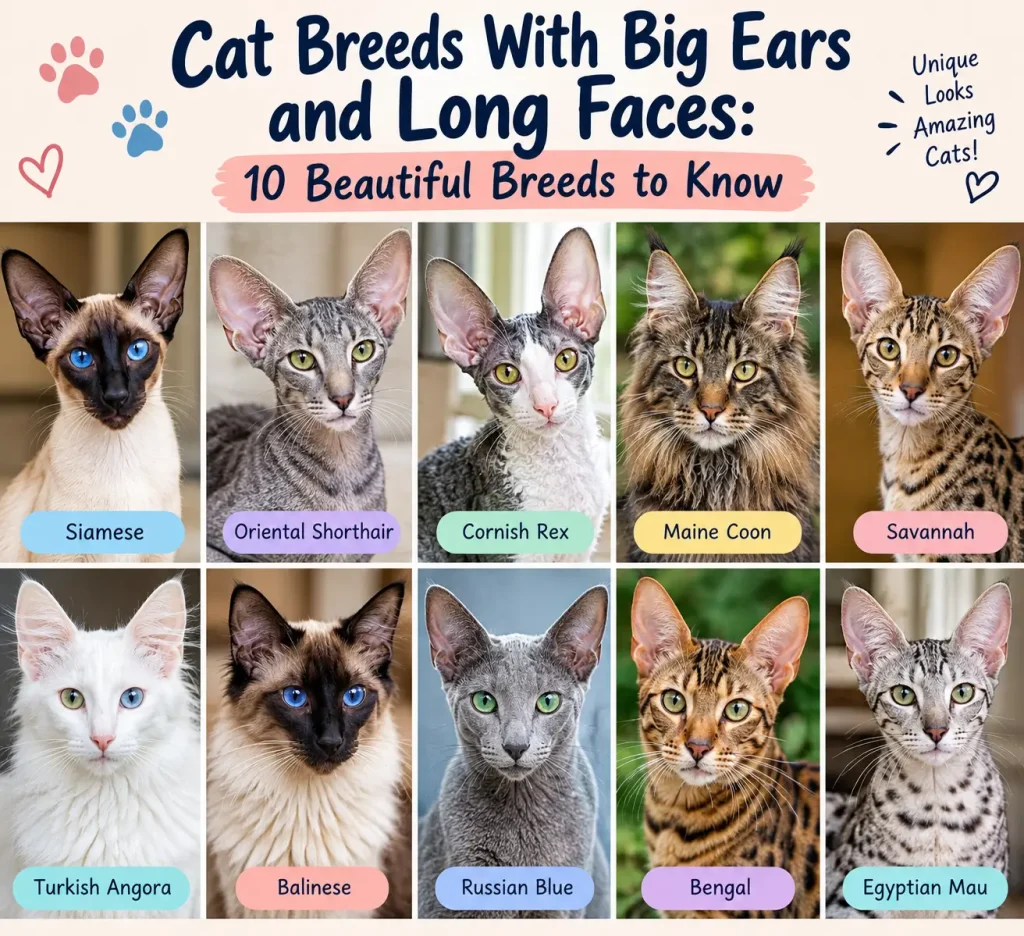
Oriental Shorthair, Siamese, Peterbald, Cornish Rex and Sphynx are the best-known cat breeds with big ears and long, narrow faces. Devon Rex, Savannah, Abyssinian, Egyptian Mau and Donskoy also have prominent ears. Ear size and face length vary by individual cat and by each breed’s standard, so the traits are not equally extreme in every breed.
10 Cat Breeds With Big Ears and Long Faces
1. Oriental Shorthair
The Oriental Shorthair is the breed most people picture. Its ears are very large and wide at the base, and they continue the lines of a long, straight wedge-shaped head. The muzzle is fine, the eyes are almond-shaped, and the body is slim and tubular.
Coat: Short, fine and glossy, in a very wide range of colors and patterns.
Personality and activity: Orientals are commonly described as social, vocal and people-focused. They tend to be energetic, so climbing trees, puzzle feeders and daily play sessions help.
Care and home: Weekly brushing is usually enough. Because they often dislike being alone, they suit homes where someone is around or where a second pet is welcome.
Best for: Owners who want a chatty, interactive companion.
Identification clue: A Siamese-like body and head, but in solid, tabby, bicolor or other non-pointed coats.
2. Sphynx
The Sphynx has very large ears set on a modified wedge head that is slightly longer than it is wide, with prominent cheekbones and big lemon-shaped eyes. With no whiskers-to-coat softness to distract, the ears and bone structure stand out strongly.
Coat: Hairless in appearance, though many have a fine down that feels like warm suede.
Personality and activity: Typically affectionate, curious and attention-seeking. Expect playful, moderately high energy.
Care and home: Skin oils are not absorbed by fur, so many Sphynx need regular bathing. Their ears collect wax faster than hairy ears, so routine checks matter. They need warmth indoors and sun protection near windows. Ask breeders about heart screening, as some lines are screened for heart disease.
Best for: Owners who enjoy hands-on grooming and a cuddly cat.
Identification clue: Wrinkled skin, especially around the head and shoulders, with no visible coat.
3. Devon Rex
The Devon Rex has large, low-set ears that sit wide on the head, giving a pixie-like look. Its face is wedge-shaped with high cheekbones, but the muzzle is short, so it reads more as a triangular face than a long one.
Coat: Short, fine, soft and wavy. It can be sparse in places.
Personality and activity: Often described as mischievous, people-loving and clever with their paws. Many love heights and food puzzles.
Care and home: Brush gently or not at all, since the coat is delicate. Check the ears for wax. Offer warm spots and sturdy perches.
Best for: Owners who want a playful, clingy companion.
Identification clue: Ears set low and wide, with a short muzzle and big eyes.
4. Cornish Rex
The Cornish Rex has a slender body and an egg-shaped head, with a long, straight profile. Its large ears are set high on the head, which stretches the look of the face.
Coat: Very short and wavy, with no guard hairs, so it feels like velvet.
Personality and activity: Typically athletic and playful, often keeping kitten-like energy well into adulthood. Daily active play and climbing space help.
Care and home: Little brushing is needed. Thin coats offer less insulation, so keep the home comfortably warm. Ears and skin should be checked regularly.
Best for: Active households that enjoy games of fetch and chase.
Identification clue: A curved, wavy coat combined with an arched back and a long Roman-type nose.
5. Siamese
Modern show-style Siamese have a long, tapered wedge head, a straight nose and large, wide-based ears that follow the same lines as the head. The eyes are almond-shaped and blue. Traditional or older-type Siamese have rounder heads, so appearance depends on the type you meet.
Coat: Short and fine, with darker color points on the face, ears, legs and tail.
Personality and activity: Known for being talkative, social and attached to their people. They need interaction and mental stimulation.
Care and home: Weekly brushing and routine dental care are enough for most. They can become stressed or noisy if left alone for long hours.
Best for: Owners who like a conversational cat.
Identification clue: Blue eyes and pointed coloring, which Oriental Shorthairs do not share.
6. Peterbald
The Peterbald was developed in Russia by crossing a Donskoy with an Oriental Shorthair. It combines the Oriental’s long head and big ears with a slender, elegant body. The profile is straight, and the muzzle is narrow.
Coat: Highly variable. Peterbalds range from fully hairless to flocked, velour, brush or straight coats, and the coat can change over time.
Personality and activity: Usually social, affectionate and active.
Care and home: Bare or thin-coated cats need skin care, warmth and sun protection. Coated types still need regular ear checks.
Best for: Owners who want an Oriental look with a varied coat.
Identification clue: A kitten’s coat can change, so a single litter may include several coat types.
Also Read : Cat Breeds With Tufted Ears That Look Wild But Love Deeply!
7. Savannah
Savannahs are domestic hybrids with serval ancestry. Their ears are tall, rounded at the tips and set high on a head that looks small compared with the long legs and body. The face is more triangular than narrow.
Coat: Short, spotted and often tawny or silver.
Personality and activity: Typically very active, athletic and curious. They need vertical space, long play sessions and secure enrichment.
Care and home: Grooming is easy, but housing and training needs are higher. Rules about owning early-generation hybrids vary by location, so check local laws before choosing a kitten.
Best for: Experienced, active owners with plenty of space.
Identification clue: Tall legs, a spotted coat and ears set high and close together.
8. Abyssinian
The Abyssinian has moderately large, alert ears with a broad base and a modified wedge head. The face is not extremely long, but the ears and fine bone structure create an elegant, lean look.
Coat: Short and ticked, with each hair banded in several colors.
Personality and activity: Commonly described as lively, curious and busy. Climbing shelves, puzzle toys and daily play suit them.
Care and home: Weekly brushing is plenty. Routine dental care supports long-term health.
Best for: People who enjoy a high-energy, inquisitive cat.
Identification clue: The ticked coat, with no stripes on the body.
9. Egyptian Mau
The Egyptian Mau has medium to large ears with a broad base and slightly pointed tips. The head is a gentle wedge without extremes, and the expression is often described as alert. Its long hind legs give it a distinctive build.
Coat: Short, naturally spotted, with markings on the forehead often compared to a letter M.
Personality and activity: Typically athletic, loyal and fast. Mau fans value interactive play and safe places to run.
Care and home: Little grooming is needed. They may be cautious with strangers, so gradual introductions help.
Best for: Owners who want a spotted, athletic cat with a quieter manner than a Siamese.
Identification clue: Naturally spotted coat and green eyes.
10. Donskoy
The Donskoy, also called the Don Sphynx, is a Russian hairless breed unrelated by gene to the Canadian Sphynx. Its ears are large and set wide, and its head is a moderate wedge with defined cheekbones. Skin wrinkles on the forehead are typical.
Coat: Hairless in several forms, including rubber bald, flocked, velour and brush types.
Personality and activity: Usually friendly and people-oriented, with moderate activity.
Care and home: Like other hairless cats, they need warmth, gentle bathing as advised by a vet, ear checks and sun protection.
Best for: Owners wanting a hairless cat and willing to manage skin care.
Identification clue: Its hairless trait comes from a dominant gene, and wrinkles are common.
Quick Comparison Table
| Cat Breed | Ear Appearance | Face Shape | Coat Type | Activity Level |
|---|---|---|---|---|
| Oriental Shorthair | Very large, broad-based | Long, straight wedge | Short, fine | High |
| Sphynx | Very large | Modified wedge, high cheekbones | Hairless or fine down | Moderate to high |
| Devon Rex | Large, low-set, wide | Short-muzzled triangle | Short, wavy, fine | High |
| Cornish Rex | Large, high-set | Egg-shaped, long profile | Very short, wavy | High |
| Siamese | Large, broad-based | Long tapered wedge | Short, pointed | Moderate to high |
| Peterbald | Large | Long, narrow wedge | Hairless to straight | Moderate to high |
| Savannah | Tall, high-set | Small triangular head | Short, spotted | Very high |
| Abyssinian | Moderately large, alert | Modified wedge | Short, ticked | High |
| Egyptian Mau | Medium to large | Gentle wedge | Short, spotted | High |
| Donskoy | Large, wide-set | Moderate wedge | Hairless varieties | Moderate |
Why Do Some Cats Have Big Ears and Long Faces?
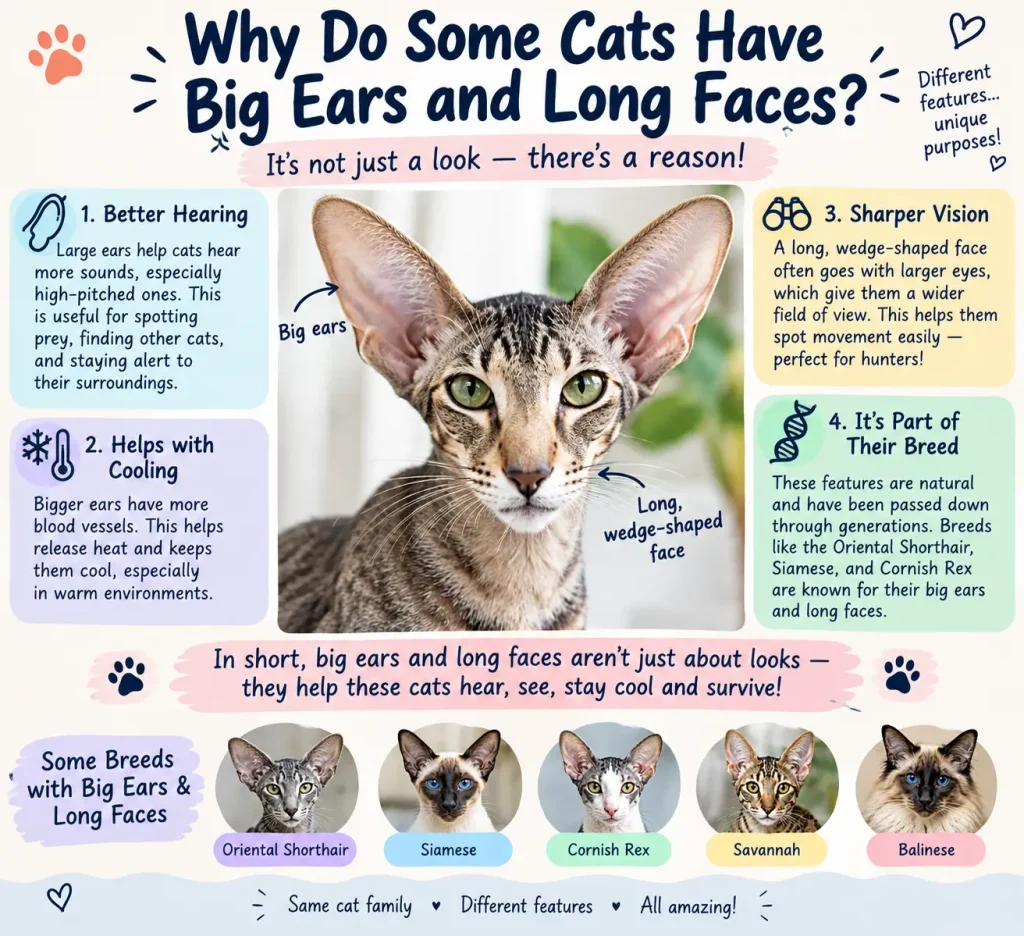
Big ears and long faces often appear together, but they are different traits.
Large ears relative to the head simply means the ear is big compared with the skull. A small head can make normal ears look oversized.
A wedge-shaped head is a triangular outline seen from the front, widening from the nose to the ears. Breed standards describe degrees of this shape, such as modified wedge or long wedge.
A narrow muzzle is the nose and mouth area. A long, narrow muzzle makes the face look longer, while a short one, as in the Devon Rex, does not.
High-set ears sit near the top of the head. They can lengthen the whole face visually, even when the head itself is not especially long.
Genetics, breed standards and individual variation all shape these features. Two cats of the same breed can look noticeably different.
How to Tell If Your Cat Has a Naturally Long Face and Large Ears
Use this checklist while looking at your cat from the front and the side:
- Ear size: Are the ears large compared with the head, or does the head just look small?
- Ear placement: Are they high, low, wide-set or close together?
- Head shape: Does the outline form a wedge, a round shape or an egg?
- Muzzle length: Is the nose long and narrow, or short and blunt?
- Eye shape and placement: Almond, round or lemon-shaped? Close or wide-set?
- Coat: Short, curly, ticked, spotted, hairless or pointed?
- Body proportions: Slim and long, or compact and muscular?
- Age: Is your cat still developing?
- Records: Do you have a pedigree, registration papers or adoption notes?
Read This :Why Is My Cat Walking Low to the Ground? 10 Curious and Surprising Reasons!
A warning: do not use ear size or facial shape to diagnose a health problem. If your cat has pain, swelling, breathing trouble or any sudden change in appearance, see a veterinarian.
Do Kittens With Big Ears Grow Into Long-Faced Cats?
Sometimes, but not always. Kittens often look all ears because the ears grow quickly while the skull and body are still developing. As the head fills out, the ears can look more proportionate. A kitten from a breed with a long wedge head may become more elongated, while a mixed-breed kitten may settle into a rounder face.
Adult appearance is hard to predict from a kitten photo, and shifts continue through the first year or longer. If you are choosing a kitten for its look, meet its parents when possible, ask for pedigree papers, and remember that personality, health and care needs matter more than shape.
Mixed-breed kittens can develop big ears and narrow faces too. A domestic shorthair may show these traits without belonging to any pedigree breed, and many shelter cats look strikingly Oriental.
Do Cats With Big Ears Need Special Care?
Large ears do not automatically mean hearing problems or unusually sensitive hearing. They are usually just part of a cat’s structure. Still, some routines are wise:
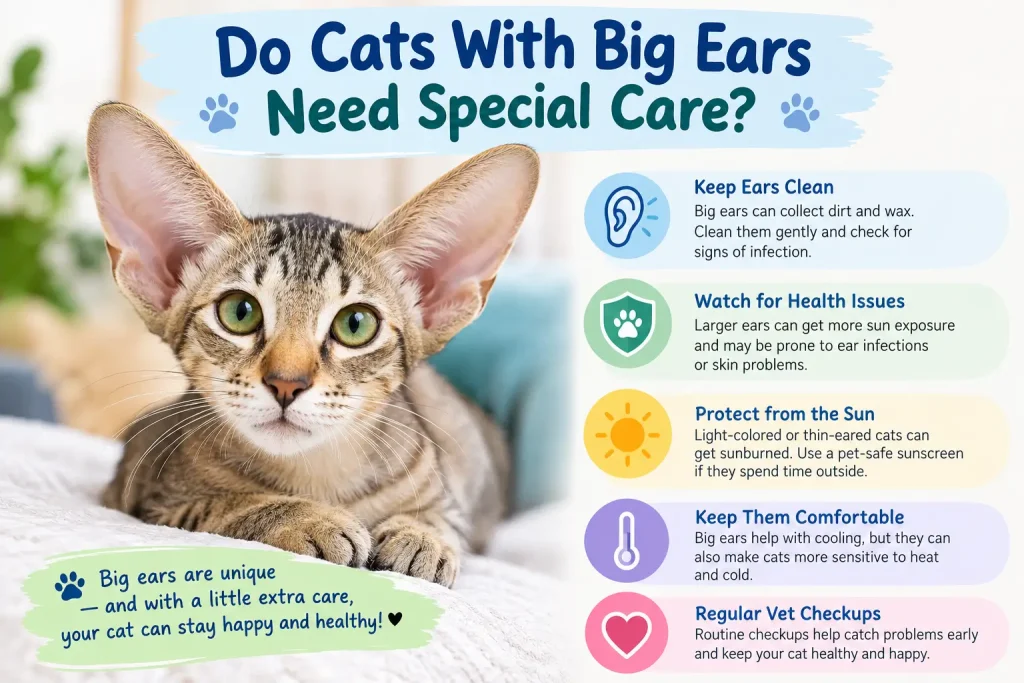
- Check ears weekly. Look for redness, swelling, odor, dark debris or discharge.
- Clean only the visible outer ear, using a veterinarian-approved cleaner on a soft cloth or cotton pad. Never push cotton swabs into the ear canal, and avoid home remedies or unapproved products.
- Protect against temperature extremes. Thin ears can chill, and hairless or thin-coated cats need warmth indoors.
- Provide sun protection. Hairless and lightly coated cats can burn, especially on ear tips. Ask your vet about safe options.
- See a vet for persistent head shaking, scratching, pain or foul odor. These can signal infection or mites, not a breed trait.
Which Big-Eared Cat Breed Is Right for You?
No breed fits every home, and no breed is hypoallergenic. Individual temperament, health and environment matter more than labels.
- First-time owners: Abyssinians, Egyptian Maus and Oriental Shorthairs can suit beginners who enjoy play. Rex and hairless cats ask for extra care.
- Active households: Savannahs, Abyssinians and Cornish Rex love activity, but Savannahs need experience and space.
- Apartment living: Oriental Shorthair, Siamese and Devon Rex adapt well if given vertical space and play time.
- Interactive family companions: Devon Rex, Siamese and Oriental Shorthair seek attention.
- Low-shedding coats: Rex and hairless breeds shed little, but individual cats vary and allergies should be tested before adopting.
- Hairless-cat skin care: Sphynx, Donskoy and hairless Peterbalds need bathing, warmth and sun protection.
- Quieter or more independent cats: Egyptian Maus and some Abyssinians are often less vocal than Siamese, though individuals differ.
Freuently Asked Questions
Which hairless cats have large ears?
Sphynx, Donskoy and hairless Peterbald cats commonly have prominent ears, which stand out more without a coat.
Can a domestic shorthair have a long face and big ears?
Yes. Domestic shorthairs are mixed-breed cats, and some develop large ears and narrow faces without any pedigree.
Do kittens’ ears look bigger as they grow?
Usually they look larger on kittens. Ears grow fast early, and as the head and body mature, proportions often even out.
Are cats with big ears more sensitive to cold?
Not because of the ears alone. Coat type matters more, since hairless and thin-coated cats lose heat quickly and need warmth.
How can I identify my cat’s breed?
Check pedigree or adoption records and compare head shape, coat, body and ears. Photos are unreliable, so ask a veterinarian or breed organization if it matters.
Are big-eared cats suitable for apartment living?
Many are, if given climbing space and daily play. High-energy breeds like Savannahs need more room than most apartments offer.
Key Takeaways
- Several breeds have prominent ears and elongated facial features.
- Oriental Shorthair and related breeds like Siamese and Peterbald are useful comparison points.
- Ear size and face shape vary among individual cats, even within a breed.
- Coat care, activity, temperament and health needs matter when choosing a cat.
- Appearance alone cannot confirm a cat’s breed or health.
Final Thoughts
A cat breed with big ears and long face can be striking, but the look is only the start. Oriental Shorthairs, Siamese, Sphynx and the rest share similar silhouettes while differing in coat, energy and care. Look past appearance to personality, grooming, health and how well a cat fits your routine. Whether you choose a pedigree or a shelter cat with a wedge-shaped face and satellite-dish ears, a good match is the one that suits your lifestyle.
15 Cat Breeds That Don’t Shed-Your Perfect Pet!
Kitten And Puppy At The Same Time: A Journey Of Love And Play!