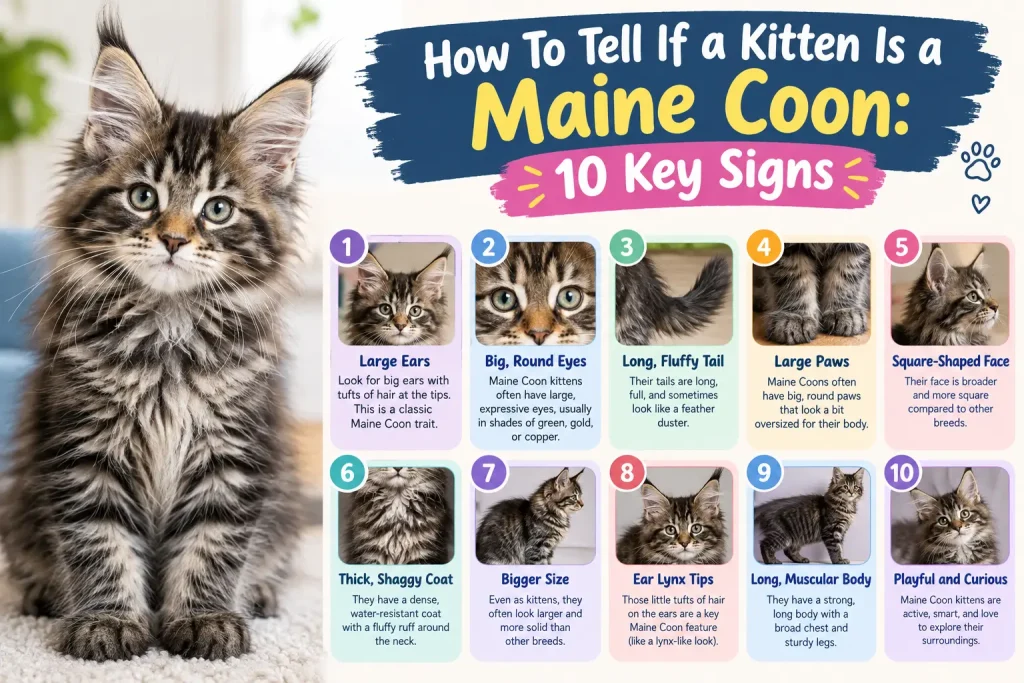
Have you adopted a fluffy kitten with large paws, a bushy tail, and unusual ear tufts? You might wonder whether your new companion is a Maine Coon. Learning how to tell if a kitten is a Maine Coon starts with examining its ears, coat, paws, tail, facial features, and body shape.
Maine Coons are known for their large frames, long coats, and friendly personalities. However, many domestic long-haired cats share these characteristics. A kitten may look like a Maine Coon without being a purebred member of the breed.
Wondering how to tell if a kitten is a Maine Coon? Look for large, wide-set ears, ear tufts, a fluffy uneven coat, a long bushy tail, big paws, and a body that grows long and rectangular. But young kittens rarely show every adult trait, and many other cats share these features. Appearance alone cannot confirm a purebred Maine Coon.
This guide covers the clues worth watching for, when they show up, where each one falls short, and how to check a kitten’s background properly.
How To Tell If a Kitten Is a Maine Coon
Check several traits together: large tufted ears, a long bushy tail, large paws, a shaggy medium-to-long coat, and a sturdy rectangular frame as the kitten grows. Then confirm with background evidence, such as parent information, breeder records, and pedigree papers. Looks are clues. Documentation is evidence.
10 Signs Your Kitten Might Be a Maine Coon
Breed standards from the Cat Fanciers’ Association (CFA) and the International Cat Association (TICA) describe adult Maine Coons. A kitten is still growing into these traits, so treat each one as a hint.
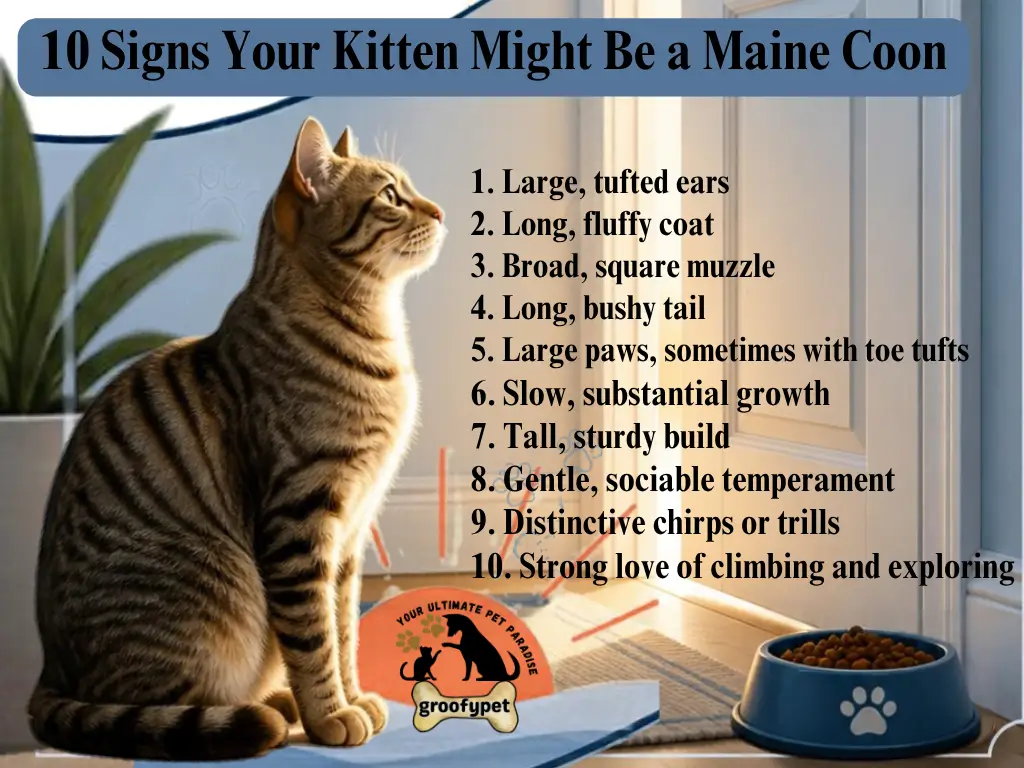
1. Large Ears With Tufts
What to look for: Large ears set high and well apart, wide at the base and tapering toward the tip. Tufts of fur may grow inside the ears and from the tips. Tufts at the tips are often called lynx tips.
When it shows: Ear size is often visible in the first weeks. Tufts usually become fuller as the coat grows in.
Limitation: Tufts vary from cat to cat, and other long-haired cats can have them. Some Maine Coons have only modest tufting.
2. Big Paws and Strong Legs
What to look for: Rounded, substantial paws, sometimes with toe tufts (fur between the toes), on sturdy legs.
When it shows: Many kittens look “all paws” by two to three months.
Limitation: Big paws on a kitten do not predict adult size, and they do not establish breed. Many kittens have oversized paws for their bodies.
3. A Fluffy, Uneven Coat
What to look for: A medium-to-long coat with a soft undercoat and longer outer guard hairs. The standard describes fur that is shorter on the shoulders and longer on the belly and rear, with a ruff (a fuller “mane”) around the neck and chest.
When it shows: Kitten fur is often fuzzier and finer than adult fur. The adult coat and ruff usually take months to develop.
Limitation: Coat texture varies, and domestic long-haired cats can have thick, uneven coats too.
4. A Long, Bushy Tail
What to look for: A long tail, wide at the base and tapering, with full, flowing fur. The standard calls for a tail at least as long as the body.
When it shows: A kitten’s tail can look thin or rat-like at first. Fullness often builds as the coat matures.
Limitation: A fluffy tail is common in many long-haired cats and proves nothing alone.
5. A Rectangular Body Shape
What to look for: A long, muscular, broad-chested body that looks rectangular from the side.
When it shows: This is hard to judge in very young kittens, who look compact and rounded. It becomes clearer after the first several months.
Limitation: Body shape depends on age, weight, and coat. A fluffy kitten can look bigger or smaller than it is.
6. A Square-Looking Muzzle
What to look for: The breed standard describes a muzzle that looks squared off, with a fairly pronounced chin when viewed from the front or side.
When it shows: Facial structure changes a lot with growth, so this is often easier to see in older kittens.
Limitation: Not every Maine Coon kitten has an obvious square face, and some non-Maine Coons do.
7. Wide-Set Eyes and Facial Features
What to look for: Large, slightly slanted eyes set well apart, with a medium-width head that is a bit longer than it is wide. Eye colors in the standard include green, gold, green-gold, and copper, with blue or odd eyes allowed in white cats.
When it shows: All kittens start with blue eyes, and the final eye color settles over the first few months.
Limitation: Eye color and spacing overlap widely with other cats. Neither can confirm breed.
8. Slow Physical Maturation
What to look for: Steady growth that continues well past the first year. Maine Coons are generally described as slow-maturing, often reaching full development at around three to five years.
When it shows: Only over time, which is why monitoring beats guessing.
Limitation: Growth speed is not a breed test. Diet, genetics, and health all affect how fast a kitten grows.
9. Curious and Social Behavior
What to look for: Curiosity, playfulness, and an interest in following people around. Many owners describe Maine Coons as friendly and people-oriented.
When it shows: Personality develops with age, and early kitten socialization has a big influence.
Limitation: Personality varies within every breed and is not proof of ancestry. A shy or independent kitten could still be a Maine Coon, and a friendly one could be anything.
10. A Variety of Coat Colors and Patterns
What to look for: Maine Coons come in many colors and patterns. Brown tabby is the classic image, but solids, bicolors, and others occur.
When it shows: Color and pattern are usually visible early, though some shades change as kittens age.
Limitation: No single color, pattern, or eye color proves a kitten is a Maine Coon.
The Three-Feature Rule of Observation
Instead of fixating on one trait, watch for three together, such as ear shape, tail development, and body structure. If all three point the same way over time, that is a stronger clue than any one feature. This is a practical habit, not a scientifically validated test.
What Does a Maine Coon Kitten Look Like at Different Ages?
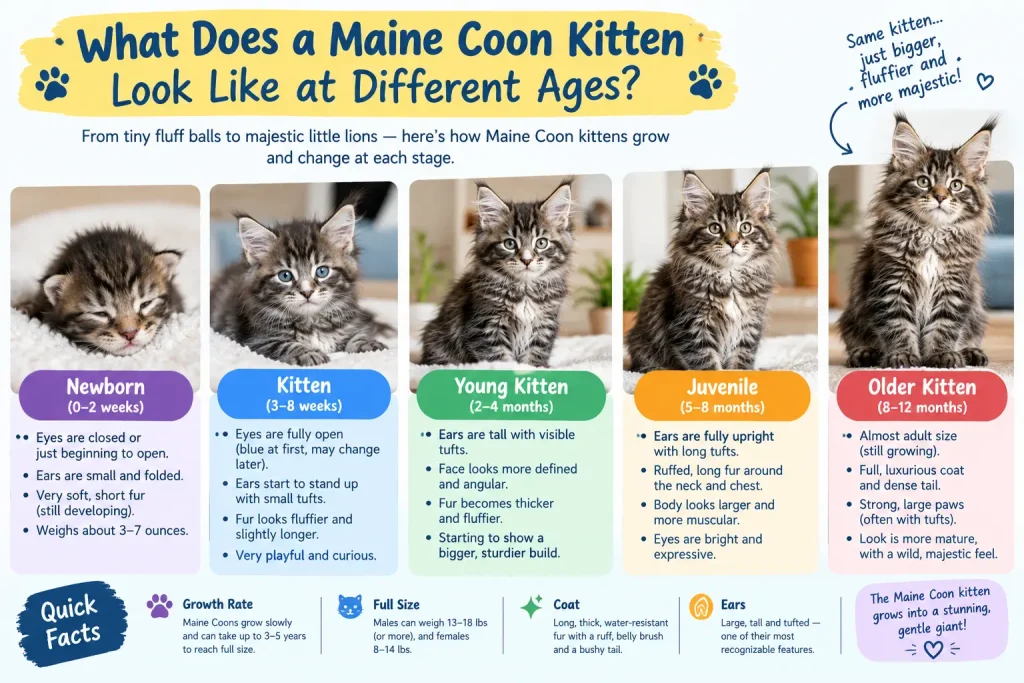
Use these ages as loose guides, not milestones for identification.
| Kitten Age | Features You May Notice | Identification Limitations |
|---|---|---|
| 0–4 weeks | Small body, developing coat, early ear and face shape | Too young for dependable breed identification by appearance |
| 5–8 weeks | Increasing activity, visible ear shape, developing coat | Most adult breed characteristics are not fully developed |
| 2–3 months | More noticeable paws, tail, and coat texture | Domestic long-haired kittens can look similar |
| 4–6 months | Coat and body proportions become easier to assess | Growth and appearance still vary considerably |
| 7–12 months | Some kittens show a more substantial frame and fuller coat | Adult size and coat development may still be incomplete |
| 1–3 years | More mature body proportions and coat characteristics | Appearance still cannot confirm purebred ancestry |
Maine Coon Kitten vs. Regular Domestic Long-Haired Kitten
Domestic long-haired cats are not a breed. The term describes any mixed-breed cat with a long coat, and they can share many Maine Coon traits. Use this table to see where differences may appear, not to make a final call.
| Feature | Maine Coon Kitten (breed-standard tendencies) | Domestic Long-Haired Kitten (varies widely) |
|---|---|---|
| Ears and tufts | Large, set high and wide, often tufted | Ear size varies; tufts possible but less consistent |
| Paws and legs | Large paws, sturdy legs, possible toe tufts | Paws and legs vary; some kittens have big paws |
| Tail | Long, tapering, bushy as it matures | Length and fullness vary |
| Coat and neck ruff | Shaggy, uneven coat with a developing ruff | Coat texture and ruff vary |
| Body shape | Long, muscular, rectangular with age | Ranges from slender to stocky |
| Growth | Often slow, with development lasting years | Often matures sooner, though not always |
| Personality | Often curious and people-oriented, but varies | Varies widely |
| Documentation | Pedigree and registration possible | Usually no pedigree papers |
The Look-Alike Warning
Fluffy tails, big paws, and ear tufts all show up in mixed-breed kittens. A kitten can look very much like a Maine Coon and still be a domestic long-haired cat or a Maine Coon mix. Many shelter cats are labeled “Maine Coon” because of appearance alone, so treat that label as a guess.
Also Read : 15 Cat Breeds That Don’t Shed-Your Perfect Pet!
How to Tell If Your Kitten Is a Purebred Maine Coon or a Mix
There are three common situations:
- Purebred Maine Coon: Both parents are Maine Coons, usually with documented ancestry.
- Maine Coon mix: One parent, or an ancestor, was a Maine Coon and another breed or a domestic cat is also in the family.
- Domestic long-haired cat with a similar look: No Maine Coon ancestry, just similar features.
The Breed Evidence Ladder
- Appearance: Gives clues but is inconclusive.
- Family history and documentation: Parent information and breeder records give stronger evidence of ancestry.
- Pedigree records from an appropriate registry: Registries such as CFA or TICA provide the clearest documentation of recognized purebred status, when the cat is registered.
Practical ways to verify
- Ask the breeder or rescue organization what background information they have.
- Review legitimate pedigree or registration documents when available.
- Ask whether the parents have documented breed ancestry.
- Consult a reputable breeder or knowledgeable feline professional.
- Consider a cat DNA test only as extra information.
DNA tests differ in their databases and abilities. A result that suggests Maine Coon ancestry does not establish recognized purebred status, and not every cat can be registered.
Can You Tell If a Kitten Is a Maine Coon From Its Face?
Partly. Large, wide-set ears with tufts, a squared muzzle, a defined chin, full cheeks, and a head slightly longer than wide can all point toward a Maine Coon kitten face. But other long-haired breeds and mixed cats share these features, so the face gives clues, not answers.
Why Kitten Faces Can Be Misleading
A kitten’s face is small and rounded. The muzzle lengthens, the cheeks fill out, and the ears seem to grow into place as the cat matures. A face that looks round at ten weeks may look quite different at ten months. Judging breed from a young kitten’s face is guesswork.
Common Myths About Identifying Maine Coon Kittens
- Myth: Every Maine Coon kitten has ear tufts. Tufting varies, and some kittens have little at first.
- Myth: Big paws guarantee a giant adult cat. Large paws are common in growing kittens of every kind, and adult size depends on genetics, nutrition, and health.
- Myth: A fluffy tail proves Maine Coon ancestry. Many long-haired cats have bushy tails.
- Myth: Friendly or vocal behavior identifies the breed. Personality varies from cat to cat, and early socialization shapes it.
- Myth: A kitten that looks like a Maine Coon must be purebred. Lookalikes are common. Only background records can support purebred status.
A Simple Maine Coon Kitten Identification Checklist
Use this at home as an observation tool, not a diagnostic test. There is no score, and no number of checked boxes confirms the breed.
- Relatively large ears
- Tufts around the ears or between the toes
- A long, increasingly bushy tail
- A developing medium-to-long coat
- Large paws and a sturdy frame
- A rectangular body shape as the kitten grows
- A substantial muzzle
- Available parentage or pedigree records
What Should You Do If You Think Your Kitten Is a Maine Coon?
- Take clear photos of the face, ears, paws, full body, and tail.
- Record the kitten’s age and approximate weight.
- Revisit the kitten’s appearance as it grows instead of relying on one photo.
- Ask the breeder, shelter, or rescue organization about its background.
- Schedule routine veterinary exams to monitor healthy growth.
- Brush a longer coat gently, and introduce grooming gradually so the kitten stays comfortable.
- Never overfeed a kitten to encourage a larger adult size.
A veterinarian can assess health and development but cannot confirm pedigree from appearance alone.
Health Comes Before Breed Size
Normal growth varies between kittens. Instead of comparing yours with breed-size charts, focus on appropriate kitten nutrition, routine veterinary care, and a healthy body condition. A well-grown, healthy kitten matters more than a “big” one.
Must Read : Should I Get Two Kittens or One? The Heartfelt Decision!
Frequently Asked Questions
How can I tell if my kitten is a Maine Coon?
Look for several traits together: large tufted ears, a long bushy tail, big paws, a shaggy coat, and a long rectangular frame as it grows. Then check records such as parent information, breeder documents, or a pedigree. Appearance gives clues, but only documentation supports a firm answer.
What age can you identify a Maine Coon kitten?
There is no age when looks alone become reliable. Features are easier to assess from around four to six months, and more so after a year. Even then, appearance cannot prove purebred ancestry. Documentation matters at every age.
Do all Maine Coon kittens have ear tufts?
No. Tufting varies between individuals and often becomes fuller with age. Some Maine Coons have only light tufts, and many other long-haired cats have them too. Tufts are a helpful hint but not a requirement or a guarantee.
Can a Maine Coon kitten have short hair?
Maine Coons are a long-haired breed, though kittens often look fluffy rather than long-coated. A truly short-haired kitten is more likely a domestic shorthair or a mix. If the parents’ coats and background are unknown, a vet or breeder can help you interpret what you see.
How big are Maine Coon kittens at three months?
They are often noticeably sturdy, but size varies with genetics, sex, and nutrition. Instead of chasing a chart, ask your vet whether your kitten’s weight and growth are healthy for its age. Healthy development matters more than matching a number.
Final Thoughts
The best clues for a Maine Coon kitten are large tufted ears, a bushy tail, big paws, a shaggy coat, and a long rectangular build that develops with age. Kittens change dramatically as they grow, and many other cats share these features, so no single trait settles the question.
Combine what you observe with reliable background information, such as breeder records, parent details, and pedigree papers. Keep taking photos, keep an eye on healthy growth, and ask your breeder, rescue, or vet for guidance as your kitten develops.