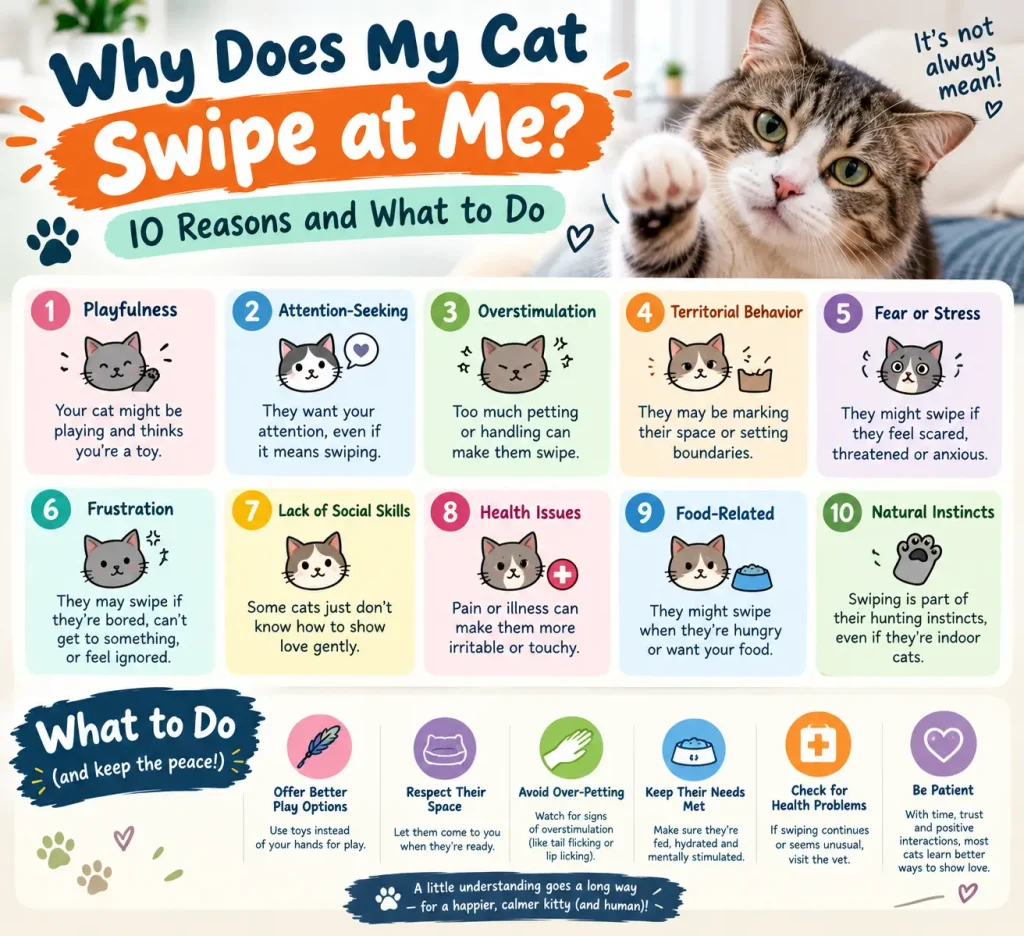
If you are wondering, “Why does my cat swipe at me?“”,” the answer is not always aggression. Cats may swipe because they are playing, overstimulated, frightened, stressed, irritated, protecting something, or simply telling you they need space.
For example, your cat may happily enjoy being petted for several minutes before suddenly turning toward your hand and giving it a quick swipe. It can feel like the behavior came out of nowhere. However, your cat may have already been showing small warning signs that it had enough.
Understanding those signals can help you prevent future swatting and build a better relationship with your cat.
Why Does My Cat Swipe at Me?
A cat swipe is often a form of communication. Your cat may be saying, “Stop,” “Give me space,” “I am scared,” or “Let’s play.” The meaning depends heavily on what happened immediately before the swipe.
A relaxed cat batting at a toy is very different from a frightened cat crouching with flattened ears. Likewise, a cat that swipes after several minutes of petting may be experiencing overstimulation rather than true aggression.
The best way to understand why my cat swipes at me is to look at the entire situation, including your cat’s body language, surroundings, and behavior before and after the swipe.
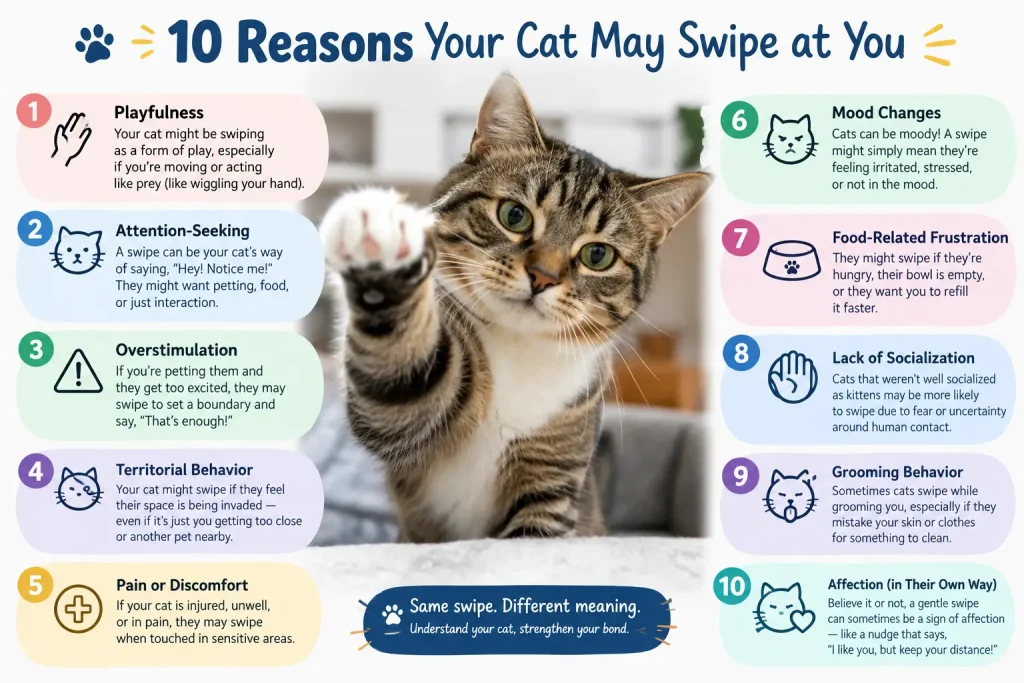
10 Reasons Your Cat May Swipe at You
1. Your Cat Is Playing
Play is one of the most common reasons for a cat swatting at you, especially in kittens and young cats. Cats naturally practice hunting behaviors through play. Stalking, chasing, pouncing, batting, and grabbing are all part of their normal behavioral repertoire.
A kitten may hide behind a chair, wait for your feet to pass, and suddenly jump out and swipe at your ankle. It may then run away and return a few seconds later.This type of playful cat swatting usually comes with a relatively relaxed body. Your cat may look excited rather than frightened or tense.
The problem starts when cats learn that human hands and feet are toys. Using a wand toy or another interactive toy gives your cat an appropriate outlet for that hunting instinct.
2. Your Cat Has Had Enough Petting
If your cat swipes when you pet him or her, overstimulation could be the reason. A cat may enjoy petting initially but eventually reach its individual touch tolerance. Repeated stroking can become uncomfortable or simply too stimulating.
Before the swipe, you might notice the tail flicking, skin twitching, ears changing position, or your cat suddenly becoming still.Your cat may also turn its head toward your hand.These signals are easy to miss because the cat may have been purring only moments earlier.
If you notice these changes, stop petting and give your cat a chance to move away. Respecting that signal can prevent the interaction from escalating.
3. Your Cat Wants You to Stop
Sometimes the answer to why my cat swipes at me is straightforward: your cat wants the interaction to end. Your cat may not want to be picked up, moved, hugged, groomed, or touched at that moment. A swipe can be a boundary-setting behavior. It does not necessarily mean your cat is angry with you.
Think about what happened immediately before the swipe. Did you reach for your cat while it was sleeping? Did you try to move it from a chair? Did you continue touching it after it moved away? Giving your cat an opportunity to leave can prevent a stronger reaction.
4. Your Cat Feels Afraid
Fear can cause defensive swatting. A frightened cat may swipe because it wants something scary to move away. Common triggers include loud noises, unfamiliar people, sudden movements, strange objects, or being cornered. You may see your cat crouching low, pulling its ears backward, widening its eyes, or attempting to escape.
This is defensive behavior rather than an invitation to interact. If your cat is frightened, avoid reaching toward it or forcing physical contact. Give it an escape route and allow it to settle down. Trying to grab a scared cat can increase its fear and make scratching or biting more likely.
5. Your Cat Is Stressed
Stress can change a cat’s behavior. A cat that normally enjoys handling may become more reactive when something in its environment changes. Moving to a new home, bringing home another pet, having frequent visitors, or dealing with construction noise can all affect a cat’s comfort. Even changes that seem minor to humans may matter to cats because they often prefer predictable surroundings.
Signs a cat is stressed can include hiding more than usual, changes in appetite, increased vocalization, reduced interaction, changes in grooming, or increased reactivity. If your cat is suddenly swatting more often, consider what has changed around it.
6. Your Cat Is Protecting Its Territory
Cats can be strongly attached to their territory. A favorite sleeping spot, window, room, food area, or hiding place may become something your cat wants to protect. Territorial behavior can become especially noticeable when another cat appears nearby.
For instance, your cat may see an unfamiliar cat outside the window and become tense. If you approach immediately afterward, your cat may swipe at you. In this situation, the other cat may have been the original trigger.Your cat’s reaction is connected to the emotional state created by the territorial encounter.
7. Your Cat Is Redirecting Aggression
Redirected aggression can be confusing because the person receiving the swipe may have done nothing wrong.Imagine your cat sitting near a window when it notices another cat outside. Your cat becomes highly aroused and watches the animal intensely. A few minutes later, the outside cat disappears.
You walk over and reach down to pet your cat. Your cat suddenly swipes at your hand. The other cat was the original trigger, but your cat’s emotional response remained. Your approach happened at the wrong moment. If your cat appears highly aroused after seeing another animal, give it time and space before attempting to handle it.
8. Your Cat Is Protecting Something Valuable
Some cats become defensive around resources they value. This might include food, treats, toys, a favorite sleeping location, kittens, or a private hiding space. A cat that normally enjoys being touched may react differently when someone reaches toward its food bowl.
Pay attention to what your cat is guarding. If swatting repeatedly occurs around one particular resource, avoid forcing interaction in that situation. Instead, manage the environment so your cat does not feel it needs to defend that resource.
9. Your Cat May Be in Pain
A sudden change in behavior deserves attention. Cats are good at hiding discomfort, so pain is not always obvious. A cat that suddenly becomes defensive when touched may be reacting to something physically uncomfortable. For example, your cat may previously have enjoyed being picked up but suddenly begins swatting whenever you touch a particular part of its body.
Other changes can include hiding, limping, reduced appetite, unusual vocalization, reduced activity, reluctance to jump, or changes in litter box habits.This does not mean every swatting cat is sick. But if the behavior is new, persistent, or linked to handling, a veterinarian can help determine whether an underlying medical problem is involved.
10. Your Cat Has Learned That Swiping Gets a Reaction
Cats learn from what happens after their behavior. Suppose your cat swipes at your hand and you immediately move away. From your cat’s perspective, the behavior worked. It created distance. That does not mean your cat is deliberately manipulating you.
The behavior may simply have become effective. This is why punishment is usually not the best approach. Instead, look for opportunities to reward calm behavior and respond to early body-language signals before your cat feels the need to swipe.
How to Tell If Your Cat Is Playing or Being Aggressive
A swipe by itself does not tell you everything. Look at the whole body and the situation.
| Behavior | Likely Meaning | What You May Notice |
|---|---|---|
| Playful swatting | Play or hunting practice | Loose body, stalking, pouncing, quick retreat |
| Defensive swatting | Fear or need for distance | Crouching, ears back, wide eyes, hissing |
| Irritated swatting | Wants interaction to stop | Tail flicking, skin twitching, head turning |
| Aggressive swatting | High arousal or conflict | Stiff body, staring, growling, repeated strikes |
| Pain-related swatting | Possible discomfort | Sudden change, touch sensitivity, avoidance |
Cat Body Language Before a Swipe
Cats often communicate before they swipe.
Learning cat body language can make a major difference.
Watch for:
- flattened or backward ears
- rapid tail flicking
- stiff posture
- crouching
- dilated pupils
- skin twitching
- staring
- growling
- hissing
- sudden head movement toward your hand
- freezing
- trying to walk away
Not every cat displays every signal.Your cat may have its own subtle warning signs. Some cats become very still before reacting. Others flick their tail or repeatedly look toward the person’s hand. The more familiar you become with your cat’s individual signals, the easier it becomes to stop an interaction before a swipe happens.
Why Does My Cat Swipe at Me When I Pet Her?
If you are asking, why does my cat swipe at me when I pet her? Overstimulation is one possible explanation. Your cat may enjoy petting but have a limited tolerance for repeated touching. Some cats also have clear preferences about where they like to be touched.
Many cats enjoy gentle contact around the cheeks, chin, and head. Others dislike having their belly, paws, tail, or certain areas of their back touched. Never assume that a cat who enjoys petting in one location will enjoy it everywhere.
Watch what your cat does during the interaction. If the tail begins moving sharply, the body becomes tense, or the cat turns toward your hand, take a break.
Also Read : Why Do Cats Flop Down in Front of You? 9 Reasons Explained
Why Does My Cat Swipe at Me but Not Other People?
It can be confusing when your cat swats at you but behaves calmly around guests.One reason is that you probably interact with your cat more than other people do.You may feed it, pick it up, groom it, move it, trim its nails, give medication, or pet it more frequently.
Your cat may also associate you with activities it does not particularly enjoy.Differences in scent, movement, voice, or handling style can matter too.It does not mean your cat hates you. In fact, a familiar cat may simply feel comfortable enough to communicate its boundaries directly with you.
Why Does My Cat Swipe at Me When I Walk Past?
If your cat attacks your feet or swipes at your legs as you walk past, play or hunting behavior may be involved.Moving feet can look like an exciting target to a cat.This is especially common in energetic kittens and young cats. Your cat may hide behind furniture and wait for the perfect moment to pounce.
Give your cat regular interactive play with appropriate toys. Wand toys can help provide an outlet for chasing and stalking without teaching the cat that human ankles are toys.If the swatting is accompanied by hissing, flattened ears, or a stiff defensive posture, fear or irritation may be more likely.
How to Stop Your Cat From Swiping at You
1. Learn Your Cat’s Warning Signals
Watch what happens before the swipe. Your cat may have a predictable pattern.
2. Stop Petting Before Overstimulation
Do not wait for the swipe. If your cat starts showing warning signs, pause the interaction.
3. Never Hit or Punish Your Cat
Physical punishment can increase fear and make defensive behavior worse. It does not teach your cat what you want it to do instead.
4. Use Toys Instead of Your Hands
Wand toys, balls, and other interactive toys can satisfy your cat’s need to chase and bat without encouraging attacks on hands.
5. Give Your Cat Space
If your cat is hiding, frightened, or highly aroused, allow it to calm down.
6. Avoid Cornering or Grabbing
A cat that cannot escape may feel forced to defend itself.
7. Provide Safe Resting Areas
Hiding places, elevated resting spots, and quiet areas can help cats feel more secure.
8. Keep a Predictable Routine
Regular feeding, play, and rest periods can make the environment easier for some cats to handle.
9. Identify Environmental Triggers
Keep track of when the swatting occurs. You may discover a pattern involving another animal, a particular room, touching, food, or noise.
10. Reward Calm Behavior
Give attention, treats, or play when your cat behaves calmly in situations that previously caused tension.The goal is not simply to stop the swipe. The goal is to reduce the reason your cat feels the need to use it.
Must Read : Why Does My Cat Hug My Arm? 10 Vet Reviewed Reasons Explained!
What Not to Do When Your Cat Swipes
- Do not hit, yell at, chase, or grab your cat after it swats.
- Do not grab its paws or force more petting.
- Do not corner it to “teach it a lesson.”
- Punishment may increase fear and stress. A frightened cat can become more defensive rather than less.
- Instead, stop the interaction, give your cat space, and think about what triggered the response.
- If the behavior is happening repeatedly, work on the trigger rather than focusing only on the final swipe.
When Should You Worry About Your Cat Swiping?
A sudden behavior change deserves more attention than a long-standing habit with an obvious trigger.Contact your veterinarian if your cat suddenly becomes aggressive without an obvious reason or reacts strongly when a particular area is touched.
Other warning signs include:
- hiding much more than usual
- reduced appetite
- limping
- vocalizing unusually
- reluctance to jump
- changes in litter box habits
- unusual tiredness
- avoiding physical contact
- sudden changes in grooming
- repeated unexplained aggression
Pain and illness can sometimes affect behavior. That is why a sudden change should not automatically be treated as a training problem.
A veterinarian can help rule out physical causes and guide you toward appropriate behavioral support if needed.
Frequently Asked Questions
Why does my cat swipe at me but not bite?
A cat may swipe without biting because the swipe is enough to communicate a boundary. Your cat may be telling you to stop touching, move away, or give it space. If the cat is relaxed and playful, the swipe may also be part of play. Look at the cat’s ears, tail, posture, and behavior before and after the swipe.
Why does my cat swipe at me when I walk past?
Your cat may swipe at your legs because moving feet trigger playful or hunting behavior. This is particularly common in young cats. If your cat crouches, waits, pounces, and runs away, play may be involved. If it hisses, flattens its ears, or looks frightened, the behavior may instead be defensive.
Why does my cat swipe at me when I pet her?
Your cat may be overstimulated or may dislike being touched in that particular area. Watch for tail flicking, skin twitching, tense muscles, ear changes, or your cat turning toward your hand. Stop petting when these signals appear. Some cats enjoy brief petting but become uncomfortable with prolonged or repetitive contact.
Why does my cat suddenly start swatting at me?
Sudden swatting can result from stress, fear, environmental changes, conflict with another animal, overstimulation, or pain. Think about what changed before the behavior began. If the change is unexplained, persistent, or accompanied by other unusual symptoms, contact your veterinarian to rule out a physical problem.
Is my cat angry when she swipes at me?
Not necessarily. A swipe can communicate many things, including play, fear, irritation, overstimulation, or a desire for space. Looking only at the paw movement can be misleading. Pay attention to the cat’s body posture, ears, tail, eyes, sounds, and what happened immediately before the swipe.
Should I punish my cat for swatting?
No. Hitting, yelling, or physically punishing a cat can increase fear and stress. It may also make the cat more defensive around people. Instead, stop the interaction, give the cat space, identify the trigger, and reward calm behavior. Humane, reward-based approaches are more useful for changing unwanted behavior.
How can I stop my cat from swatting at my hands?
Avoid using your hands as toys and switch to interactive toys such as wand toys. During petting, stop before your cat becomes overstimulated. Learn your cat’s warning signals and respect them. If swatting is sudden or unusually intense, consider having your cat checked by a veterinarian.
Does swatting always mean cat aggression?
No. Swatting does not always mean aggression. Cats may swipe during play, when they are overstimulated, when they are frightened, or when they want an interaction to end. The surrounding body language and situation help determine the likely reason. Repeated or sudden aggressive behavior should receive closer attention.
Why does my cat swipe at my legs?
Moving legs can trigger a cat’s hunting or play response. Your cat may be practicing stalking and pouncing behavior. Regular interactive play can provide a safer outlet. However, if your cat appears frightened or defensive while swatting your legs, the behavior may have a different cause.
Why does my cat swipe at me and then run away?
Swiping and running away can mean your cat wanted distance rather than a fight. A frightened, irritated, or overstimulated cat may use a quick swipe to create space and then retreat. A playful cat may also swipe and run as part of a game. Look at the cat’s body language to understand the difference.
Key Takeaways
- A cat swipe does not automatically mean aggression.
- Swatting is often a form of feline communication.
- Playful and defensive swatting usually have different body-language clues.
- Overstimulation is a common reason cats swipe during petting.
- Learning your cat’s warning signals can prevent many swats.
- Physical punishment should never be used to correct the behavior.
- Sudden or unexplained changes in aggression deserve veterinary attention.
Final Thoughts
If you keep asking, why does my cat swipe at me, start by looking at what happened immediately before the swipe.Was your cat being petted for a long time? Did you reach toward its food? Was another animal nearby? Did something frighten it? Were you playing with your hands? Or did the behavior appear suddenly without any obvious trigger?
Those details can tell you much more than the swipe itself.Your cat is not necessarily being mean, spiteful, or trying to hurt you. In many cases, it is communicating a limit or reacting to something in its environment.
Give your cat appropriate ways to play, respect its personal space, learn its body language, and avoid punishment. When you understand the reason behind the behavior instead of focusing only on stopping it, living with your cat becomes much easier.
And if the swatting is sudden, severe, or connected with signs of pain or illness, a veterinary check is the safest next step.
Why Is My Cat So Jumpy? A Caring Guide To Help Your Nervous Cat Feel Safe!