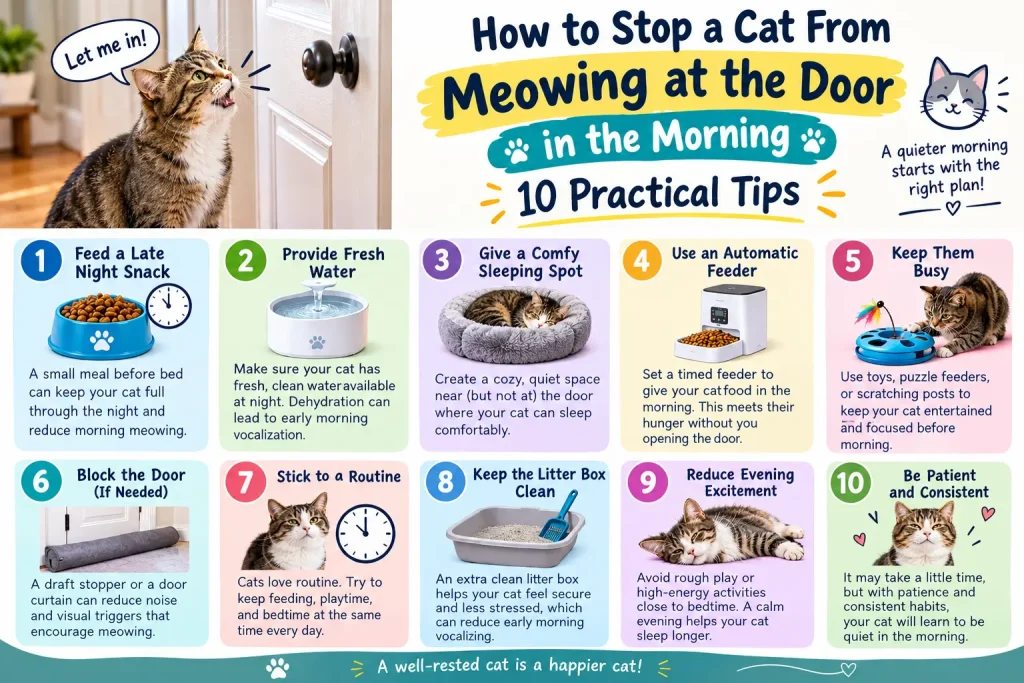
How to stop cat from meowing at door in morning? If your cat meows at your bedroom door every morning, you are not alone. Many cats become active around dawn and quickly learn that meowing can get a response from their owners.
The best way to stop a cat from meowing at the door in the morning is to first understand why it is happening. Hunger, attention, boredom, outdoor activity, access to another room, and learned habits can all play a role. A consistent feeding schedule, evening play, enrichment, and rewarding quiet behavior can often help.
However, if your cat suddenly becomes much more vocal or seems distressed, a health problem should also be considered.
How Do I Stop My Cat From Meowing at the Door in the Morning?
To reduce morning meowing, identify the reason behind the behavior, avoid rewarding repeated vocalization, keep feeding times consistent, provide evening play and enrichment, and reward your cat when it is calm. An automatic feeder can also help when hunger or breakfast anticipation is causing your cat to wake you.
Why Does My Cat Meow at the Door in the Morning?
Morning meowing does not always mean your cat is being difficult. Cats use vocalization to communicate, and the reason can be different from one cat to another.
Understanding what happens immediately before and after the meowing can give you useful clues.
Hunger and Breakfast Expectations
Food is one of the most common reasons cats become active early in the morning.If your cat normally eats shortly after you wake up, it may begin anticipating breakfast before you are ready to get out of bed. Over time, your cat may learn that meowing at the door brings breakfast closer.
This can create a simple pattern:
Meow → owner gets up → breakfast arrives.
If this happens every morning, your cat has little reason to change the behavior.
Natural Dawn Activity
Cats are generally crepuscular, which means they tend to be more active around dawn and dusk. Your cat may naturally become alert as the house starts getting lighter. Outdoor sounds, birds, other animals, sunlight, or household movement can also increase activity. This normal biological rhythm can become more noticeable if your cat sleeps for much of the night.
Attention Seeking
Some cats simply want their person. Your cat may meow because it wants petting, play, conversation, or access to the bedroom. If you regularly respond by opening the door or talking to your cat, the behavior can become learned. Even negative attention, such as shouting, may sometimes encourage the behavior because your cat still receives a response.
Learned Behavior
Cats are excellent at noticing patterns. If your cat discovers that meowing eventually makes you open the door, the behavior may become stronger. This is a form of behavioral reinforcement.
For example, imagine that your cat meows for ten minutes and you finally get up and open the door. Your cat may learn that persistence works. This is why consistency matters when changing morning behavior.
Your Cat Wants Access
The door itself may be the problem. Your cat may want to enter the bedroom, reach another family member, investigate another room, or access a favorite sleeping area. If food, water, the litter box, or another important resource is behind the door, the meowing may be a genuine request rather than simple attention seeking.
Boredom and Excess Energy
A cat that does not receive enough physical activity or mental stimulation during the day may become restless early in the morning. This is especially common in young, active cats. Interactive toys, climbing areas, scratching posts, puzzle feeders, and evening play can provide useful enrichment.
Wanting to Go Outside
If your cat normally goes outdoors, early morning activity can be very exciting. Birds, insects, other cats, people, and other outdoor sounds may encourage your cat to vocalize near the door or window. If outdoor access is not part of your cat’s routine, do not start opening the door simply because it is meowing. Otherwise, your response may reinforce the behavior.
Stress or Changes in Routine
Cats often prefer predictable routines. Moving furniture, changing feeding times, bringing home another pet, changing work schedules, or other household changes can affect a cat’s behavior. If morning meowing began after a major change, look at the entire environment rather than focusing only on the bedroom door.
Also Read : Cat Crying When Pooping A Painful Sign Every Pet Owner Knows!
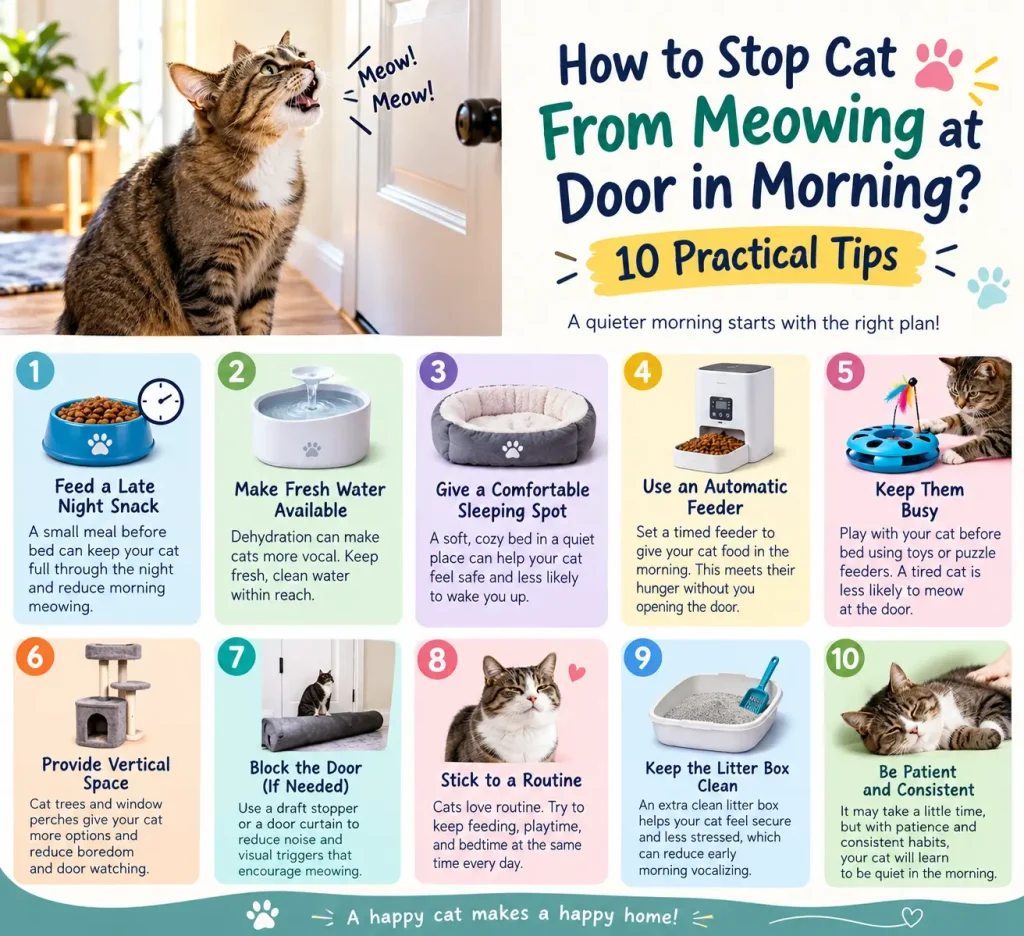
How to Stop a Cat From Meowing at the Door in the Morning
Once you have identified the likely trigger, start changing the routine gradually and consistently.
1. Find Out Why Your Cat Is Meowing
Before trying to stop the noise, observe your cat.
Ask yourself:
- What time does the meowing begin?
- Does your cat run toward the food bowl?
- Does it scratch the door?
- Does it stop when you speak?
- Does it want to go outside?
- Does it seem restless?
- Does it calm down after eating?
- Is anything unusual happening around the house?
These clues can help you understand the behavior.
2. Stop Accidentally Rewarding the Meowing
If your cat meows and you immediately open the door, feed it, or provide attention, your cat may connect the behavior with a reward. When basic needs have already been met, try not to respond immediately to demanding vocalization. Instead, wait for a brief period of quiet before providing attention or access when appropriate.
Do not yell at your cat. The goal is to teach a different pattern, not frighten it.
3. Use an Automatic Feeder
An automatic feeder can be especially useful for cats that wake their owners because they expect breakfast.
Instead of learning:
“When I wake my human, I get food.”
Your cat can begin learning that breakfast comes from the feeder at a predictable time. Place the feeder in a suitable location away from the bedroom when practical. This can reduce the connection between your waking up and your cat’s breakfast.
4. Keep a Consistent Feeding Schedule
Cats often respond well to predictable routines.Feed your cat according to a schedule that fits its nutritional needs and your veterinarian’s advice. Avoid moving breakfast earlier every time your cat starts meowing.Otherwise, the cat may learn that louder or earlier vocalization makes food arrive sooner.
5. Give Your Cat an Evening Play Session
Interactive play before bedtime can help provide both physical activity and mental stimulation.
Try using:
- Wand toys
- Chase toys
- Interactive toys
- Puzzle feeders
- Food-dispensing toys
- Short hunting-style games
Allow your cat to stalk, chase, and catch the toy during appropriate play.A calm period after play can then become part of the bedtime routine.
6. Provide Overnight Enrichment
Your cat does not need to sleep through the entire night simply because you do. Give it safe ways to stay occupied. A scratching post, cat tree, window perch, puzzle feeder, or suitable independent toy can provide enrichment. Avoid leaving toys with loose strings, small detachable parts, or other potential hazards unattended.
7. Reward Quiet Behavior
One of the most useful changes is learning to reward the behavior you want. If your cat becomes quiet and relaxed, provide attention or another appropriate reward when practical. This teaches your cat that calm behavior can also produce positive results. You are not simply trying to make the cat stop making noise. You are teaching it what behavior works better.
8. Keep the Bedroom Door Routine Consistent
Consistency is extremely important. If you ignore the meowing on Monday but open the door after five minutes on Tuesday, your cat may keep trying because persistence sometimes works. Everyone in the household should follow the same basic routine. Changing the response from day to day can make behavior modification much harder.
9. Reduce Morning Triggers
Look around the room for things that make your cat more active. If birds or outdoor cats are visible through the window, closing the curtains during the early morning may help. If sunlight wakes your cat, room-darkening curtains may make the sleeping environment more comfortable. The goal is not to eliminate normal cat behavior. It is to reduce unnecessary stimulation during the hours when you need to sleep.
10. Never Punish Your Cat
Do not hit, kick, spray, scare, or yell at your cat for meowing. Punishment can increase fear and stress without teaching your cat what you actually want it to do. Reward-based training, environmental changes, and a predictable routine are better approaches.
Read This : when do kittens balls drop? simple signs that show your kitten is healthy!
What If My Cat Meows and Scratches at the Door?
Some cats combine vocalization with scratching when they want access to a room. The scratching may come from frustration, attention seeking, curiosity, or a desire to get through the door. Place an appropriate scratching post or scratching pad in a suitable location and reward its use.
If the bedroom door is becoming damaged, focus on changing the reason for the behavior rather than simply stopping the scratching. For example, if boredom is the trigger, increasing evening play may be more useful than repeatedly telling the cat to stop.
Should I Ignore My Cat When It Meows in the Morning?
Ignoring attention-seeking meowing can sometimes help, but it should not be your only strategy. First make sure your cat has its basic needs met. It should have appropriate access to food, fresh water, a clean litter box, a comfortable environment, and any necessary medication or care.
You should also consider whether the vocalization sounds normal for your cat. A sudden distressed cry is different from a familiar demand for breakfast. If the behavior is new, unusually intense, or accompanied by other changes, contact a veterinarian instead of simply ignoring it.
How Long Does It Take to Stop Morning Meowing?
There is no fixed timeline. A cat that has only recently developed the habit may adjust fairly quickly. A cat that has been rewarded for morning meowing for months may take longer. You may also notice that the meowing briefly becomes more persistent when the old reward disappears. This can happen when a previously successful behavior suddenly stops working.
The most important thing is consistency.Do not expect your cat to understand the new routine after one morning. Continue rewarding calm behavior and avoid accidentally rewarding persistent vocalization.
What Should I Do the Night Before?
Your nighttime routine can make a big difference.
Before bed, consider this simple checklist:
- Have an interactive play session.
- Provide the normal evening meal.
- Refresh the water.
- Clean the litter box.
- Set up safe enrichment.
- Make the sleeping area comfortable.
- Check that the cat has access to its important resources.
- Keep the bedtime routine predictable.
The purpose is not to exhaust your cat completely. It is to give it appropriate physical activity, mental stimulation, and a predictable transition toward nighttime.
When Morning Meowing May Be a Medical Problem
Not every change in vocalization is behavioral.A cat that suddenly starts meowing much more than usual may be experiencing pain, discomfort, anxiety, or another health problem.Medical conditions can sometimes affect appetite, thirst, sleep patterns, activity, and vocalization.
Potential concerns can include:
- Pain or discomfort
- Hyperthyroidism
- Cognitive changes
- Kidney disease
- Urinary problems
- Increased hunger
- Increased thirst
- Hearing changes
- Vision changes
- Anxiety
You should be especially careful with a senior cat that develops a new vocalization pattern.Contact your veterinarian if the meowing is sudden, unusually loud, persistent, or accompanied by changes in eating, drinking, urination, weight, mobility, sleep, or general behavior.
Do not assume that an older cat is simply becoming “needy.” A veterinary examination can help rule out medical causes.
Why Older Cats May Meow More in the Morning
Senior cats can experience changes that affect their daily routines.Changes in hearing or vision may make familiar surroundings feel different. Cognitive changes can also affect sleep and wake patterns.An older cat may become vocal because it feels confused, uncomfortable, hungry, anxious, or unable to locate something.
If your senior cat suddenly begins calling at the bedroom door every morning, look for other changes as well.Has it started wandering at night? Is it eating or drinking differently? Is it using the litter box normally? Does it seem confused?These details can help your veterinarian understand what may be happening.
A Simple 7-Day Plan to Reduce Morning Meowing
A structured routine can make the process easier.
| Day | What to Do |
|---|---|
| Day 1 | Observe when and why your cat starts meowing. |
| Day 2 | Establish a consistent feeding schedule. |
| Day 3 | Add an evening interactive play session. |
| Day 4 | Improve overnight enrichment and comfort. |
| Day 5 | Stop rewarding demanding meowing when basic needs are met. |
| Day 6 | Reward calm and quiet behavior. |
| Day 7 | Review the pattern and adjust the routine if needed. |
This is a starting plan, not a guarantee that every cat will become quiet within seven days.Some cats need more time, especially when the behavior has been reinforced for a long period.
Common Mistakes That Make Morning Meowing Worse
One of the biggest mistakes is feeding a cat immediately after it begins meowing.
Another is opening the bedroom door after several minutes of noise. From the cat’s perspective, the lesson may be that continued meowing eventually works.
Other common mistakes include:
- Yelling at the cat
- Changing the rules every morning
- Providing too little enrichment
- Moving breakfast earlier whenever the cat complains
- Giving attention only after loud vocalization
- Ignoring sudden changes in behavior
- Expecting overnight results
A calm and predictable response usually works better than reacting differently every time.
Frequently Asked Questions
Why does my cat meow at my bedroom door every morning?
Your cat may be hungry, seeking attention, wanting access to the bedroom, bored, responding to dawn activity, or following a learned routine. Watch what your cat does immediately before and after meowing to identify the likely trigger.
How do I stop my cat from waking me up at 5 AM?
Create a consistent bedtime routine, provide evening play and enrichment, avoid rewarding demanding meowing, and consider an automatic feeder if breakfast is the main motivation.
Should I feed my cat when it meows in the morning?
Avoid making meowing the signal that immediately starts breakfast. A consistent feeding schedule or automatic feeder can help separate food from your response to the vocalization.
Will ignoring my cat make the morning meowing stop?
Ignoring attention-seeking behavior can help, but first make sure your cat’s basic needs are met. Sudden or distressed vocalization should not automatically be ignored.
Why does my cat meow at the door but stop when I get up?
Your cat may have learned that getting you out of bed produces attention, food, or access. If this happens regularly, your response can unintentionally reinforce the behavior.
Why does my cat scratch the bedroom door and meow?
The cat may want access, attention, stimulation, or outdoor activity. Scratching can also occur when the cat becomes frustrated by the closed door.
Will an automatic feeder stop early morning meowing?
It can help when hunger or meal anticipation is the main trigger. The feeder changes the association between your waking up and breakfast.
Why does my cat wake me up even when it has food?
Food may not be the reason. Your cat could want attention, play, access to another room, outdoor stimulation, or social interaction. Boredom and learned behavior are also possible.
Why has my older cat suddenly started meowing in the morning?
A sudden increase in vocalization in an older cat can have behavioral or medical causes. Pain, cognitive changes, sensory changes, thyroid problems, and other health concerns should be considered with your veterinarian.
How can I keep my cat entertained while I am sleeping?
Provide safe enrichment such as a scratching post, cat tree, suitable independent toys, or a puzzle feeder. Make sure anything left unattended is safe for your particular cat.
Final Thoughts
How to stop cat from meowing at door in morning?Morning meowing can be frustrating, especially when it happens at the same time every day and keeps interrupting your sleep. But the behavior usually has a reason.Start by watching your cat closely. If breakfast is the trigger, adjust the feeding routine or try an automatic feeder. If boredom is involved, add evening play and enrichment. If your cat wants attention, avoid rewarding persistent meowing and give attention when it is calm instead.
Most importantly, stay consistent. Opening the door after ten minutes of meowing can teach your cat that persistence works.And remember that a sudden change in vocalization is different from an established morning habit. If your cat becomes unusually vocal or shows other changes in appetite, thirst, weight, litter box use, sleep, or behavior, speak with your veterinarian.
Tonight, focus on play, enrichment, food, water, and a predictable bedtime routine. Tomorrow morning, reward calm behavior rather than persistent meowing. With patience and consistency, many cats can learn a quieter morning routine.
Why Do Cats Bite When Grooming? Shocking Truth!
Why Does My Cat Hug My Arm? 10 Vet Reviewed Reasons Explained!