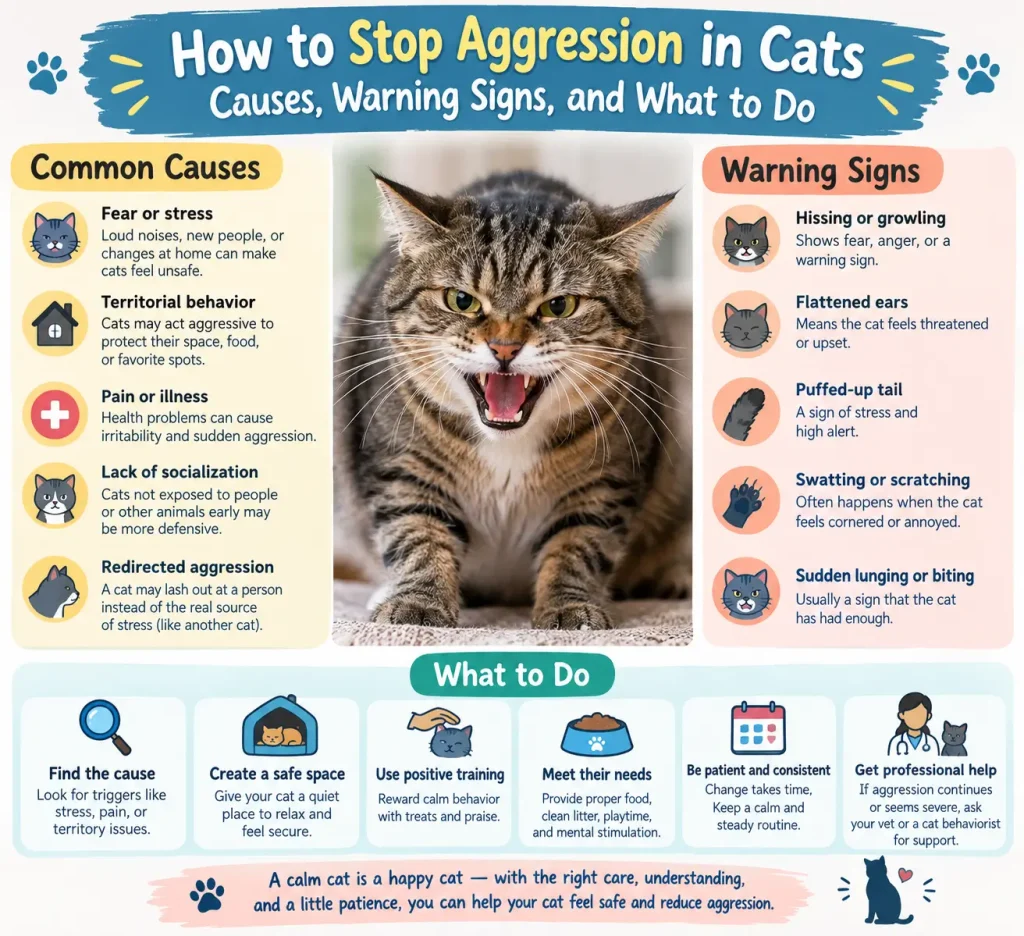
Learning how to stop aggression in cats starts with finding out why the cat is reacting aggressively in the first place. Fear, pain, stress, territorial conflict, frustration, overstimulation, play, and redirected arousal can all lead to hissing, swatting, scratching, biting, or chasing.
A friendly cat can also become aggressive suddenly. For example, a cat that normally enjoys being touched may hiss and swat when someone reaches toward its back. That change should not simply be treated as bad behavior. There may be a trigger, or even a medical problem, behind it.
The safest approach is to understand the behavior, prevent injuries, remove triggers when possible, and use reward-based behavior modification rather than punishment. Veterinary sources also recommend ruling out medical causes, particularly when aggression appears suddenly.
How to Stop Aggression in Cats
The best way to stop aggression in cats is to identify the trigger, prevent repeated confrontations, give the cat enough space, meet its normal behavioral needs, and reward calm responses. There is no single solution for every aggressive cat. A kitten attacking ankles because it wants to play needs a different approach from an older cat that suddenly bites when its back is touched.
Start by asking what happened immediately before the aggressive behavior. Was another cat nearby? Was your cat being touched? Did someone try to pick it up? Was there a loud noise? Was food involved? Did anything change in the home?
Those details can reveal the motivation behind the aggression.
Why Do Cats Become Aggressive?
Cat aggression is not one single behavior. It can range from subtle warning signals to biting and scratching. Much feline aggression is designed to increase distance from something the cat considers threatening or uncomfortable.
Common causes include:
- Fear
- Pain
- Stress
- Frustration
- Territorial behavior
- Redirected aggression
- Play or predatory behavior
- Petting-induced aggression
- Resource guarding
- Conflict with another cat
- Overstimulation
Early experiences can also influence behavior. Poor socialization, inadequate early handling, or frightening experiences may make some cats more likely to react defensively later in life.
The important thing is to look at the motivation rather than labeling the cat as simply aggressive.
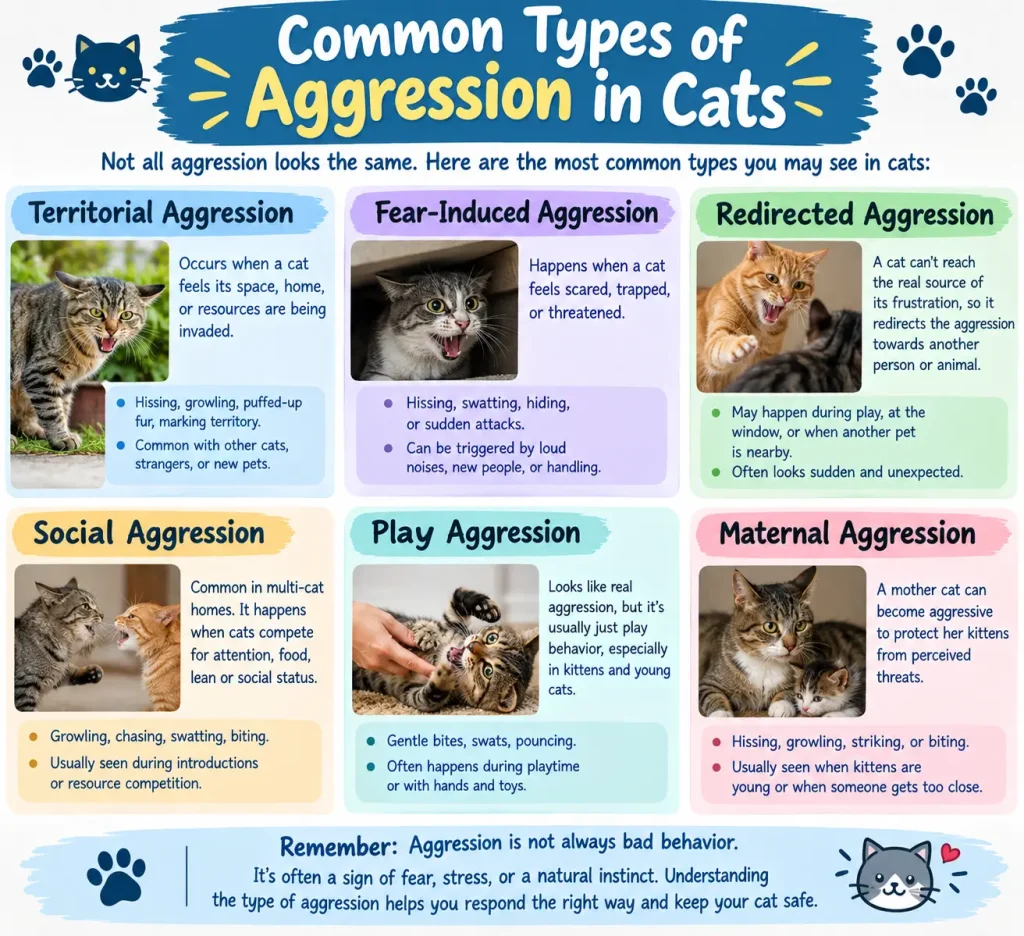
8 Common Types of Aggression in Cats
1. Fear Aggression
Fear is one of the most important causes of defensive aggression. A frightened cat may hiss, growl, swat, scratch, or bite when it believes it cannot safely escape. You may notice a crouched posture, flattened ears, tucked tail, dilated pupils, or fur standing on end.
A new person, unfamiliar animal, loud noise, carrier, or unpleasant experience can trigger this response. If your cat is frightened, do not corner it or force contact. Give it an escape route and enough distance to calm down. The goal is to make the cat feel safer, not to prove that you are in control.
2. Territorial Aggression
Cats naturally care about their living space. Territorial aggression can occur when a new cat enters the home, an unfamiliar animal appears outside, or even when a familiar cat returns after being away. A cat may defend rooms, resting spots, windows, food areas, or other locations it considers important.
This type of aggression can involve staring, blocking access, chasing, swatting, or attacking.If two cats are fighting over territory, simply putting them together and expecting them to work things out can make the problem worse. Separation followed by gradual reintroduction is usually safer.
3. Redirected Aggression
Redirected aggression can be especially confusing for cat owners. Imagine your cat sees an unfamiliar cat through the window. It becomes highly aroused but cannot reach the animal outside. A few minutes later, you walk over and try to touch your cat.
Your cat suddenly attacks you. You were not the original trigger. The outside cat was. The emotional arousal simply remained after the original stimulus disappeared. Other possible triggers include loud noises, unfamiliar animal scents, or conflict with another cat in the home. If your cat is highly aroused after seeing another animal, give it space rather than approaching it immediately.
4. Play Aggression
Play aggression is common in kittens and young cats. A playful cat may stalk, chase, pounce, swat, grab, or bite. You might see your kitten hiding behind a sofa before jumping at your ankles as you walk past. This behavior becomes a problem when the cat learns that human hands and feet are appropriate targets.
Use interactive toys instead. Wand toys can allow a cat to chase and pounce while keeping your hands away from its teeth and claws. Regular play also gives energetic cats an appropriate outlet for their natural hunting behavior.
5. Petting-Induced Aggression
Some cats enjoy being petted but have a limited tolerance for physical contact. Your cat may begin by purring and leaning into your hand. After several minutes, it may start flicking its tail, shifting its ears, twitching its skin, or turning its head toward your hand. Then comes the bite or swipe.
This is sometimes called petting-induced aggression. Overstimulation may be involved, although individual cats differ greatly in how much handling they enjoy. The solution is to stop before the cat reaches that point. Learn your cat’s early warning signs and end the interaction while it is still calm.
6. Pain-Related Aggression
Pain can make even a gentle cat defensive. A cat with discomfort may react aggressively when someone tries to touch, lift, groom, or move it. A cat that suddenly becomes sensitive around one part of its body deserves particular attention. Medical problems associated with aggression can include painful conditions such as arthritis, dental disease, and injuries.
Other illnesses can also affect behavior. If your cat becomes aggressive suddenly or its behavior changes without an obvious reason, arrange a veterinary examination rather than assuming it is a training issue.
7. Maternal or Protective Aggression
A mother cat may become defensive while caring for young kittens. She may hiss, growl, swat, or attempt to drive people or other animals away. Give a nursing mother a quiet, low-stress area and avoid unnecessary handling of her or the kittens when she appears tense.
This behavior often decreases as kittens become older and more independent.
8. Resource-Related Aggression
Some cats become defensive around things they value.
These may include:
- Food
- Treats
- Toys
- Favorite sleeping areas
- Hiding places
- Kittens
- Preferred territory
Resource competition can become particularly problematic in multi-cat homes.
Providing separate resources can reduce competition and give cats opportunities to avoid each other. Food, water, litter boxes, resting areas, and hiding spots should not all be concentrated in one location.
How to Read Cat Body Language Before an Attack
Cats often provide warning signals before they become fully aggressive.
Learning feline body language can help you recognize when to stop an interaction.
| Body Language | Possible Meaning | What to Do |
|---|---|---|
| Flattened ears | Fear or high arousal | Stop approaching |
| Dilated pupils | Fear or excitement | Give space |
| Tail lashing | Irritation or arousal | End interaction |
| Crouched body | Defensive fear | Provide an escape |
| Arched back | Defensive display | Do not corner the cat |
| Hissing or growling | Clear warning | Increase distance |
| Stiff body | High tension | Stop handling |
| Raised fur | Strong arousal | Avoid interaction |
The same signal can have different meanings depending on the situation. Look at the entire body rather than focusing on one feature.
Also Read : Why Do Cats Bite When Grooming? Shocking Truth!
How to Calm an Aggressive Cat
When a cat becomes aggressive, your first priority should be safety.
- Stop the interaction. If you were petting or handling the cat, stop.
- Create distance. Allow the cat to move away instead of following it.
- Provide an escape route. A frightened cat can become more defensive if it feels trapped.
- Keep your movements calm. Do not chase, yell, or wave your hands at the cat.
- Do not physically restrain an aroused cat. Trying to grab an aggressive cat can result in serious scratches or bites.
- Separate fighting cats safely. Use a physical barrier instead of putting your hands between them. Cats involved in fights should be separated and allowed to calm down before any reintroduction process begins.
A cat may need considerable time to return to a calm emotional state. Do not assume that it is ready for petting just because it has stopped hissing.
How to Stop Aggression in Cats Long-Term
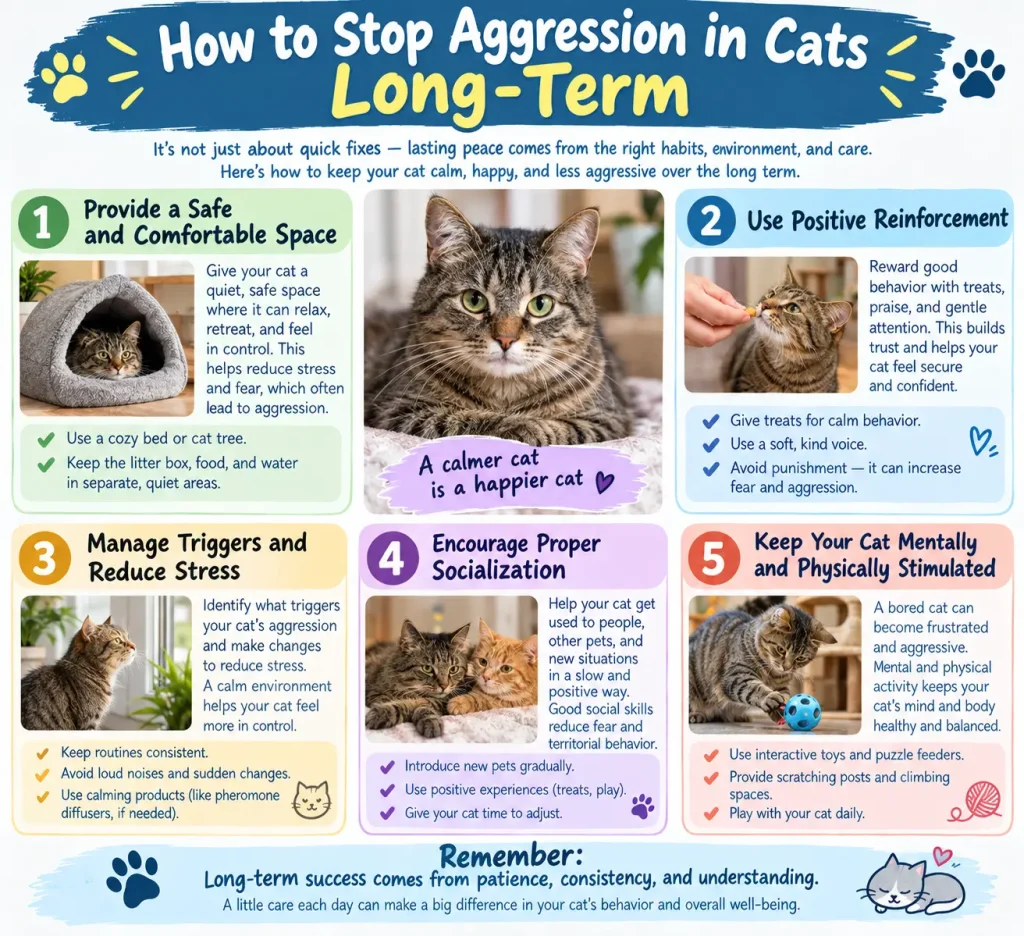
1. Identify the Trigger
Keep a simple aggression diary.
Write down:
- What happened before the incident
- Where it occurred
- Who was nearby
- Which animals were present
- Whether food or toys were involved
- Whether your cat was touched
- What sounds or sights were present
- What your cat did afterward
Patterns often become clearer after several incidents.
2. Prevent Repeated Incidents
Prevention is an important part of behavior modification. If your cat repeatedly becomes aggressive when another cat enters a particular room, avoid putting the cats together until you have a safer plan. Environmental management can include distance, visual barriers, physical barriers, and temporary separation.
Preventing another incident also gives the cat fewer opportunities to practice the aggressive response.
3. Meet Normal Feline Needs
Cats need more than food and a litter box.
A healthy environment should allow opportunities for:
- Hunting-like activity
- Playing
- Scratching
- Climbing
- Perching
- Exploring
- Hiding
- Resting
- Eating and drinking
Providing these outlets can make the home more comfortable and reduce some sources of frustration.
4. Improve the Home Environment
Consider adding:
- Cat trees
- Elevated perches
- Scratching posts
- Hiding boxes
- Quiet resting areas
- Interactive toys
- Puzzle feeders
Vertical space can be particularly useful in multi-cat homes because cats can spread out instead of constantly passing through the same areas.Giving cats enough space and resources can reduce competition and allow them to avoid each other.
5. Use Interactive Play
Give your cat appropriate ways to stalk, chase, and pounce.A wand toy can imitate prey movement and keep your hands safely away from the action.Rotate toys occasionally so the cat does not lose interest.Avoid rough games involving your fingers or toes. A kitten that learns to attack moving hands may continue that habit as an adult.
6. Reward Calm Behavior
Positive reinforcement teaches the cat that calm behavior produces something valuable.For example, if your cat notices another cat from a distance but remains relaxed, reward that calm response with a treat or favorite activity.The reward should happen while the desired behavior is occurring.Over time, the goal is to build a positive association with situations that previously created tension.
7. Keep a Predictable Routine
Cats often benefit from predictable feeding, play, and rest periods.A consistent routine can also help you identify unusual behavior. If your cat normally eats, plays, and sleeps at predictable times, changes may become easier to notice.
8. Use Desensitization and Counterconditioning
These techniques can help change a cat’s emotional response to a trigger.Desensitization means exposing the cat to a trigger at a level it can tolerate rather than overwhelming it.Counterconditioning means pairing the trigger with something positive, such as a favorite treat or play activity.
For example, if two cats become tense when they see each other, you might begin with enough distance or a barrier that allows both cats to remain calm. Positive experiences can then gradually be associated with the presence of the other cat.The process must move at the cat’s pace. If aggression appears, the situation is too intense and the distance should be increased.
9. Teach an Alternative Response
Response substitution gives a cat something else to do.Instead of rushing toward a visitor, a cat might learn to move to a specific resting area and receive a reward there.The alternative behavior must be realistic and practiced before the cat becomes highly aroused.
10. Manage the Environment
Sometimes the easiest way to reduce aggression is to change the situation.Close a window if an outdoor cat repeatedly triggers your cat.Move food stations apart if cats become tense around meals.Provide additional hiding spots if one cat repeatedly blocks another.Environmental management is not a failure. It is a practical part of preventing aggressive episodes.
Must Read : Cat Gurgling Sound Breathing: When to Worry and How to Help Fast!
How to Stop a Cat From Attacking Another Cat
Cat-to-cat aggression requires patience.First, separate the cats safely. Do not allow them to “fight it out.” Repeated fights can reinforce the conflict and result in injuries.
Give each cat its own:
- Food and water
- Litter resources
- Bedding
- Hiding areas
- Resting spaces
Once both cats are calm, gradual reintroduction can begin.
Scent exchange may be useful before face-to-face contact. You can also provide food or treats on opposite sides of a closed door so the cats begin associating the other cat’s presence with something positive.
- Later steps can involve controlled visual contact at a comfortable distance.
- The process should move forward only while both cats remain calm. If aggression returns, go back to an easier stage.
- Reintroduction can take weeks or even months depending on the cats and the severity of the conflict.
- Never put your hands between fighting cats. A barrier such as a sturdy panel can be used to create separation safely.
How to Stop a Cat From Attacking You
- If your cat attacks people, first identify when it happens.
- Does it occur during petting? When you walk past? When you pick up the cat? When another animal is nearby? During play?
- Each pattern suggests a different strategy.
- If your cat attacks your ankles during play, increase appropriate interactive play and stop using hands or feet as toys.
- If the attacks happen during petting, shorten the interaction and stop at the first warning signal.
- If your cat attacks after seeing another animal outside, give it space until its arousal decreases.
- If the attacks are sudden or unexplained, arrange a veterinary examination.
- Do not chase the cat after an attack. The goal is to reduce future triggers rather than create another confrontation.
What Not to Do With an Aggressive Cat
- Never hit or kick a cat for aggressive behavior.
- Do not yell aggressively, chase it, corner it, or force physical contact.
- Do not try to “dominate” the cat.
- Punishment can increase fear and anxiety and may make future aggression worse. Veterinary behavior sources recommend avoiding physical punishment and using prevention, environmental management, and reinforcement-based methods instead.
- Do not put your hands between fighting cats either.
A cat in a highly aroused state may bite or scratch anyone who gets close, even if that person is normally trusted.
When Is Cat Aggression a Medical Problem?
A sudden personality change should always get your attention.
Pain can cause defensive aggression, particularly when a cat expects to be touched or moved. Medical problems such as dental disease, arthritis, injuries, and other illnesses may contribute to aggressive behavior.
Watch for:
- Sudden aggression
- Sensitivity to touch
- Limping
- Difficulty jumping
- Reduced appetite
- Hiding
- Unusual vocalization
- Changes in grooming
- Litter box changes
- Unusual tiredness
- Reluctance to be handled
If your normally gentle cat suddenly starts biting or scratching without an obvious reason, do not assume it needs stricter training.
A veterinarian can help rule out physical causes before a behavior plan is developed.
How Long Does It Take to Stop Cat Aggression?
There is no universal timeline.
A kitten displaying play aggression may improve relatively quickly once its play routine and boundaries change. A cat with years of fear or intercat conflict may need a much longer behavior modification program.
The timeline depends on:
- The cause
- Severity
- How long the behavior has existed
- The cat’s environment
- Number of animals involved
- Medical factors
- Consistency of the behavior plan
Behavior change is usually gradual. Merck Veterinary Manual notes that behavior treatment can take time and that there are no reliable “quick fixes” for these problems.
Can an Aggressive Cat Become Affectionate Again?
Yes, some aggressive cats can become considerably calmer when their triggers are identified and managed.But the goal should not always be to make a cat highly affectionate.A better goal is to create a cat that feels safe, has appropriate ways to communicate, and can handle everyday situations without attacking.
Some cats may eventually seek more interaction. Others may always prefer limited handling.Respecting those individual differences can actually improve the relationship.
Frequently Asked Questions
How do I stop aggression in cats?
Start by identifying the trigger and preventing situations that repeatedly lead to aggression. Give the cat space, improve environmental enrichment, reward calm behavior, and avoid physical punishment. Because pain and illness can contribute to aggression, sudden or unexplained behavior changes should be evaluated by a veterinarian before assuming the problem is purely behavioral.
Why is my cat suddenly aggressive?
Sudden aggression can be related to fear, stress, environmental changes, redirected arousal, overstimulation, conflict, or pain. A sudden change deserves attention because medical problems can sometimes affect behavior. Look for other changes such as hiding, appetite loss, limping, sensitivity to touch, or altered litter box habits, and contact your veterinarian when the cause is unclear.
How do I calm an aggressive cat?
Stop the interaction and give the cat space. Avoid cornering, chasing, yelling, or trying to pick up an agitated cat. If another cat is involved, separate them using a safe barrier rather than your hands. Allow the cat time to settle before attempting interaction again. Repeated aggression may require a structured behavior plan.
Should I punish my cat for being aggressive?
No. Physical punishment can increase fear and anxiety and may worsen aggressive behavior. It can also damage trust between the cat and its owner. Instead, identify the trigger, prevent repeated incidents, provide appropriate outlets, and reward calm behavior. Veterinary behavior sources recommend avoiding physical punishment when managing feline aggression.
Why does my cat attack me?
Your cat may attack because it is frightened, overstimulated, playing, protecting a resource, reacting to another animal, or experiencing pain. The circumstances surrounding the attack are important. Consider what happened during the previous 30 minutes, including handling, noises, animals nearby, food, and changes in the environment.
How do I stop my cat from biting and scratching?
Avoid using your hands and feet as toys, provide interactive play, and learn your cat’s early warning signals. Stop petting or handling before the cat becomes overstimulated. If biting or scratching happens suddenly or is associated with touch sensitivity, have the cat examined by a veterinarian to rule out pain or illness.
How do I stop my cat from attacking another cat?
Separate the cats safely and give each one its own food, water, litter, resting, and hiding resources. Do not let them fight it out. Once both cats are calm, use gradual reintroduction with controlled visual contact and positive reinforcement. Severe or persistent intercat aggression may require help from a veterinarian or veterinary behaviorist.
Can stress cause aggression in cats?
Yes. Stress can make cats more reactive and can contribute to aggressive behavior, especially when the cat feels threatened or cannot escape. Household changes, unfamiliar animals, loud noises, social conflict, and limited resources can contribute to stress. Providing safe spaces, predictable routines, environmental enrichment, and opportunities to avoid conflict can help.
Can pain make a cat aggressive?
Yes. A cat in pain may become defensive when someone approaches, touches, lifts, or moves it. Pain-related aggression can occur even in cats that are normally gentle. If aggression appears suddenly or is linked to handling, a veterinary examination is important. Treating an underlying medical problem may be an essential part of improving the behavior.
How do I know if my cat’s aggression is serious?
Aggression is more concerning when it causes injuries, happens frequently, appears without an obvious trigger, or represents a sudden change in behavior. It is also important to take aggression seriously when cats repeatedly fight or when people cannot safely interact with the cat. Veterinary or professional behavior support may be needed in these situations.
Can an aggressive cat be trained?
Many forms of feline aggression can be managed with behavior modification, environmental changes, prevention, and positive reinforcement. Techniques such as desensitization, counterconditioning, and response substitution can be useful when applied correctly. The appropriate plan depends on the cause of aggression, so professional guidance may be valuable for difficult cases.
Will my cat stop being aggressive with age?
Some forms of aggression may change as a cat matures, but age alone should not be relied upon to solve the problem. Young cats may show play aggression, while older cats can develop new irritability related to medical or environmental issues. If aggression persists or suddenly appears later in life, investigate the underlying cause rather than simply waiting for it to disappear.
Key Takeaways
- Cat aggression usually has a trigger or underlying motivation.
- Fear, stress, pain, frustration, and territorial conflict are common causes.
- Play aggression should be redirected toward appropriate toys.
- Cat body language can provide important warnings before an attack.
- Physical punishment can increase fear and worsen aggression.
- Environmental management can prevent repeated aggressive incidents.
- Sudden or unexplained aggression should be discussed with a veterinarian.
Final Thoughts
Learning how to stop aggression in cats is not really about forcing a cat to stop acting aggressively. It is about understanding what causes the behavior and changing the situation that produces it.A cat that hisses, swats, scratches, or bites is communicating something.
Once you identify that message, your response becomes much clearer.Give your cat safe places to retreat, appropriate opportunities to play and explore, enough resources, and a predictable environment. Watch its body language and reward calm behavior rather than punishing unwanted behavior.