If you clean your home with Pine-Sol and share that home with a cat, you’ve probably paused mid-mop and wondered if you’re putting your cat at risk. Is pine sol safe for cats? It’s a fair question. Cats spend most of their lives close to the floor, they groom constantly, and their bodies process certain chemicals very differently than ours do.
The short answer: Pine Sol is not considered a cat-safe cleaner. It isn’t formulated for use on or around pets, and depending on the formula, it can cause irritation or worse if your cat walks on a wet surface, inhales strong fumes, or licks the product off their fur or paws.
Used correctly with cats kept out of the room until everything is dry, most cats won’t have a problem. Used carelessly, it can.
This guide breaks down exactly what’s in Pine-Sol, why cats react to cleaning chemicals more strongly than people or dogs do, what poisoning symptoms look like, what to do if exposure happens, and which cleaners are genuinely safer for a cat household.
Is Pine Sol Safe for Cats?
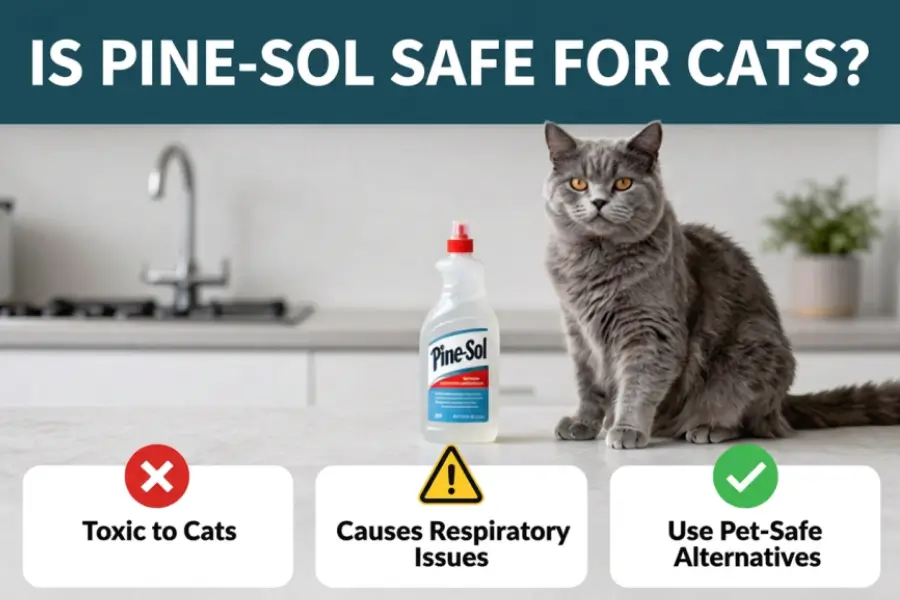
Pine-Sol is not safe for direct contact with cats. While most current formulas no longer contain pine oil, the cleaning agents, fragrances, and surfactants in Pine-Sol can irritate a cat’s skin, paws, eyes, and digestive system. Pine-Sol should only be used in homes with cats if the cat is kept out of the area during cleaning and surfaces are allowed to dry completely before the cat returns.
Caution is necessary because cats lack some of the liver enzymes that humans and dogs use to break down certain chemical compounds, which means substances that are mildly irritating to us can affect cats more strongly.
Pine-Sol exposure becomes genuinely dangerous in three scenarios: when a cat walks on a still-wet surface and later licks its paws clean, when a cat is shut in a small, poorly ventilated room while strong fumes build up, and when a cat drinks or licks the concentrated product directly from a bottle, sponge, or bucket.
- Main risks: paw and skin irritation from wet residue, eye and respiratory irritation from fumes, and digestive upset or chemical poisoning from ingestion.
- Safe handling tips: keep cats in another room while cleaning, ventilate well, and don’t let cats back in until floors are 100% dry.
- When to contact a vet: if your cat licked Pine-Sol directly, shows drooling or vomiting after exposure, or has any trouble breathing — call your veterinarian or a pet poison hotline right away.
Pine-Sol is a multi-surface household cleaner first sold in 1929. The original formula relied heavily on pine oil, which gave the product its name and signature scent. Over the decades, the formula has changed, and most current Pine-Sol products no longer list pine oil as a main ingredient, though it’s always worth checking the label, since some regional or specialty versions still contain it.
Common Uses of Pine-Sol
- Floor cleaning on sealed hardwood, tile, vinyl, and laminate
- Bathroom cleaning for sinks, tubs, and tile surfaces
- Kitchen cleaning on countertops and hard, non-porous surfaces
It’s marketed as a multi-surface cleaner and, in its original formula, as an EPA-registered disinfectant. Scented variants (lemon, lavender, cherry blossom, and similar) clean and deodorize but are not registered disinfectants.
Main Ingredients Found in Pine-Sol
| Ingredient Type | Example Compounds | Purpose |
|---|---|---|
| Surfactants | Alcohol ethoxylates, alkyl sulfonates | Lift grease and dirt from surfaces |
| Acids | Citric acid | Helps cut through grime and adjust pH |
| Fragrance | Synthetic and/or natural fragrance blends | Scent and odor masking |
| Thickeners | Xanthan gum | Controls product texture |
| Preservatives & colorants | Various | Shelf stability and appearance |
Pine-Sol does not contain ammonia or phosphorus, and the manufacturer does not recommend mixing it with bleach or other cleaning products, since combining chemicals can release harmful gases.
Why Cats React Differently to Cleaning Products
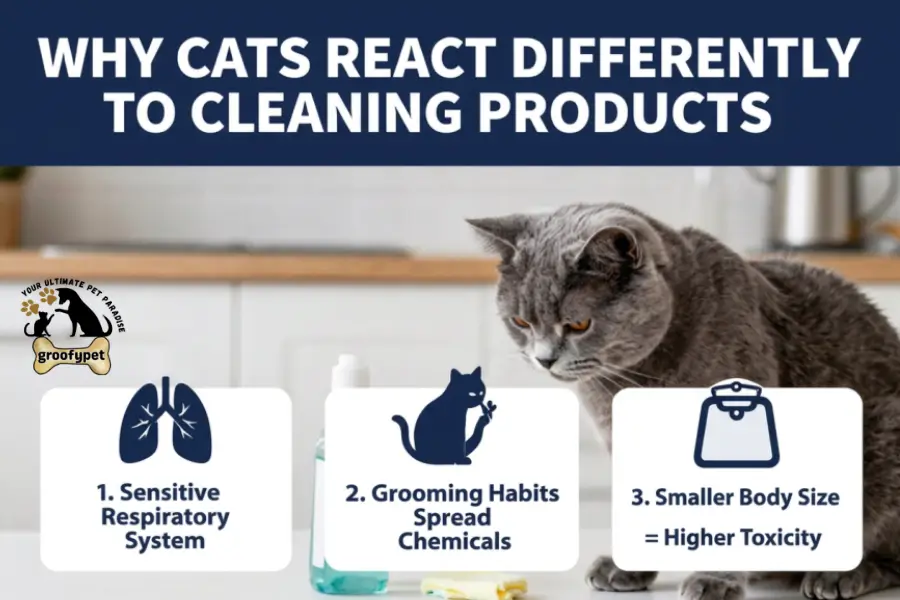
- Sensitive respiratory system: Cats have a much more developed sense of smell than humans and small, efficient airways that react quickly to strong fumes.
- Grooming behavior: Cats groom themselves constantly, which means anything on their fur or paws is very likely to end up in their mouth.
- Smaller body size: A cat weighs a fraction of an adult human, so the same amount of residue or fumes represents a much higher relative dose.
Why Can Pine-Sol Be Dangerous for Cats?
Quick answer: Pine-Sol can be dangerous for cats mainly through skin/paw contact with wet residue, inhalation of concentrated fumes in poorly ventilated spaces, and ingestion from licking the product or a contaminated paw.
- Cleaning agents (surfactants and acids): can irritate skin, paws, and the lining of the mouth and stomach if ingested.
- Fragrance ingredients: some cats are sensitive to added fragrances and may react with sneezing, drooling, or skin irritation.
- Essential oil compounds (in pine-oil-based formulas): pine oil and related phenolic compounds are well documented in veterinary literature as risky for cats because of how cats metabolize them.
Inhalation Risks
- Breathing fumes: strong cleaning fumes in an enclosed space can irritate a cat’s nose, throat, and lungs.
- Airway irritation: signs include sneezing, coughing, or rapid breathing.
- Indoor ventilation concerns: small bathrooms, closets, or rooms with closed windows allow fumes to concentrate, increasing risk.
Skin and Paw Exposure
- Walking on wet floors: a cat that crosses a freshly cleaned, still-wet floor picks up residue on its paw pads.
- Absorption through skin: cats can absorb some chemicals through their paw pads and skin, though licking is the bigger concern.
- Irritation risks: redness, mild burning, or discomfort on the paws is the most commonly reported reaction.
Risks From Licking Surfaces
- Grooming after exposure: cats instinctively lick their paws clean, which turns surface contact into oral exposure.
- Accidental ingestion: a cat that licks residue off its paws, fur, or whiskers may ingest a small amount of the product.
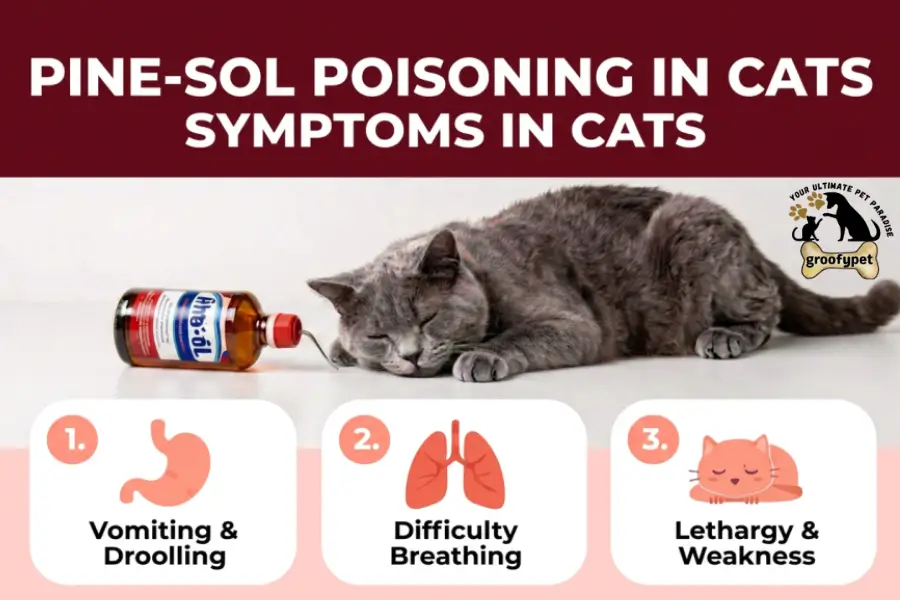
Pine-Sol Poisoning Symptoms in Cats
Quick answer: Symptoms range from mild paw or eye irritation to vomiting, drooling, and lethargy, and in rare, high-exposure cases, breathing difficulty or collapse. Most reported cases involve mild symptoms because the amount picked up from a dried or lightly diluted surface is small.
| Severity | Symptoms | Typical Cause |
|---|---|---|
| Mild | Drooling, paw licking, eye redness/irritation, sneezing | Brief contact with wet residue or mild fumes |
| Moderate | Vomiting, diarrhea, loss of appetite, lethargy | Licking a contaminated paw or fur, or ingesting a small amount |
| Severe | Difficulty breathing, tremors, lack of coordination, collapse | Direct ingestion of concentrated product or prolonged exposure in an unventilated space |
Mild Symptoms
These are the most commonly reported reactions and usually resolve on their own once the cat is removed from exposure and the residue is cleaned off.
Moderate Symptoms
Vomiting, diarrhea, reduced appetite, and lethargy suggest the digestive system has been irritated, often from licking a paw or surface. These warrant a call to your veterinarian, even if your cat seems otherwise alert.
Severe Symptoms
Breathing difficulty, tremors, wobbliness, or collapse are emergency signs. These are uncommon with brief, incidental exposure but require immediate veterinary care if they occur.
Mild symptoms (paw licking, drooling) often appear within minutes of contact. Digestive symptoms like vomiting or diarrhea typically show up within a few hours. If your cat seems fine immediately after exposure, it’s still worth monitoring them for the rest of the day.
What Happens If a Cat Walks on a Pine-Sol-Cleaned Floor?
Quick answer: A small amount of diluted Pine-Sol residue on a cat’s paws is unlikely to cause serious harm, but it can lead to mild paw irritation and, if the cat licks its paws afterward, mild drooling or an upset stomach.
Exposure Through Paws
When you mop with diluted Pine-Sol, the amount that ends up on a cat’s paw pads after a brief crossing is generally small. Still, paw pads are sensitive, and even mild residue can cause discomfort, especially if the cat has any existing skin sensitivity.
Grooming Risks After Contact
The bigger concern isn’t the floor contact itself; it’s what happens next. Cats almost always groom their paws shortly after walking through something unfamiliar, which converts a surface exposure into an oral one.
How Long Floors Should Dry Before Pets Return
As a general rule of thumb, keep cats off cleaned surfaces until they are completely dry to the touch. For Pine-Sol specifically, that’s a minimum of 30 minutes, but allowing 2–3 hours in a well-ventilated room is a safer practice for sensitive cats, kittens, or homes where ventilation is limited.
First Aid Steps for Cat Owners
- Remove your cat from the source of exposure immediately.
- Wipe or wash any visibly wet residue from paws, fur, or skin.
- Keep your cat somewhere quiet and observe them closely for the next several hours.
- Do not induce vomiting at home — this can cause additional irritation to the mouth and esophagus.
- Do not give any human or pet medication unless a veterinarian specifically instructs you to.
- Call your veterinarian or a pet poison control hotline if you have any concerns.
When to Contact a Veterinarian Immediately
Call right away if your cat:
- Has difficulty breathing, is wheezing, or seems to be gasping
- Has tremors, seizures, or loses coordination
- Vomits or has diarrhea repeatedly
- Drank or licked a significant amount of the undiluted product
- Seems unusually lethargic, weak, or unresponsive
Emergency resources:
- ASPCA Animal Poison Control Center: (888) 426-4435 (consultation fee may apply)
- Pet Poison Helpline: (855) 764-7661 (consultation fee may apply)
Can the Smell of Pine-Sol Affect Cats?
Quick answer: Yes — cats can smell Pine-Sol far more strongly than humans can, and the scent alone (without any direct contact) can cause mild stress or respiratory irritation in sensitive cats, especially in small or poorly ventilated spaces.
Cats and Strong Fragrances
A cat’s sense of smell is many times more sensitive than a human’s. A scent that seems pleasant or mild to you can be overwhelming to your cat. If the smell feels strong to you while cleaning, it’s reasonable to assume it feels much stronger to your cat.
Stress and Behavioral Changes
Some cats respond to strong, unfamiliar chemical smells with stress-related behaviors — hiding, avoiding a room, or reduced appetite near the treated area. This is more of a comfort issue than a toxicity issue, but it’s still worth respecting.
Respiratory Sensitivity Concerns
Cats with asthma or other respiratory sensitivities are more likely to react to strong fumes with coughing, wheezing, or labored breathing, even without direct skin or paw contact. Good ventilation reduces this risk significantly.
Are Some Pine-Sol Products Safer Than Others?
Quick answer: Pine-Sol’s original, scented, and “Clean” formulas are not designed to be pet-safe, but they vary in fragrance intensity and ingredients. Checking the label and safety data sheet for each specific product is the only reliable way to know what’s in the bottle you own.
Differences Between Formulas
The original Pine-Sol Multi-Surface Cleaner is registered with the EPA as a disinfectant and is generally used at full strength or a stated dilution. Scented variants (lemon, lavender, cherry blossom, tropical, and similar) are formulated mainly as cleaners and deodorizers rather than disinfectants, and they tend to carry stronger added fragrance, which can be more irritating to a sensitive cat.
Reading Product Labels
Always check the ingredient list and, if available, the product’s safety data sheet (SDS). Look specifically for:
- Pine oil or “pine needle oil”
- Phenol or phenolic compounds
- Any essential oil blend
If any of these appear, treat the product with extra caution around cats.
Ingredients Cat Owners Should Avoid
- Concentrated pine oil
- Phenol-based disinfectants (often found in products with “-sol” in the name)
- Strong added essential oils, particularly tea tree, citrus, and pine-derived oils
Safe Cleaning Practices for Homes With Cats
Quick answer: The safest way to use Pine-Sol (or any strong cleaner) in a cat household is to remove the cat from the room, ventilate well, let surfaces dry completely, and store the product securely afterward.
Ventilate Rooms Properly
Open windows or run a fan while cleaning and for a while afterward. Good airflow disperses fumes quickly and reduces the concentration your cat would otherwise breathe in.
Keep Cats Away During Cleaning
Close the door or move your cat to a different part of the house while you clean and while the surface dries. This single habit prevents the majority of exposure incidents.
Allow Surfaces to Dry Completely
Wet surfaces are the main risk point. Wait until floors are fully dry, not just “mostly dry,” before letting your cat back into the room.
Store Cleaning Products Securely
Keep bottles tightly closed and stored somewhere your cat can’t knock them over or access, such as a high shelf or a cabinet with a secure latch.
Clean Food and Water Areas Carefully
Avoid cleaning your cat’s food and water bowl area with strong chemical cleaners. If you do, rinse thoroughly with water afterward and let the area dry completely before placing bowls back down.
Cat-Safe Alternatives to Pine-Sol
Quick answer: Plain dish soap and water, diluted unscented cleaners, and EPA-registered pet-safe disinfectants are generally gentler options for homes with cats than fragranced, phenol-containing cleaners.
| Alternative | Best For | Notes |
|---|---|---|
| Dish soap and warm water | Everyday floor and surface cleaning | Simple, low-risk, but doesn’t disinfect |
| Diluted white vinegar | Light cleaning and odor control | Avoid on natural stone; rinse well |
| Accelerated hydrogen peroxide cleaners | Disinfecting in pet-heavy spaces | Used by many shelters as a cat-safe disinfectant |
| Unscented, pet-labeled cleaners | General cleaning around pets | Look for products specifically labeled pet-safe |
| Fragrance-free enzymatic cleaners | Litter box areas and accidents | Breaks down odor-causing residue without strong chemicals |
Pet-Safe Commercial Cleaners
Look for products explicitly labeled as pet-safe or veterinary-recommended, and double-check that the label doesn’t simply mean “safe once dry” some products are formulated to have no harmful residue at all, even before drying.
Veterinary-Recommended Cleaning Products
Animal shelters and veterinary facilities commonly use accelerated hydrogen peroxide cleaners for disinfecting cat areas, since they’re effective against pathogens while being gentler on cats than phenol-based products.
Fragrance-Free Cleaning Solutions
Unscented formulas reduce the chance of respiratory irritation and are generally a safer default in households with sensitive cats.
Natural Cleaning Options
A solution of plain dish soap and water remains one of the simplest, lowest-risk options for routine cleaning, though it requires a rinse step and doesn’t disinfect on its own.
Pros and Cons of Using Pine-Sol Around Cats
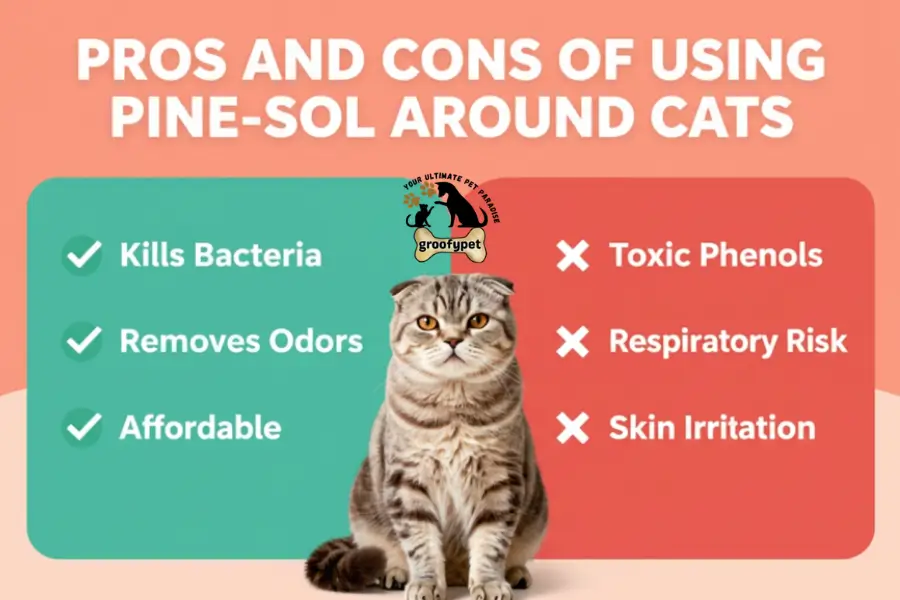
- Effective at cutting through grease and grime
- Helps remove household odors
- Widely available in stores
- Affordable compared to many specialty cleaners
- Multipurpose — works on several surface types
- May irritate a cat’s skin, paws, or eyes
- Strong fragrance can bother sensitive cats
- Some formulas carry a higher toxicity risk if ingested
- Not safe to use directly on or near a cat
- Can cause respiratory discomfort in enclosed spaces
Common Mistakes Cat Owners Make With Cleaning Products
Using Too Much Product
Applying more Pine-Sol than the label recommends increases both the strength of the fumes and the amount of residue left behind, raising risk without improving cleaning results.
Poor Ventilation
Cleaning in a closed bathroom or small room without airflow lets fumes build up to levels that are far more likely to bother a cat.
Letting Cats Enter Too Soon
The most common mistake is opening the door and letting a curious cat back into a room before the floor has fully dried.
Ignoring Product Labels
Skipping the label means missing dilution instructions, surface restrictions, and any pet-specific warnings the manufacturer includes.
Frequently Asked Questions
Is dried Pine Sol safe for cats?
Once Pine-Sol has fully dried, the risk is significantly lower, but trace residue can still remain on the surface. Most cats are fine on dried surfaces, but very sensitive cats or kittens may still react to any leftover residue or lingering scent.
Can cats smell Pine-Sol?
Yes. Cats have a far more sensitive sense of smell than humans, so they can detect Pine-Sol’s scent well after it’s no longer noticeable to you and may find it overwhelming even at low concentrations.
What should I do if my cat licks a Pine-Sol-cleaned floor?
If the floor was dry, a small lick is unlikely to cause serious harm, but watch for drooling or stomach upset. If the floor was still wet or your cat licked directly from a wet area, rinse their mouth if safe to do so and contact your veterinarian or a pet poison hotline.
Can Pine-Sol cause breathing problems in cats?
Yes, especially in enclosed, poorly ventilated spaces. Strong fumes can irritate a cat’s airways and cause sneezing, coughing, or labored breathing in sensitive cats.
Which household cleaners are safest for cats?
Unscented, pet-labeled cleaners, diluted dish soap and water, and accelerated hydrogen peroxide products are generally considered safer choices for homes with cats than phenol-based or heavily fragranced cleaners.
How long should cats stay away after cleaning?
At minimum, keep cats away until the surface is completely dry — typically at least 30 minutes, though 2–3 hours in a well-ventilated room is a safer margin for sensitive cats.
Is Pine-Sol safer than bleach around cats?
Both require caution. Bleach fumes can also irritate a cat’s respiratory system, and the two products should never be mixed. Neither should be used directly around cats, and both require full drying and good ventilation before pets return.
Can Pine-Sol harm kittens?
Kittens are smaller and more sensitive to chemical exposure than adult cats, so the same amount of residue or fumes poses a relatively higher risk to them. Extra caution — including longer drying times and stricter room separation — is recommended in homes with kittens.
Final Thoughts
Is pine sol safe for cats? Pine Sol isn’t formulated to be cat-safe, and most veterinary and pet-safety resources agree it should be kept away from direct contact with cats. The real-world risk for most households is low when the product is used as directed: dilute it properly, keep your cat out of the room, ventilate well, and wait until everything is completely dry before letting your cat back in.
Bottom line: Is Pine Sol safe for cats? Not directly, but used carefully, with your cat kept away until surfaces are dry, it can be used in a cat household without major incidents. When in doubt, a fragrance-free or pet-labeled alternative removes the guesswork entirely.