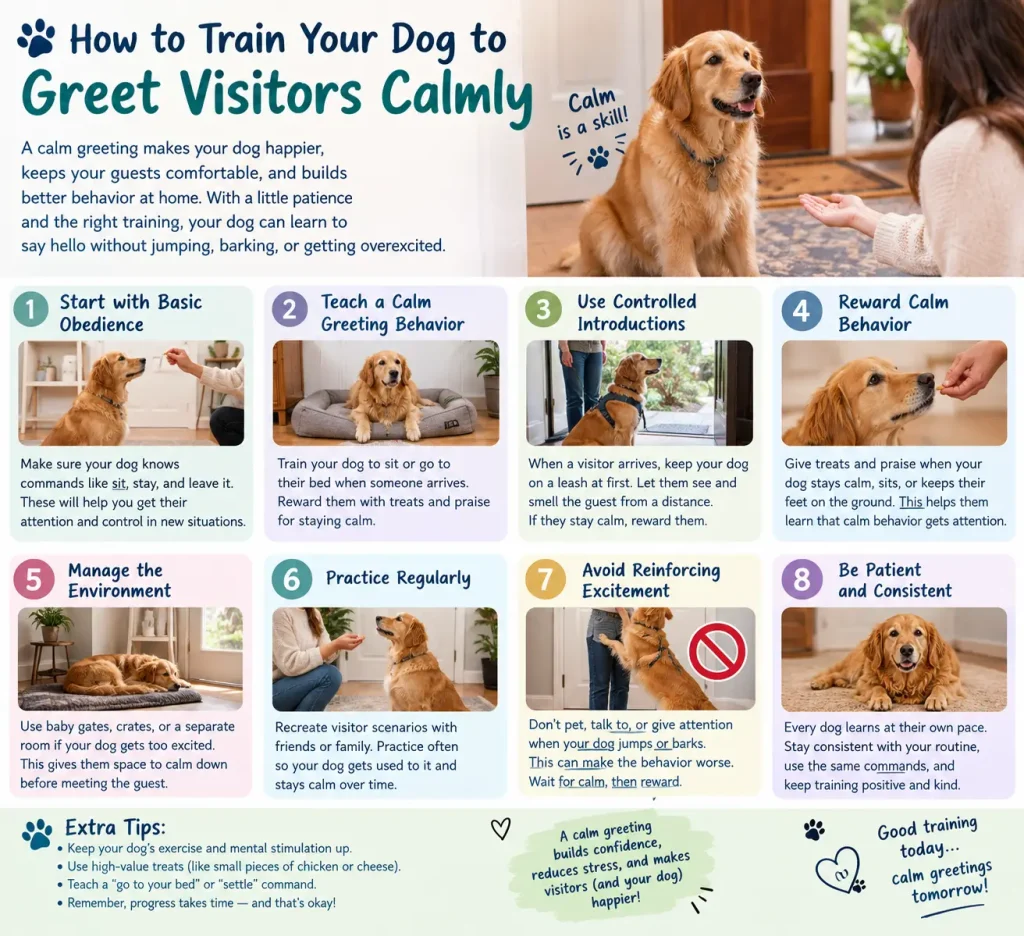
The doorbell rings, and your dog launches into a wild routine of barking, spinning, and jumping. Many owners know this scene well. The good news is that dogs can learn calmer habits. How to train your dog to greet visitors calmly comes down to three things: managing the doorway, practising in small steps, and rewarding the behavior you want to see.
Dogs rush, jump, or bark at guests for different reasons. Some are thrilled. Some are frustrated that a leash or gate is holding them back. Others are nervous and trying to create distance. Each reason needs a slightly different approach.
Quick answer: To train your dog to greet visitors calmly, manage the doorway with a leash or gate, teach a mat or sit cue, and practice the doorbell at low intensity. Reward four paws on the floor and relaxed behavior, add difficulty slowly with helpers, and pause the greeting whenever your dog becomes too excited or worried.
In this guide, you will learn why dogs react the way they do, how to prepare your home, and a seven-step training process. You will also find help for door barking and fearful dogs, common mistakes, a seven-day starter plan, and signs that it is time to call a professional.
Why Does Your Dog Get Overexcited When Visitors Arrive?
Most dogs do not jump or bark to be rude. They are reacting to a big, exciting, or confusing event. Here are the most common reasons.
- Excitement about meeting people. Many dogs love company, and a new person is the best thing that happened all day.
- Attention seeking. If jumping has ever earned eye contact, laughter, or petting, the dog learns that jumping works.
- Little practice with calm greetings. Dogs often only rehearse the door routine when real guests arrive, and that is the hardest moment to learn anything.
- Arrival triggers. Doorbells, knocking, and footsteps can set off a chain reaction before anyone steps inside.
- Fear or uncertainty. Some dogs bark or back away because unfamiliar people feel threatening.
- Frustration. A leash, gate, or closed door can build tension, and the dog may explode with barking.
Two dogs can show the same behavior for opposite reasons. One jumps from joy, and the other jumps from nerves. Before you choose a method, watch your dog’s body language. Loose, wiggly movement suggests excitement. A stiff, frozen, or retreating body suggests worry.
Prepare Your Dog Before Guests Arrive
Good preparation makes every training step easier. Set up your home and your plan before the first practice session.
Offer exercise and sniffing time. A walk or a game of sniff-and-search can take the edge off some dogs. Exercise helps, but it does not replace training. A tired dog can still jump, and some dogs get more wound up after intense play.
Gather small, tasty treats. Use soft treats the size of a pea so your dog can eat quickly and keep working. Chicken, cheese, or commercial training treats all work well.
Set up your management tools. Keep a leash, baby gate, or exercise pen near the entrance. These tools prevent your dog from practicing the wrong behavior while it is still learning.
Choose a settling spot. Pick a mat or bed that you can place at a distance from the door. Use the same spot each time so your dog learns what it means.
Brief your visitors. Ask guests to ignore the dog at first, stay calm, and follow your instructions. A short text before they arrive helps.
Plan a safe backup. If your dog becomes overwhelmed, you need a quiet room, a gated area, or a comfortable crate ready. Using it is smart planning, not failure.
Also Read : Why Does My Dog Scratch the Carpet?Reasons and Tips to Stop It!
How to Train Your Dog to Greet Visitors Calmly Step by Step
Work through these steps in order. Practice in short sessions of about three to five minutes, and move on only when your dog succeeds easily at the current stage.
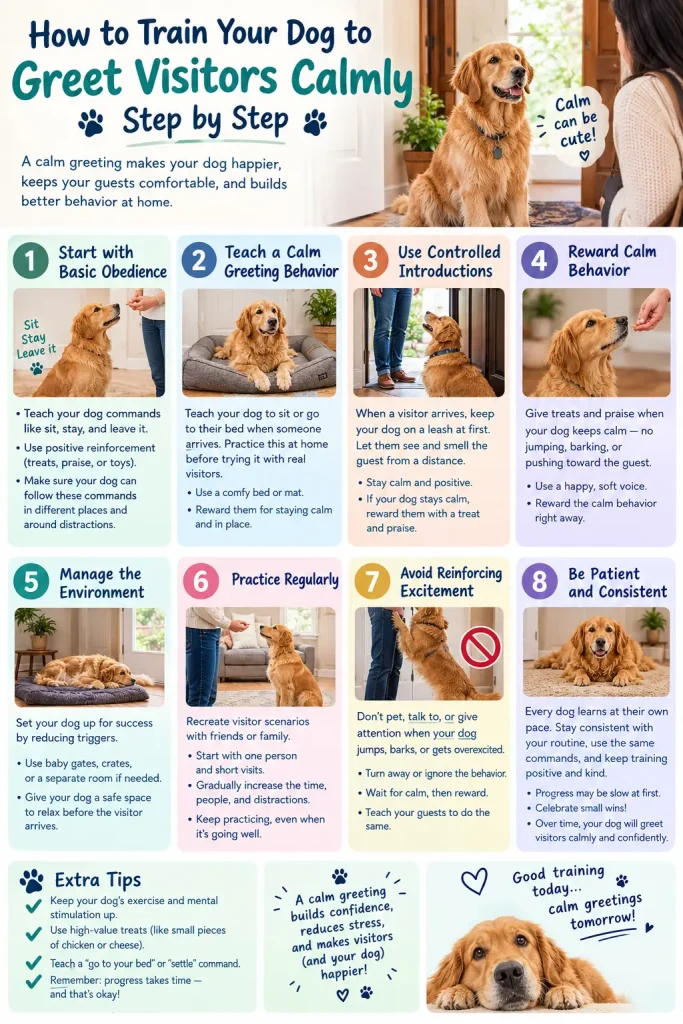
Step 1: Teach Your Dog to Respond to the Doorbell
Start with the sound itself. Play a recording of the doorbell very quietly, or knock lightly on a wall from another room. The moment your dog stays calm, looks at you, or walks toward its mat, give a treat.
Make the sound a little louder or closer over several sessions. Increase the difficulty only if your dog is still relaxed. If your dog starts barking or spinning, go back to an easier level. The goal is to turn the doorbell into a signal that something good happens.
Step 2: Teach a Reliable Sit or Four Paws on the Floor
Reward your dog for keeping all four paws on the ground. Some dogs sit easily. Others do better when you simply reward standing calmly. Either works, as long as the dog is not jumping.
Practice first with family members at the door. Say the cue once, then reward the correct behavior. Avoid repeating a command again and again when your dog is already too excited to think. Repeated cues become background noise. It is better to reward the behavior you want and reduce the excitement level so your dog can succeed.
Step 3: Introduce a Place or Mat Cue
A mat gives your dog a clear job. Place the mat on the floor and reward any interest in it. Then reward stepping onto it, then lying down, and then staying there for a few seconds. Add a cue word such as “mat” once your dog goes there reliably.
Build duration slowly. Next, add small distractions. Walk to the door, touch the handle, or knock lightly while your dog stays on the mat. Reward often at first, then gradually stretch the time between treats.
Step 4: Practice with a Familiar Helper
Ask a trusted friend to act as the visitor. Start with the helper standing far from your dog, outside the door or across the room. Your dog should be able to take treats and respond to cues at that distance.
Then build the routine one small piece at a time. The helper can approach the door, knock, open it, step in, and finally sit down. Add only one new piece per round. If your dog struggles, lower the difficulty and try again.
Step 5: Reward Calm Greetings
When your dog is calm, let the helper move closer. Reward four paws on the floor, a voluntary sit, or a relaxed approach. For a dog that loves people, the greeting itself can be the reward. If the dog stays calm, the visitor gets to say hello. If the dog gets too excited, the visitor steps back.
This teaches a simple rule: calm behavior makes good things happen.
Step 6: Prevent Jumping and Rushing
Management matters most during this step. Use a leash, gate, or door barrier so your dog cannot rush ahead. If your dog jumps, calmly pause the greeting and move back to a distance where success is possible.
Once your dog offers a better behavior, such as sitting or standing quietly, the greeting can continue. Never yank the leash, shout, or force your dog into contact. Pulling and intimidation can raise stress and damage trust. The American Veterinary Society of Animal Behavior (AVSAB) recommends reward-based methods and advises against punishment-based training.
Step 7: Practice with Different People and Situations
Dogs often succeed with one person and fail with another. Practice with different visitors, voices, outfits, and arrival times. Try a delivery person’s knock, a friend with a backpack, or a guest who arrives with a coat and bags.
Change one thing at a time. If you add a new person and a new location together, your dog may struggle. Reward progress often, and expect setbacks when the situation is more exciting.
The 10-Second Visitor Arrival Routine
Once your dog knows the basics, rehearse this quick routine before you open the door:
- Secure your dog with a leash, gate, or other barrier.
- Ask for the mat cue or another practiced calm behavior.
- Reward your dog for staying settled.
- Let the visitor enter without crowding your dog.
- Allow a greeting only when it is safe and your dog seems comfortable.
If the situation feels unsafe or your dog is too stressed, skip the greeting. Keep your dog separated and use a gate or quiet room.
The Visitor Greeting Readiness Checklist
Before you let a guest say hello, ask yourself whether your dog:
- Responds to a familiar cue, such as “mat” or “sit”
- Takes treats gently instead of grabbing frantically
- Can stay at a comfortable distance from the visitor
- Looks loose and relaxed, not stiff, frozen, or anxious
- Can walk away from the visitor and return to you
If you cannot check every box, keep practicing at a distance. Remember that taking a treat or sitting does not prove your dog is comfortable. Some nervous dogs sit and eat while feeling very uneasy.
Must Read : Why Does My Dog Lick My Nose So Gently?
What to Do When Your Dog Barks at the Door
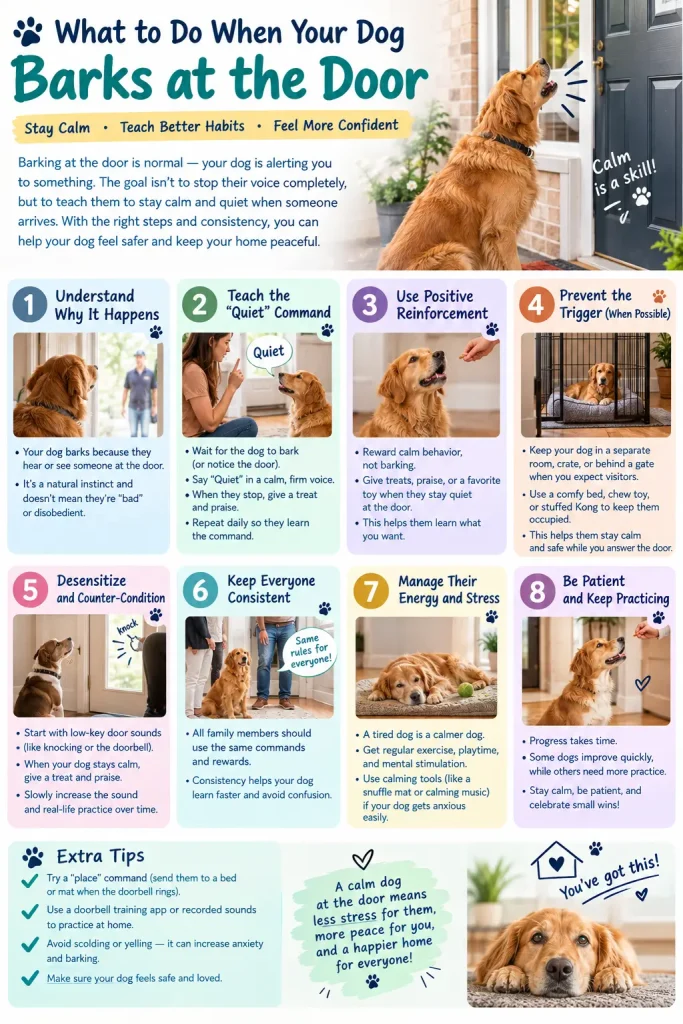
Not all door barking means the same thing. Alert barking announces something new. Excitement barking is usually high-pitched and bouncy, with a wagging body. Fear barking often comes with stiff posture, backing away, or hiding. Knowing which type you are dealing with helps you pick the right response.
Try these practical steps:
- Control the trigger. Use a sign asking visitors to knock softly, or turn off the doorbell during training.
- Reward a pause. Even a one-second break in barking earns a treat. Then reward longer pauses.
- Teach an alternative behavior. Send your dog to its mat or ask for a hand target.
- Add distance. Practice farther from the entrance if your dog cannot focus.
- Use a gate or quiet room when you need a calmer setup.
- Stay calm. Yelling can sound like you are barking too, and it may raise your dog’s excitement.
If the barking comes from fear or includes lunging or growling, you will need individualized support from a qualified trainer or veterinary behaviorist.
What to Do When Training Fails at the Door
Some days your dog will be too excited to listen. That is normal. When it happens:
- Stop the practice safely. Calmly guide your dog away using the leash or gate.
- Create distance between your dog and the door or visitor.
- Use a barrier such as a gate, pen, or closed door.
- Make the exercise easier by using a quieter sound, a calmer helper, or a bigger distance.
- Try again later after your dog has had time to settle.
Management is part of training, not a failure. Every time your dog avoids practicing a bad habit, you protect your progress.
What If Your Dog Is Afraid of Visitors?
A fearful dog needs a different plan than an overexcited one. Excited dogs want to get closer. Scared dogs want more space or a way to escape.
Signs of fear can include a tucked tail, a lowered body, repeated lip licking, hiding, freezing, or trying to move away. Context matters, because a single sign does not tell the whole story. Look at your dog’s face, tail, posture, and movement together.
To help a nervous dog, try these steps:
- Give more distance. Let your dog decide how close to get.
- Let your dog choose. Never push or pull a dog toward a guest.
- Coach your visitors. Ask them to avoid staring, reaching over your dog’s head, or leaning toward its face.
- Reward calm observation. Treat your dog for noticing the visitor from a comfortable spot.
- Never corner your dog. Make sure it can always walk away.
The main method here is called desensitization and counterconditioning. In plain terms, you show your dog the scary thing at a low level and pair it with something wonderful, like treats. Over time, the visitor starts to predict good things instead of danger.
If your dog growls, snaps, lunges, or seems more frightened over time, stop training with guests and contact a professional.
How to Teach Visitors to Help Instead of Hinder Training
Guests can make or break your progress. Share these simple rules before they arrive:
- Stay calm and quiet. Avoid squealing, baby talk, or sudden movements.
- Do not chase, grab, or hug the dog.
- Do not encourage jumping, even with a laugh.
- Avoid reaching toward the dog’s face or head.
- Follow your instructions about treats, petting, and space.
- Let the dog come to you instead of forcing contact.
Children should never be expected to manage an overexcited or fearful dog. Adults need to supervise, use barriers, and step in when needed.
Common Mistakes to Avoid During Visitor Training
- Allowing jumping sometimes. If it works even once in a while, your dog will keep trying. Make the rule the same for everyone, and reward four paws on the floor every time.
- Practicing only with real guests. Real arrivals are too hard for learning. Rehearse with family and helpers first.
- Repeating commands to an overwhelmed dog. Lower the excitement level instead, and then ask once.
- Punishing barking or growling. Punishment can hide warning signals without fixing the cause. A growl is communication, and it deserves attention.
- Letting visitors encourage jumping. Give guests clear instructions so they support the plan.
- Moving too fast. If your dog fails often, you moved ahead too quickly. Go back a step.
- Ignoring early stress signals. Lip licking, yawning, a stiff body, or turning away can show growing worry. Respond by adding space.
- Assuming every dog wants to meet every guest. Some dogs prefer to stay on a mat or in another room, and that is fine.
A Simple 7-Day Calm Greeting Training Plan
Use this table as a starting framework. Some dogs may need more than a week for each stage, and that is perfectly fine.
| Day | Training Goal | Practice Activity | Signs of Progress |
|---|---|---|---|
| 1 | Reward calm behavior on a mat | Reward your dog for stepping on the mat and lying down, in three short sessions | Dog goes to the mat on its own and settles |
| 2 | Practice the doorbell or knocking sound | Play a quiet doorbell recording and reward calm responses | Dog stays relaxed or looks to you when it hears the sound |
| 3 | Practice sitting or keeping four paws on the floor | Reward four paws on the floor near the door with family members | Dog offers a sit or stays grounded without being asked repeatedly |
| 4 | Rehearse the arrival routine with a household member | Have a family member go out, knock, and come in while your dog uses the mat | Dog recovers quickly after the knock and returns to the mat |
| 5 | Practice with a familiar helper at a comfortable distance | Helper stands far away, then approaches slowly while you reward calm behavior | Dog takes treats and stays loose and relaxed at distance |
| 6 | Combine the doorbell, mat cue, and greeting routine | Run the full 10-second arrival routine with the helper | Dog follows the sequence with less jumping or barking |
| 7 | Review progress and repeat the easiest successful exercises | Choose the two exercises your dog does best and practice them | Dog finishes sessions calm and eager to keep working |
How Long Does It Take to Train a Dog to Greet Guests Calmly?
There is no fixed timeline. Progress depends on your dog’s age, temperament, past learning, motivation, and how consistent you are. It also depends on whether the behavior comes from excitement or fear. Fear usually takes longer to change and needs a gentler pace.
Short, positive sessions work better than long, tiring ones. Three practice sessions of a few minutes each beat one exhausting hour. Track small wins, such as less jumping, a shorter barking burst, or a faster return to the mat after the doorbell.
When Should You Get Professional Dog Training Help?
Contact a qualified reward-based trainer or a veterinary behaviorist if you notice any of these signs:
- Growling, snapping, or biting
- Lunging or chasing visitors away
- Severe fear or panic
- Behavior that is getting worse
- Children or vulnerable guests at risk
- A history of bites or injuries
Look for trainers with recognized credentials, such as a Certified Professional Dog Trainer, and for veterinary behaviorists when medical issues or serious anxiety may be involved.
If there is any bite risk, keep your dog physically separated from guests. Do not try unsupervised greeting practice with a dog that may bite.
Frequently Asked Questions
How do I stop my dog from jumping on guests at the door?
Prevent practice by using a leash or gate so your dog cannot jump successfully. Reward four paws on the floor and calm sitting every time. Ask guests to wait until your dog is grounded before giving attention. Consistency across all visitors helps your dog learn that jumping never works.
Should I let visitors pet my dog when they arrive?
Only if your dog is calm and wants to approach. Let your dog walk up on its own, and ask visitors to offer a brief, gentle touch on the chest or shoulder. If your dog backs away, looks stiff, or seems unsure, skip petting and let your dog relax.
How do I calm my dog before guests come over?
Offer a walk or sniffing time earlier in the day, and keep your dog’s mat and treats ready. Use a gate or leash at the door and rehearse the arrival routine. A familiar resting area gives your dog a place to settle once guests are inside.
Should I ignore my dog when it jumps on visitors?
Withdrawing attention can help, but it is not enough alone. Your dog needs to learn what to do instead. Prevent jumping with a leash or gate, then reward sitting or standing calmly. A dog who is highly aroused may not respond to ignoring, so reduce excitement first.
Can an older dog learn to greet visitors calmly?
Yes, older dogs can learn new routines. They may move more slowly, so keep sessions short and comfortable. Check with your veterinarian if your senior dog seems stiff, sore, or confused, because pain or hearing changes can affect door behavior. Use soft treats and a comfortable mat.
Why does my dog bark at visitors but not family members?
Family members are familiar, while visitors are new and unpredictable. The barking could be excitement, an alert response to someone entering the home, or fear. Watch your dog’s body language and context before deciding. Different causes need different training plans.
Is it better to crate my dog when visitors arrive?
A crate can work well if your dog sees it as a safe retreat. Add treats, a chew, and a cozy blanket, and practice with the door open before guests come. Never use the crate as punishment. If your dog panics inside it, choose a gated room instead.
What should I do if my dog growls at a guest?
Calmly create distance and prevent contact. Do not punish the growl, because it is a warning that your dog is uncomfortable. Think about what triggered it, and keep your dog away from similar situations for now. Contact a qualified professional for personalized guidance.
Conclusion
Learning how to train your dog to greet visitors calmly takes patience, but the steps are simple. Prepare your space, teach the doorbell, mat, and four paws skills, and practice with helpers before real guests arrive. Reward the behavior you want, use gates and leashes when needed, and respect your dog’s comfort at every stage.
Practice consistently in short sessions and celebrate small progress. If your dog is nervous, give it space and time. Above all, put safety first. A calm, safe hello is always better than a forced one.