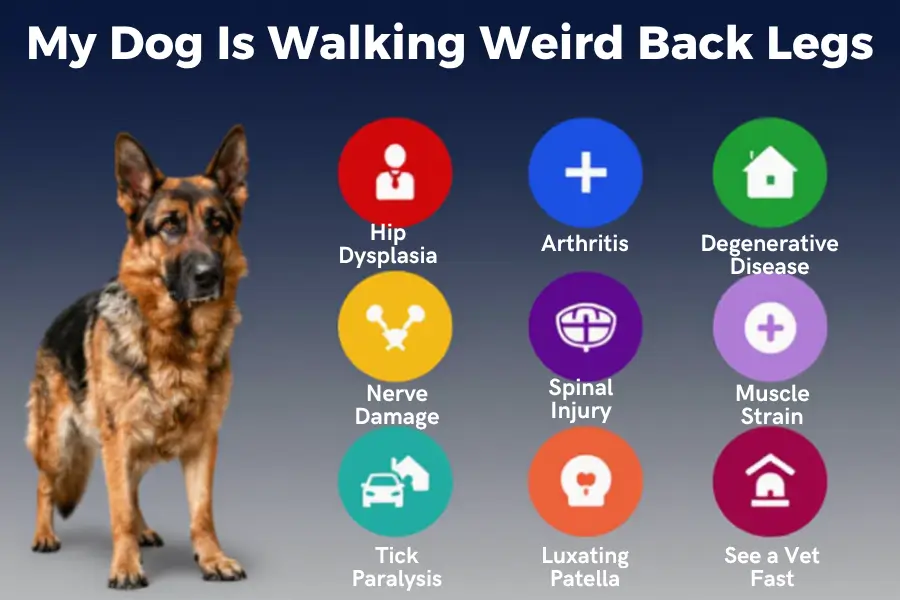
If your dog is walking weird back legs wobbling, dragging his paws, crossing his hind legs, or seeming weak the cause could range from mild arthritis or a muscle strain to a spinal disc problem or a neurological condition.
Some causes are manageable at home with rest, while others (sudden paralysis, severe pain, loss of bladder control) are emergencies that need immediate veterinary care. Because abnormal hind-leg movement is a symptom, not a diagnosis, a veterinary exam is the only reliable way to know what’s actually going on.
My Dog Is Walking Weird Back Legs: What Does It Mean?
When owners say their dog is “walking weird” in the back legs, they’re usually describing one or more of the following: wobbling, stumbling, dragging paws, crossing legs, general weakness, limping, stiffness, or difficulty standing up. Sometimes it happens suddenly; your dog was fine an hour ago and now can’t put weight on a leg.
Other times it creeps in slowly, appearing first as reluctance to jump onto the couch or hesitation before stairs, and gradually worsening over weeks or months.
There isn’t one single explanation for dog hind leg weakness. The back legs rely on a chain of working parts joints, muscles, tendons, ligaments, spinal discs, and nerves and a problem anywhere along that chain can produce a similar-looking wobble or limp.
That’s exactly why symptoms alone can’t tell you what’s wrong. A dog walking wobbly from early arthritis can look surprisingly similar, at a glance, to a dog with an early spinal issue, even though the treatment paths are completely different. If the abnormal gait is persistent, painful, or getting worse, it’s time to involve a veterinarian rather than guess.
Why Is My Dog Walking Weird With Its Back Legs?
Below are the most common categories of hind leg problems in dogs, roughly ordered from the everyday to the more serious.
Arthritis and Joint Problems
Joint disease is one of the most frequent reasons a dog develops an odd back-leg gait, especially as dogs age. Osteoarthritis, the wear-and-tear breakdown of cartilage inside a joint, causes inflammation, stiffness, and discomfort that’s often worst right after resting and improves once the dog “warms up” and starts moving.
Hip problems, including hip dysplasia (common in larger breeds such as Labrador Retrievers, Golden Retrievers, and German Shepherds), can cause swaying through the hips, difficulty rising, and a bunny-hopping gait when running.
Knee problems, including luxating patella (a kneecap that slips out of place, common in smaller breeds), can cause an intermittent skip or hop in one hind leg. General joint inflammation from any cause tends to produce stiffness that’s most noticeable first thing in the morning or after a nap.
Muscle, Tendon, or Ligament Injury
Soft-tissue injuries are another very common cause of sudden dog leg pain and lameness. Sprains and strains can happen during normal play, a rough landing, or a slip on a hard floor. Overexertion, an unusually long hike, an intense play session, or a burst of zoomies can leave muscles sore and gait temporarily off. Sports and jumping injuries are common in active or working dogs.
One especially important injury to know about is cruciate ligament disease (damage to the cranial cruciate ligament in the knee), which is one of the most common causes of hind-limb lameness in dogs of all sizes. It can happen suddenly during activity or develop gradually from chronic joint instability, and it often causes a dog to hold the affected leg up or refuse to bear weight on it.
Spinal and Disc Problems
Spinal issues are a more serious category and are a leading cause of sudden dog neurological problems in the back legs. Intervertebral disc disease (IVDD) occurs when the cushioning discs between the vertebrae bulge or rupture, putting pressure on the spinal cord.
This is especially common in long-backed, short-legged breeds like Dachshunds and French Bulldogs, though it can affect any breed. Lower-back or lumbosacral disease affects the joints and nerves near the base of the spine, often causing pain, weakness, or a reluctance to jump.
Spinal cord compression, from any cause, interferes with the nerve signals that tell the back legs how to move properly, which is why spinal problems can cause weakness, poor coordination (a swaying, drunken-looking gait), or in severe cases, paralysis. Spinal injuries can worsen quickly, so any sudden change paired with back pain or hind-end weakness deserves prompt attention.
Nerve Problems
Beyond the spinal cord itself, nerve issues in the limbs can also cause abnormal movement. Peripheral nerve injury (damage to the nerves that run out from the spine into the leg) and nerve compression can both interfere with a dog’s ability to sense where its paw is and control it properly.
This is often what’s behind the unsettling sign of a dog dragging back legs or scuffing the tops of the paws along the ground the nerve signal telling the dog to lift and place the foot correctly isn’t getting through. Broader neurological disorders can also present with abnormal gait, incoordination, or dragging.
Degenerative Myelopathy
Degenerative myelopathy is a progressive spinal cord disease seen most often in older, large-breed dogs (German Shepherds are frequently mentioned in connection with it, though other breeds can be affected too).
It causes a slow, painless decline in hind-leg coordination and strength, often starting with subtle knuckling of the back paws or dragging of the nails and progressing over months. Because it looks similar in its early stages to arthritis or a mild orthopedic issue, diagnosis requires veterinary evaluation, often including advanced imaging and ruling out other spinal conditions.
Tick Paralysis
In regions where certain tick species are present, tick paralysis is an important cause to be aware of. A toxin in the saliva of the tick can cause rapidly progressing hind-leg incoordination and weakness, sometimes advancing to the front legs and, critically, to the muscles involved in breathing.
Because tick paralysis can escalate quickly, any dog with fast-worsening weakness, especially alongside changes in breathing or voice, needs urgent veterinary attention. Checking for and removing ticks is a simple but important step if this is a possibility in your area.
Other Possible Causes
A number of less common conditions can also produce dog difficulty walking on the back legs, including trauma (falls, being hit by a car, or other accidents), infections affecting the joints, spine, or nervous system, nutritional problems, blood-flow disorders (such as a blood clot affecting circulation to the hind legs, which is a true emergency), tumors affecting the spine or nerves, and metabolic or neuromuscular diseases that affect muscle strength and function throughout the body.
Signs My Dog Is Walking Weird Back Legs

Keep an eye out for any of the following, and note when they started and whether they’re getting better, staying the same, or getting worse:
- Wobbling or swaying while walking or standing
- Stumbling or tripping
- Falling over, especially when turning or on stairs
- Dragging one or both back paws
- Crossing the hind legs while walking
- Difficulty standing up from a lying position
- Limping or favoring one leg
- Shaking or trembling in the back legs
- Signs of pain (whimpering, reluctance to be touched, restlessness)
- Muscle loss or thinning in the hindquarters
- Tail weakness or a limp tail
- Urinary or fecal accidents in a previously house-trained dog
A short list like this is useful, but context matters just as much as the symptom itself — a dog that’s stiff for the first few steps after a nap and then walks normally is a very different situation from a dog whose back legs are giving out completely.
When Is Weird Back-Leg Walking an Emergency?
Some situations require immediate veterinary care rather than a wait-and-see approach. Treat it as an emergency if your dog:
- Cannot stand or walk without assistance
- Experiences sudden paralysis
- Is in severe, obvious pain
- Has suffered major trauma (a fall, being hit by a car, etc.)
- May have a fracture
- Shows rapidly worsening weakness over hours
- Has difficulty breathing
- Has lost control of bladder or bowel function
Dogs unable to stand or walk without assistance, or dogs with major trauma, should receive emergency veterinary care right away — don’t wait to see if it resolves on its own. Spinal and neurological problems in particular can worsen quickly, and the sooner treatment starts, the better the chances of a good outcome.
What Should I Do If My Dog Is Walking Weird?

While you arrange veterinary care, there are sensible steps you can take at home:
- Restrict running, jumping, and stairs. Activity can worsen many of the underlying causes, especially joint and spinal issues.
- Keep your dog somewhere safe to prevent falls — a small, low-traffic room with good footing is ideal.
- Don’t force exercise. Let your dog rest rather than trying to “walk it off.”
- Don’t massage or manipulate the spine or joints without veterinary guidance — with an undiagnosed spinal problem, this can make things worse.
- Record a short video of the abnormal walking. Gait changes can be subtle or intermittent, and a video is often more useful to your vet than a description alone.
- Arrange a veterinary examination if symptoms persist, worsen, or come with pain or weakness — don’t wait out of hope that it will resolve on its own.
How Will a Veterinarian Diagnose the Problem?
A vet works through hind leg problems in dogs systematically, usually starting with:
- Medical history — when it started, how it’s progressed, recent activity, past injuries, and general health
- Physical examination — checking joints, muscles, and overall condition
- Gait assessment — watching your dog walk, trot, and turn
- Orthopedic examination — feeling for joint instability, pain, or swelling, especially around the hips and knees
- Neurological examination — testing reflexes and how well your dog senses and controls paw placement
- Reflex and paw-position testing — for example, checking whether your dog immediately corrects a paw that’s placed knuckled-under
- Blood tests when appropriate, to check for infection, metabolic disease, or other systemic issues
- X-rays to assess bones and joints
- Ultrasound, in some cases, to evaluate soft tissue or internal causes
- CT or MRI when a spinal cord or nerve problem is suspected and more detailed imaging is needed
Which combination of these your vet recommends depends on what they find during the initial exam.
Treatment Options
Treatment for a dog walking weird on the back legs depends entirely on the underlying cause, which is why an accurate diagnosis matters so much. Options a vet might use include:
- Rest and activity restriction, often the first step for many soft-tissue and mild joint issues
- Veterinary-prescribed pain medication, tailored to your dog’s condition and health history
- Treatment for joint disease, which may include joint supplements, weight management, and anti-inflammatory medication
- Surgery, when necessary — for example, for some cruciate ligament injuries, severe hip dysplasia, or certain spinal conditions
- Physical rehabilitation, including targeted exercises, hydrotherapy, or massage under professional guidance
- Supportive care, such as harnesses or slings to assist mobility during recovery
- Treatment of neurological or systemic disease, addressing the underlying condition rather than just the symptom
Never give human painkillers to a dog, and don’t start any medication without veterinary direction — many common human drugs are dangerous for dogs even at doses that seem small.
Can a Dog Recover From Hind-Leg Weakness?
Prognosis varies widely and depends on the cause, severity, how the nerves and tissues are affected, and how quickly treatment starts. Many injuries and orthopedic issues improve significantly with appropriate rest, medication, or surgery, and dogs often return to a good quality of life.
Progressive neurological conditions, such as degenerative myelopathy, generally can’t be reversed but can sometimes be managed for a period of time with supportive care and mobility aids. In general, the sooner a cause is identified and addressed, the better the odds of a positive outcome, which is the main reason not to delay a veterinary visit when something looks off.
Frequently Asked Questions
Why is my dog suddenly walking weird on his back legs?
Sudden changes are often caused by an acute injury (a sprain, strain, or ligament tear), a spinal disc problem, or in some cases a neurological event. Because sudden onset can indicate something serious, it’s worth having your dog checked promptly, especially if there’s pain, weakness, or reluctance to move.
Why are my dog’s back legs weak, but he is not in pain?
Painless weakness can happen with some neurological conditions, including degenerative myelopathy, where nerve signals to the legs are affected without necessarily causing pain. It can also happen with milder orthopedic issues where a dog compensates without showing obvious discomfort. Either way, painless weakness still warrants a vet visit.
Why is my dog dragging his back paws?
Paw dragging usually points to a nerve or spinal cord problem interfering with your dog’s ability to sense and control paw placement, rather than a simple muscle strain. It’s one of the more concerning signs and generally merits a same-week, if not same-day, veterinary evaluation.
Can arthritis make a dog walk strangely?
Yes. Osteoarthritis and other joint problems are among the most common causes of an odd, stiff, or hesitant hind-leg gait, particularly in middle-aged and older dogs.
Can a slipped disc affect a dog’s back legs?
Yes. Intervertebral disc disease (IVDD) can compress the spinal cord and cause weakness, poor coordination, or paralysis in the hind legs. It’s considered a medical emergency if it progresses quickly.
Is hind-leg weakness in dogs an emergency?
It can be. Sudden, severe, or rapidly worsening weakness, especially with pain, paralysis, or loss of bladder or bowel control, should be treated as an emergency. Mild, gradual weakness still needs veterinary attention, just not necessarily on an emergency basis.
Should I let my dog walk if his back legs are weak?
It’s best to restrict activity and avoid stairs, jumping, or running until your dog has been evaluated. Short, supervised bathroom breaks are usually fine, but forcing exercise can worsen many of the underlying causes.
When should I take my dog to the vet?
Take your dog to the vet promptly for any persistent, painful, or worsening change in gait, and immediately for sudden paralysis, inability to stand, major trauma, or loss of bladder or bowel control.
Final Thoughts
Why is my dog is walking weird back legs? Unusual hind-leg movement can come from many places: arthritis, a pulled muscle, a torn ligament, a spinal disc problem, a nerve issue, or something more serious like degenerative myelopathy or tick paralysis.
The wide range of possible causes is exactly why unusual back-leg walking should be treated as a symptom rather than a diagnosis you can make from home. Watching for patterns when it happens, how it’s changed, and whether there’s pain and getting a proper veterinary evaluation are the most reliable paths to figuring out what’s going on.
If the change is sudden, severe, or paired with pain, paralysis, or loss of bladder or bowel control, don’t wait: get your dog to a vet right away.