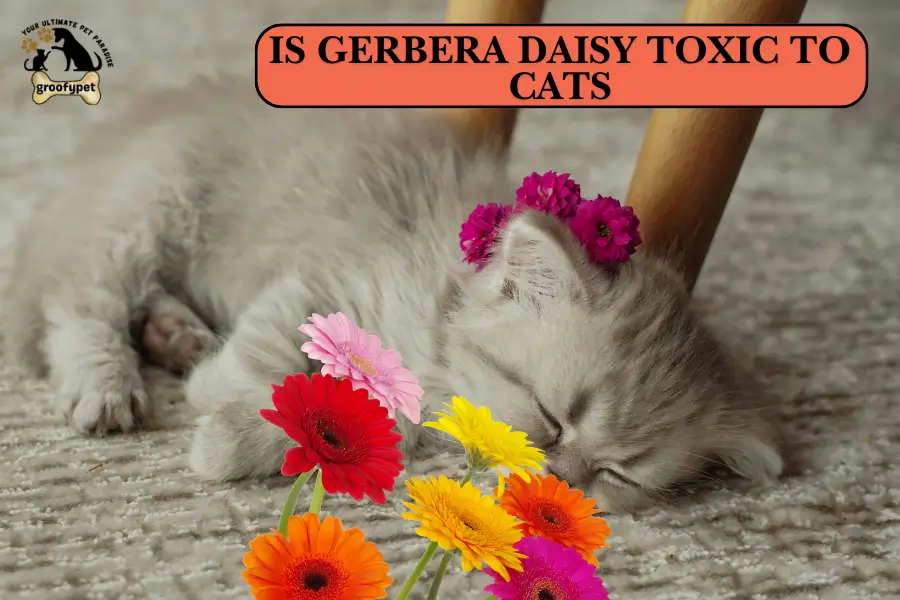
Gerbera daisies are not toxic to cats. Major pet safety references classify them as a non-toxic flower, which makes them one of the safer bouquet choices for a home with cats. But “non-toxic” is not the same as “safe to eat in any amount”. If your cat chews on a Gerbera daisy, you’re unlikely to see anything serious, though mild stomach upset can still happen.
This article walks through what gerbera daisy toxicity actually means, what happens if a cat eats one, which parts of the plant matter, and what steps to take if you catch your cat mid-nibble. We’ll also cover why cats chew plants in the first place, how Gerbera daisies compare to genuinely dangerous flowers like lilies, and how to set up your home so flowers and curious cats can coexist without a vet visit.
If you’re short on time, here’s the quick version: Gerbera daisies are generally safe, lilies are not, and any plant eaten in large amounts can cause an upset stomach in cats. The rest of this guide fills in the details.
Is Gerbera Daisy Toxic to Cats?
No. Gerbera daisy toxicity is not a real concern in the way it is for many other common flowers. Pet poison references list Gerbera daisy (Gerbera jamesonii) as non-toxic to cats, dogs, and horses. That means the plant does not contain compounds known to cause organ damage, poisoning, or life-threatening reactions in cats.
That said, non-toxic’ doesn’t mean a cat should treat it as a snack. Any plant material, even something harmless like grass or a Gerbera petal, can irritate a cat’s digestive tract if enough of it is swallowed. Cats aren’t built to digest plant fiber efficiently, so a cat that eats a large mouthful of leaves or petals may vomit or have loose stool, not because the plant is poisonous, but because its stomach is reacting to something it can’t process well.
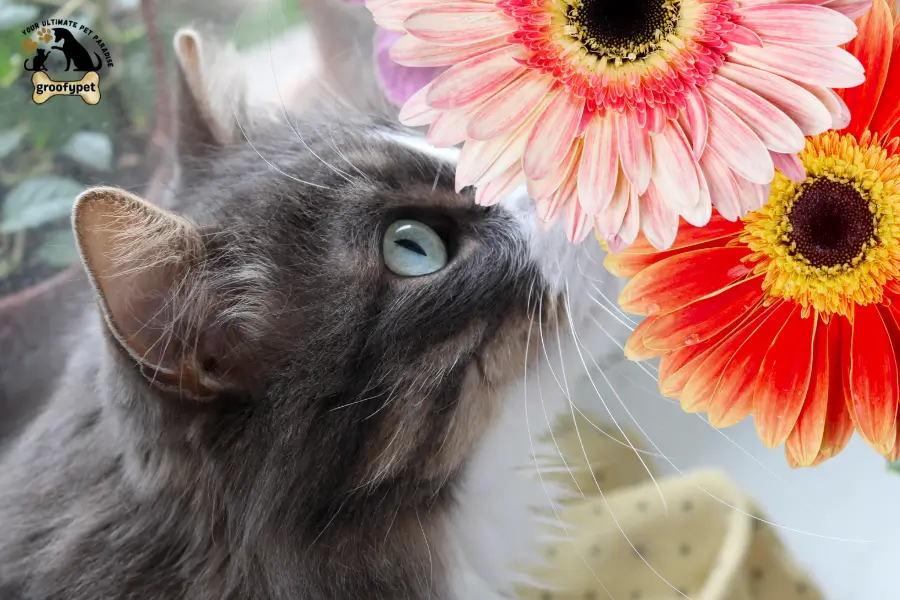
This is the key distinction worth remembering throughout this article: toxicity refers to whether a plant contains harmful chemical compounds. Digestive upset is a separate, much milder issue that can happen with almost any plant, toxic or not. Gerbera daisies fall into the “non-toxic but not meant to be eaten” category, along with quite a few common houseplants and cut flowers.
What Is a Gerbera Daisy?
Gerbera daisies, sometimes called gerber daisies, Transvaal daisies, African daisies, or Barberton daisies, are a popular flowering plant known for their large, colourful blooms. They belong to the daisy family and are native to parts of Africa and Asia, though they’re now grown and sold worldwide.
The flowers themselves are what make Gerbera daisies so popular. Each bloom has a central disc surrounded by long, layered petals in shades of red, orange, yellow, pink, white, and purple. The petals are soft and slightly papery, and the flower heads sit atop long, slender stems.
The leaves grow in a low rosette at the base of the plant. They’re broad, slightly fuzzy, and dark green, forming a cluster close to the soil while the flower stems rise above them. The stems themselves are thin but sturdy enough to hold the large flower heads upright.
Gerbera daisies are grown both indoors as potted plants and outdoors in gardens and flower beds. They’re also a staple in the cut flower industry, showing up in bouquets, floral arrangements, and gift shops because of their bright colors and long vase life. People often choose them specifically because they’re considered a safer option for households with pets, which is part of why “is Gerbera daisy toxic to cats” is such a common search.
Are Gerbera Daisy Flowers Safe for Cats?
The flower heads, meaning the petals and central disc, are generally considered safe for cats in the sense that they aren’t classified as toxic. A cat that bats at a gerbera daisy bloom, chews on a petal out of curiosity, or knocks a flower off the stem isn’t at risk of poisoning from the flower itself.
Still, a cat-safe flower doesn’t automatically become part of a cat’s diet. Petals have texture and fiber that a cat’s digestive system isn’t designed to break down easily. If a cat eats several petals or an entire flower head, the result can be mild nausea, a bit of drooling, or an upset stomach. This isn’t toxicity. It’s more like the reaction a person might have from eating something fibrous and unfamiliar in a large quantity.
Occasional nibbling on a single petal is unlikely to cause any noticeable reaction at all. The concern grows with quantity, not with a single curious lick or bite. If you have a cat that likes to graze on bouquets, it’s worth keeping an eye on how much they’re actually consuming rather than assuming one nibble equals one problem.
Are Gerbera Daisy Leaves and Stems Safe for Cats?
Leaves and stems deserve their own mention because cats don’t always go straight for the flower. Some cats are more interested in the leaves at the base of the plant or the stem itself, especially if the plant is still potted and accessible at floor level.
Available safety information treats Gerbera daisy leaves and stems the same way as the flowers: not classified as toxic. Cats often chew on leaves and stems simply because they’re curious, because the texture is interesting to bite, or because plants in general seem to attract feline attention, whether that’s due to movement, scent, or just the novelty of something green and alive in the house.
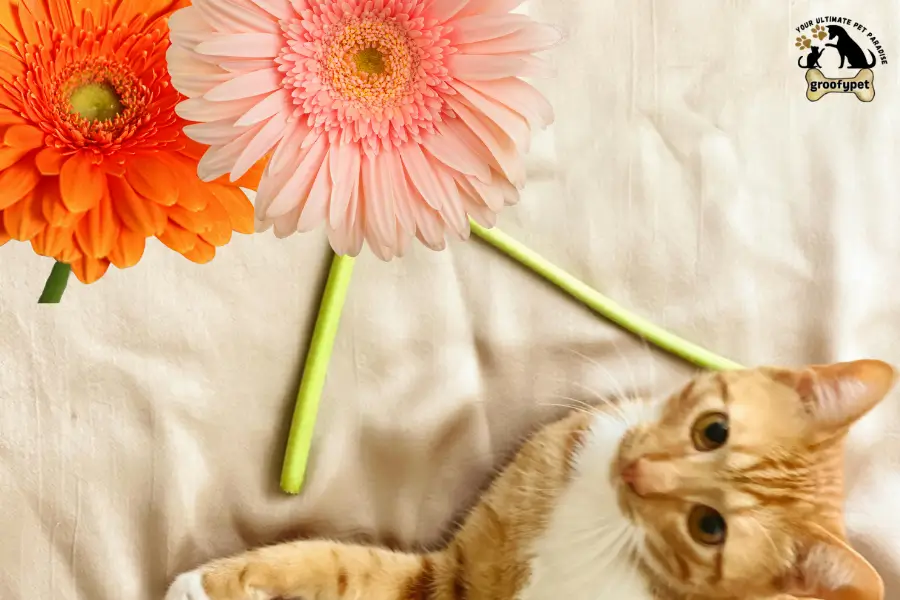
Even without toxicity, ingestion of leaves or stems can sometimes lead to mild gastrointestinal irritation. Stems in particular can be a bit fibrous and harder to digest than petals. A cat that swallows a chunk of stem might experience some digestive discomfort simply from the texture and fiber content, not from any chemical compound in the plant.
If you notice a cat repeatedly chewing on the leaves of a potted Gerbera daisy, it’s reasonable to relocate the plant somewhere less accessible, not because it’s dangerous, but because ongoing chewing increases the odds of stomach upset and can also damage the plant.
Also Read : Can Cats Eat Watercress? Benefits, Risks, and Safe Feeding Guide
What Happens If a Cat Eats a Gerbera Daisy?
In most cases, not much happens. A cat that eats a small amount of petal, leaf, or stem from a Gerbera daisy often shows no symptoms at all. Because the plant isn’t toxic, there’s no poison to worry about working its way through the cat’s system.
When a reaction does occur, it tends to be mild and short-lived. Possible signs include:
- Vomiting
- Diarrhea
- Drooling
- Mild stomach discomfort, which might look like reduced activity or a hunched posture
- Reduced appetite for a meal or two
These symptoms, when they happen, are usually the cat digestive system responding to unfamiliar plant material rather than a toxic reaction. The severity tends to track with how much was eaten. A cat that mouths a single petal and spits it out is very different from a cat that eats half a flower head.
Every cat is a little different. Some cats have more sensitive stomachs and will react to almost any new food or plant material, while others could eat a fair amount of a Gerbera daisy and show no reaction whatsoever. Age, overall health, and whether the cat has an empty or full stomach can all play a role in how noticeable any symptoms are.
It’s worth repeating that severe poisoning is not an expected outcome here. Gerbera daisy exposure is not comparable to exposure to a genuinely toxic plant, and owners shouldn’t assume the worst if their cat has taken a bite.
Can Gerbera Daisies Cause Vomiting or Diarrhea in Cats?
Yes, but the mechanism is digestive irritation, not poisoning. It helps to separate these two ideas clearly, because they get confused often in casual conversation about “toxic” plants.
Toxicity means a plant contains a compound that harms the body when absorbed, something like the chemicals in true lilies that damage a cat’s kidneys. Digestive irritation is a much more mechanical issue. It happens when the stomach and intestines react to something that’s hard to break down, whether that’s plant fiber, a hairball, or a random object the cat decided to chew.
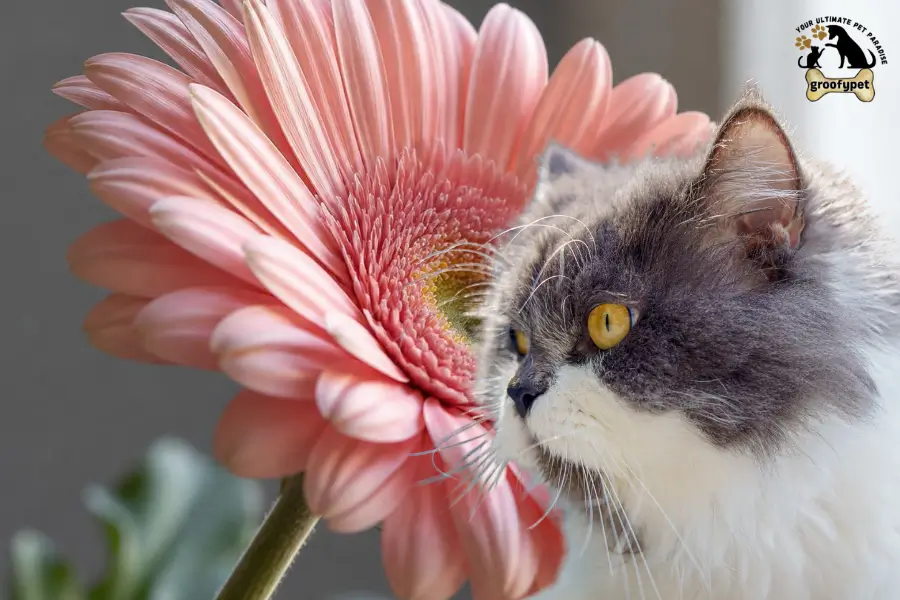
Gerbera daisies fall firmly into the second category. If a cat vomits or has diarrhea after eating one, it’s the digestive tract responding to fibrous plant material, not a toxin moving through the bloodstream. This is why the vomiting or diarrhea, if it happens, tends to resolve on its own within a short window rather than escalating.
Mild, isolated symptoms that clear up within a day and don’t repeat are usually fine to monitor at home. Veterinary advice becomes appropriate when symptoms are severe, when they don’t improve, when they happen repeatedly, or when they’re paired with other signs like lethargy or loss of appetite that lasts more than a day. This isn’t a precise medical rule, just a general sense of when “watch and wait” should turn into “make a call.”
Must Read : Can Cats Eat Spirulina? Benefits, Risks, and Safe Feeding Guide
What Should I Do If My Cat Eats a Gerbera Daisy?
If you catch your cat eating a Gerbera daisy or find chewed-up petals and suspect they’ve had a snack, here’s a practical, calm approach:
- Remove the plant from the cat’s reach. Move the bouquet or potted plant somewhere your cat can’t get to it again. This prevents repeat exposure while you sort out what happened.
- Determine approximately how much was eaten. A single missing petal is very different from a stripped flower head or a chewed stem. This matters for deciding how closely to monitor your cat.
- Identify the plant correctly. Make sure it’s actually a Gerbera daisy and not a similar-looking flower. Some daisies, like Shasta daisies, are not the same species and carry different safety information. If you’re not sure what your cat ate, treat it as an unknown plant until you can confirm.
- Check whether the plant was treated with pesticides, fertilizers, or other chemicals. This is a separate safety question from the plant itself, covered in more detail below.
- Monitor the cat for unusual symptoms. Watch for vomiting, diarrhea, drooling, or a drop in appetite or energy over the next several hours.
- Contact a veterinarian if concerning symptoms develop. Repeated vomiting, ongoing diarrhea, lethargy, or any symptom that seems severe or doesn’t improve is worth a call.
Don’t try to induce vomiting at home. This isn’t necessary for Gerbera daisy exposure, and doing it without guidance can cause its own problems. Similarly, don’t give any medication, human or otherwise, without direction from a veterinarian. Most of the time, watching and waiting is all that’s needed, but it’s always reasonable to call a vet or a pet poison hotline if you’re uncertain.
Are Gerbera Daisies Safe If They Have Been Treated With Chemicals?
This is a question that gets overlooked, but it matters. The Gerbera daisy plant itself is non-toxic, but what’s been sprayed, dusted, or watered onto it is a completely separate safety issue.
Commercially grown flowers, especially those sold at florists or grocery stores, are sometimes treated with:
- Pesticides, used to protect the crop from insects during growth
- Insecticides, applied similarly to prevent pest damage
- Fertilizers, which can leave residue on soil and lower leaves
- Floral preservatives, the small packets or additives mixed into vase water to extend a bouquet’s freshness
None of these are part of the Gerbera daisy plant itself, but a cat chewing on treated leaves or drinking preservative-laced vase water could be exposed to substances that aren’t accounted for in “the plant is non-toxic” statements. This is why a plant being non-toxic doesn’t automatically make every version of it risk-free.
If you’re buying cut flowers, it’s reasonable to rinse them before display and to keep cats from drinking the vase water, especially if you’ve added a floral preservative packet. For potted plants, especially ones bought from a garden center, it’s worth asking whether they’ve been treated with any pesticide, particularly if you know your cat likes to chew on leaves.
There isn’t a universal answer here about specific products, since formulations vary by brand and grower. The general takeaway is simply to treat commercially sourced flowers with a bit more caution than the plant’s baseline toxicity rating alone would suggest.
Gerbera Daisy vs Other Flowers for Cats
Seeing Gerbera daisies next to other common flowers helps put their safety profile in context.
| Flower | General Cat Safety | Main Consideration |
|---|---|---|
| Gerbera Daisy | Generally non-toxic | Eating plant material may cause stomach upset |
| Rose | Generally non-toxic | Thorns can cause injury |
| Sunflower | Generally non-toxic | Avoid treated plants |
| Snapdragon | Generally non-toxic | Monitor for digestive upset |
| Lily | Highly dangerous | Can cause life-threatening kidney injury |
The gap between Gerbera daisies and true lilies is worth pausing on. Lilies aren’t just “more toxic” than Gerbera daisies in a minor way. They’re in an entirely different risk category. Even a small amount of pollen or a lick of water from a vase holding lilies can trigger kidney failure in a cat. This is a genuine emergency, not something to monitor at home.
It’s also worth noting that not every flower in the lily family carries identical risk, and not every rose or sunflower situation is risk-free either. Roses are generally non-toxic, but thorns can cause physical injury, cuts, or punctures that have nothing to do with toxicity. The safety of a flower depends on more than just its toxicity classification.
Which Flowers Are Toxic to Cats?
While Gerbera daisies are safe, plenty of common flowers are not, and it’s worth knowing the major ones.
True lilies, including Easter lilies, tiger lilies, and daylilies, are the most dangerous flowers for cats by a wide margin. Every part of the plant, including pollen and vase water, can cause severe poisoning. Cats can suffer serious kidney damage from surprisingly small amounts of exposure, and this can happen quickly. Any suspected lily exposure should be treated as urgent.
Beyond lilies, other plants and flowers carry their own risks, though generally less severe. Some bulbs, certain flowering plants used in holiday arrangements, and various common garden plants can cause anything from mild irritation to more significant reactions depending on the species and the amount consumed.
Rather than trying to memorize an exhaustive list, the more reliable approach is to identify any unfamiliar plant before letting your cat near it. If you receive a bouquet, get a potted plant as a gift, or aren’t sure what’s growing in your garden, take a moment to find out what it is before assuming your cat is safe around it.
Why Do Cats Eat Plants and Flowers?
There isn’t one single proven reason cats chew on plants, but a few explanations come up consistently.
Curiosity plays a large role. Cats explore their environment with their mouths as much as their paws, and a new plant in the house is often treated as something worth investigating.
Play is another factor. The way petals flutter or stems bend can trigger a cat’s instinct to bat, pounce, or bite, especially with younger or more energetic cats.
Texture matters too. Some cats seem drawn to the specific feel of certain leaves or petals in their mouth, similar to how they might be drawn to chewing on cardboard, plastic, or fabric.
Other contributing factors include general boredom, especially in indoor cats without much environmental stimulation, an interest in movement, since a plant swaying in a breeze or being brushed past can catch a cat’s eye, and an attraction to plant smells, since some plants have scents cats find interesting even if they aren’t catnip.
It’s unlikely that any single explanation covers every cat. Plant chewing is probably a mix of instinct, boredom, and simple curiosity, and it varies quite a bit from one cat to another.
How to Keep Gerbera Daisies Safe Around Cats
Since Gerbera daisies are non-toxic but not meant to be eaten, a bit of practical prevention goes a long way toward avoiding stomach upset and keeping your flowers intact.
- Keep flowers where cats cannot chew them. Elevated shelves, closed rooms, or areas your cat doesn’t frequent all work well.
- Remove fallen petals and leaves. Cats will sometimes go after debris on the floor even if the main plant is out of reach.
- Avoid plants treated with unknown chemicals. If you’re not sure whether a plant has been treated, rinse it or ask before bringing it into a cat-accessible area.
- Choose cat-safe plants for homes with curious cats. If a particular cat is a known plant-chewer, it may be easier to stick with plants that are both non-toxic and less appealing to chew.
- Identify unfamiliar flowers before bringing them indoors. This is especially important with gift bouquets, which often mix several flower types, some of which may be genuinely toxic.
- Watch cats around new plants, at least for the first day or two, to see how much interest they show.
None of this requires giving up flowers entirely. It’s mostly about being deliberate with placement and knowing what you’re bringing into the house.
Cat-Safe Flower Alternatives
If you want to diversify your flower choices beyond Gerbera daisies, a few other options are commonly regarded as safer for cat households:
- Roses are non-toxic, though the thorns require some handling care.
- Sunflowers are generally safe and popular for their bold look.
- Orchids are typically considered non-toxic and are a common choice for indoor arrangements.
- Snapdragons are generally safe, with occasional mild digestive upset possible if eaten in quantity.
- Zinnias are another commonly recommended non-toxic option for gardens and cut arrangements.
As with Gerbera daisies, “non-toxic” doesn’t mean “edible.” Each of these flowers can still cause mild stomach upset if a cat eats a large amount, and factors like thorns, pesticides, fertilizers, and floral preservatives remain relevant regardless of which flower you choose. The safety label applies to the plant tissue itself, not to everything that might be on or around it.
How to Tell If a Cat May Have Plant Poisoning
Since Gerbera daisies aren’t a poisoning risk, this section is really about recognizing when a different, more dangerous plant might be involved. General warning signs of possible plant poisoning in cats include:
- Repeated vomiting
- Severe diarrhea
- Excessive drooling
- Weakness
- Tremors
- Difficulty breathing
- Loss of coordination
- Collapse
- Severe lethargy
These symptoms vary quite a bit depending on which plant is involved. A cat with mild digestive upset from something harmless might vomit once and otherwise act normal. A cat exposed to a genuinely toxic plant, like a lily, can show a very different pattern, including symptoms that escalate quickly and affect the whole body.
If you know or strongly suspect your cat has eaten a plant known to be toxic, don’t wait to see whether symptoms show up before seeking guidance. Prompt veterinary contact is the safer path any time a known toxic plant is involved.
When Should You Call a Veterinarian?
Certain situations call for professional advice rather than at-home monitoring:
- The cat ate an unknown plant, and you can’t confirm what it is.
- The plant may be a lily, in any variety.
- The plant was heavily treated with chemicals.
- The cat develops repeated vomiting.
- The cat develops severe diarrhea.
- The cat becomes unusually weak or lethargic.
- The cat has difficulty breathing.
- The cat develops tremors or seizures.
- The cat collapses.
For gerbera daisy exposure specifically, most of these situations are unlikely. A cat that nibbles a petal and seems fine an hour later doesn’t need a vet visit. But if you’re ever uncertain about what plant was actually eaten, or if any of the more serious symptoms above show up, it’s better to call than to guess. Suspected lily exposure in particular should always be treated as an emergency and addressed immediately rather than waiting for symptoms to appear.
Frequently Asked Questions
Is gerbera daisy toxic to cats?
No. Gerbera daisy is generally classified as non-toxic to cats. It doesn’t contain compounds known to cause poisoning. Eating a large amount of the plant can still cause mild digestive upset, but this is different from toxicity, and serious harm isn’t expected from typical exposure.
Are Gerbera daisies safe for cats?
Yes, in the sense that they aren’t toxic. Cats can safely be around Gerbera daisies without a poisoning risk. That said, the flowers aren’t meant to be eaten regularly, and chemicals used on commercially grown or treated plants are a separate consideration worth checking.
What happens if my cat eats a Gerbera daisy?
Most cats show no reaction to a small amount. If a larger quantity is eaten, mild symptoms like vomiting, diarrhea, or drooling are possible. These usually resolve on their own and reflect digestive irritation rather than poisoning.
Can cats eat Gerbera daisy petals?
Cats can chew or swallow petals without being poisoned, since the flower isn’t toxic. Eating a large number of petals may still cause an upset stomach, so petals shouldn’t be treated as a regular snack.
Are Gerbera daisy leaves toxic to cats?
No, leaves are also considered non-toxic. Like the petals, they can cause mild digestive irritation if eaten in quantity, especially since the fibrous texture isn’t easy for a cat’s stomach to process.
Can Gerbera daisies cause vomiting in cats?
Yes, in some cases, but this comes from digestive irritation rather than toxicity. A cat that eats a significant amount of petal, leaf, or stem may vomit as its stomach responds to the plant material.
Can Gerbera daisies cause diarrhea in cats?
It’s possible, particularly after eating a larger amount of the plant. As with vomiting, this is a digestive reaction rather than a sign of poisoning, and it typically resolves without lasting effects.
What should I do if my cat eats a Gerbera daisy?
Move the plant out of reach, estimate how much was eaten, and watch your cat for symptoms like vomiting or diarrhea. Contact a veterinarian if symptoms are severe, repeated, or don’t improve within a reasonable time.
Are Gerbera daisies safe indoors with cats?
Generally, yes. They’re one of the safer flowering plants for a home with cats. Placement still matters, since ongoing chewing can lead to stomach upset even though the plant itself isn’t dangerous.
What flowers are toxic to cats?
True lilies are the most dangerous, capable of causing severe kidney damage from small exposures. Other plants carry varying levels of risk. Identifying unfamiliar flowers before exposing your cat to them is the safest general approach.
Are roses safe for cats?
Roses are generally non-toxic to cats. The main concern is physical, since thorns can cause cuts or punctures rather than any chemical toxicity.
Are lilies dangerous for cats?
Yes, significantly so. True lilies can cause life-threatening kidney injury in cats, even from small amounts of pollen or vase water. Any suspected lily exposure should be treated as an emergency requiring immediate veterinary attention.
Key Takeaways
- Gerbera daisies are generally considered non-toxic to cats.
- Non-toxic does not mean edible, and large amounts of any plant can cause stomach upset.
- Vomiting, diarrhea, or drooling after eating a Gerbera daisy usually reflects digestive irritation, not poisoning.
- Chemicals used on commercially grown or treated flowers, like pesticides or floral preservatives, are a separate risk from the plant itself.
- Correctly identifying unknown plants before your cat has access to them is one of the most useful safety habits you can build.
- True lilies are a major exception and should always be treated as a serious danger to cats.
- Contact a veterinarian if symptoms are severe, persistent, or involve an unknown or potentially toxic plant.
Final Thoughts
Gerbera daisies are one of the more forgiving flowers to have around a curious cat. They don’t carry the poisoning risk that so many other common flowers do, which is part of why they show up so often in cat-safe flower recommendations. A cat that nibbles a petal or chews a leaf isn’t facing a poisoning emergency.
That doesn’t mean the plant should be treated as cat food. Large amounts of any plant material, Gerbera daisy included, can upset a cat’s stomach simply because cats aren’t built to digest fiber the way some other animals are. Add in the possibility of pesticide residue or floral preservatives on commercially sourced flowers, and it’s clear that “non-toxic” is only part of the safety picture.
The most useful habit for any cat owner is simple: know what plant is in your home before your cat gets curious about it. Gerbera daisies are a safe bet in that regard. Lilies and a handful of other flowers are not, and knowing the difference is what actually keeps cats safe.