You call your dog’s name for the fourth time. They glance at you, go back to sniffing the grass, and stroll the other way. It is easy to decide your dog is being stubborn.Most of the time, though, a “stubborn” dog is a distracted, confused, stressed, or under-rewarded dog. The best way to train a stubborn dog is to use consistent reward-based training, short sessions, one clear cue at a time, rewards your dog truly values, and gradual practice in new places.
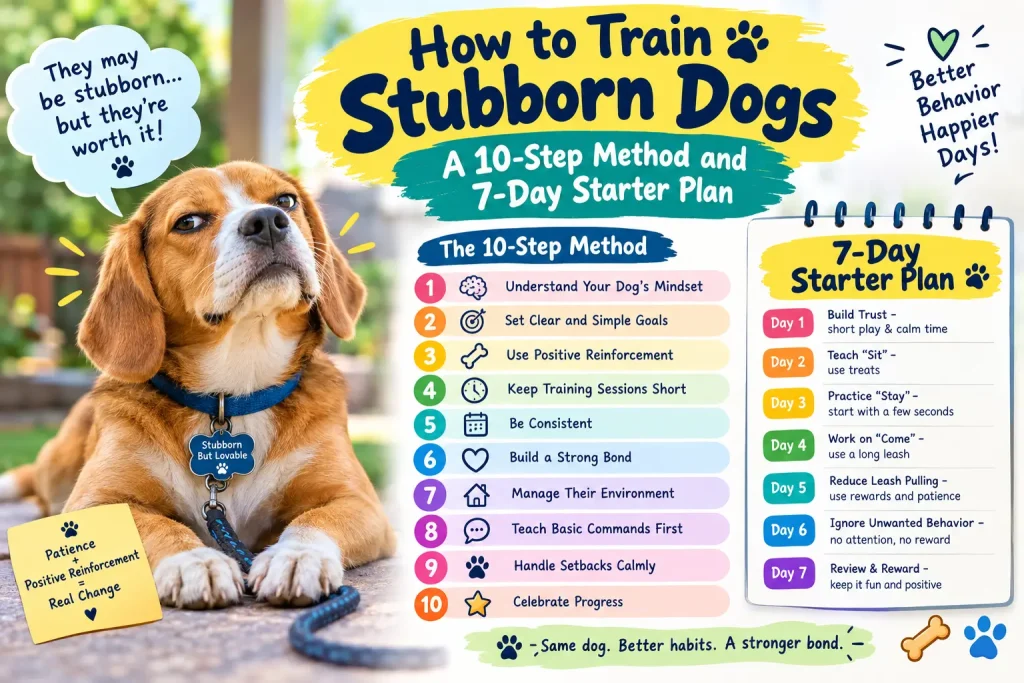
In this guide, you will learn why dogs seem stubborn, how to tell the difference between distraction and defiance, a 10-step training method, a 7-day starter plan, and when to ask a professional for help.
How to Train Stubborn Dogs
To train a stubborn dog, pick one behavior, start in a quiet place, and reward the correct response right away with something your dog loves. Use one clear cue, keep sessions short, and add distractions slowly. Progress depends on your dog’s history, motivation, and environment.
Here is the basic sequence:
- Choose one behavior to teach.
- Begin in a quiet environment.
- Pick a reward your dog enjoys.
- Give one clear verbal cue.
- Reward the correct response immediately.
- Repeat in short sessions.
- Gradually introduce distractions.
Every dog moves at a different pace. A shy rescue, a bouncy adolescent, and a calm senior will all need different timing, rewards, and expectations.
Why Does My Dog Seem So Stubborn?
Dogs rarely ignore you out of spite. When a dog does not respond, there is usually a reason you can fix. These are the most common ones:
- The dog does not fully understand the cue. A dog who sits in the kitchen may not yet know that “sit” means sit at the park.
- The environment is too distracting. Squirrels, smells, and other dogs can easily outcompete you.
- The reward is not motivating enough. A dry biscuit may lose to an exciting scent trail.
- The dog has too much energy or needs rest. Overexcited and overtired dogs both struggle to focus.
- Commands are inconsistent. If one person says “down” and another says “off,” your dog may be guessing.
- Fear, stress, or anxiety is getting in the way. A worried dog is busy coping, not learning.
- Pain, illness, hearing changes, or aging affect responses. A dog who suddenly “stops listening” may not be able to comply comfortably or may not hear you.
Is Your Dog Stubborn or Just Distracted?
A quick test: can your dog do the behavior easily in a quiet room? If yes, the dog probably understands the cue, and the problem is likely the environment or the reward. If no, the dog may not have learned the cue yet.
Also Read : Why Do Dogs Bark at Cats? 10 Reasons and Proven Solutions!
Use this table to sort out what you are seeing. These are general patterns, not a diagnosis.
| What You Notice | Possible Reason | What to Try |
|---|---|---|
| Sits indoors, ignores you at the park | Distractions are too strong, or the skill is not generalized | Practice in easier outdoor spots, move farther from triggers, use better rewards |
| Never responds, even in a quiet room | The cue was never fully taught | Go back to basics and teach the behavior in small steps |
| Responds, but only sometimes | Rewards are inconsistent or low in value | Reward every correct response while learning, test higher-value treats |
| Freezes, yawns, lip-licks, or avoids you | Stress or fear | Lower the pressure, shorten sessions, watch body language, consider professional help |
| Used to listen, now doesn’t | Possible pain, hearing change, or other health issue | Schedule a veterinary check |
| Gets wild and mouthy during training | Too excited or overtired | Train after a walk, shorten sessions, add calm rest breaks |
Not every disobedient moment is defiance. Treat it as information about what your dog needs next.
10 Steps to Train a Stubborn Dog
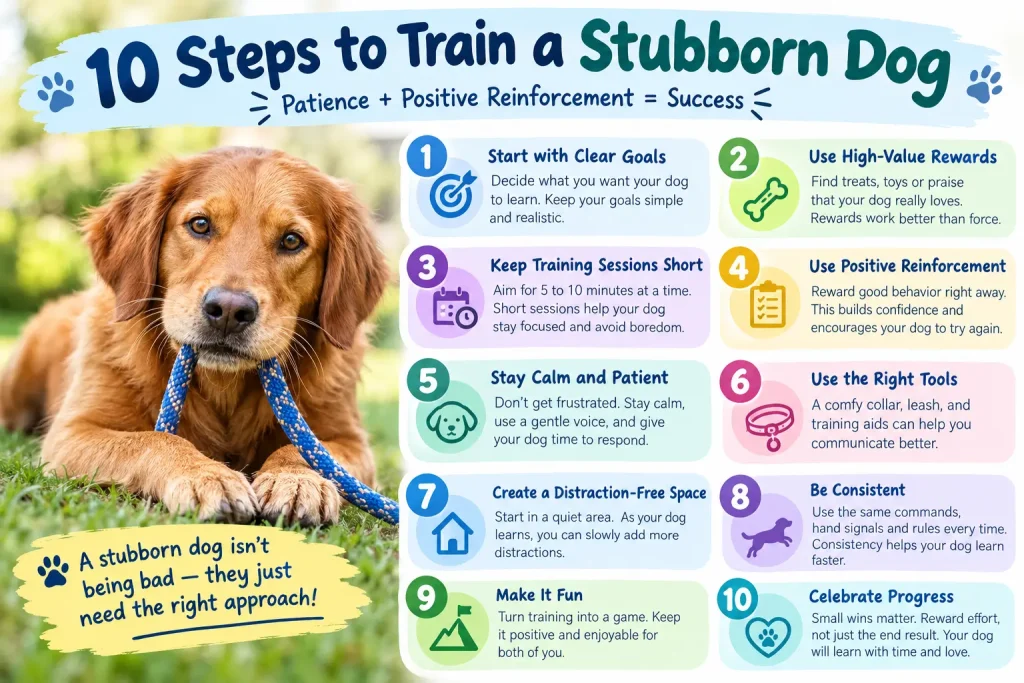
Step 1: Start With One Simple Command
Choose one behavior, such as sit, come, stay, or leave it. Teaching several new cues at once can overwhelm a dog and blur the lines between them.
Example: This week, work only on “sit.” Next week, add “down” once sit is reliable at home.
Step 2: Find What Motivates Your Dog
Rewards differ between dogs and between situations. Try small soft training treats, a favorite toy, enthusiastic praise, or permission to sniff something interesting.
Example: Offer a piece of dry kibble, then a pea-sized piece of chicken. Notice which one makes your dog’s eyes light up.
Step 3: Train in a Quiet Environment
Start in a familiar room with little noise and no other pets. Success comes faster when your dog can actually focus on you.
Example: Practice in the living room with the TV off and the kids in another room.
Step 4: Use Short and Consistent Training Sessions
Several brief sessions of about 3 to 5 minutes are a practical starting point. Adjust to your dog’s attention and comfort, and stop while your dog is still engaged.
Example: Do three mini-sessions a day: before breakfast, mid-afternoon, and before dinner.
Step 5: Give Clear Commands Once
Say the cue one time, then give your dog a moment to respond. Rapid repetition (“sit, sit, SIT”) teaches dogs that the first cue can be ignored. Avoid stacking different instructions together.
Example: Say “Sit” once, wait three to five seconds, then guide or reset if needed.
Step 6: Reward the Correct Behavior Immediately
Use a consistent marker word like “Yes!” or a clicker at the exact moment your dog does the right thing. Then deliver the reward promptly. Good timing tells your dog exactly what earned the treat.
Example: The moment your dog’s bottom touches the floor, say “Yes!” and give the treat.
Step 7: Make Difficult Tasks Easier
Break challenging behaviors into smaller steps. If your dog cannot do the full exercise, lower the difficulty instead of forcing the response.
Example: If your dog won’t stay, reward one second of staying. Then two. Then five.
Step 8: Practice Around Gradual Distractions
Introduce mild distractions only after your dog succeeds in a quiet setting. Change one thing at a time: distance, duration, or distraction.
Example: Practice “sit” in the hallway while a family member walks past at a distance, rather than starting with a busy sidewalk.
Step 9: Prevent Unwanted Habits From Being Rehearsed
Every time a behavior pays off, it gets stronger. Use management tools such as baby gates, secure leashes, closed doors, and controlled spaces so your dog cannot practice the habits you are trying to change. Management does not replace training. It makes success easier while the new skills build.
Example: If your dog bolts out the front door, use a gate or leash at the entry while you train a solid “wait.”
Step 10: Stay Consistent and Track Progress
Ask everyone in the household to use the same cues and the same reward rules. Track small improvements instead of expecting instant obedience.
Example: Post a sheet on the fridge listing the cue words, and note each day how many times your dog responded correctly.
The 7-Day Stubborn Dog Training Plan
This is a starting plan, not a promise that every dog will master these skills in one week. Some dogs will need to repeat a day several times. That is normal.
| Day | Training Goal | Practice Activity | Signs of Progress |
|---|---|---|---|
| 1 | Identify the most important behavior and choose rewards | Test 3 to 4 rewards. Pick one target behavior, such as come or sit | You know which reward your dog works hardest for |
| 2 | Attention and name recognition | Say your dog’s name once, mark and reward eye contact. Do 3 short sessions | Dog looks at you quickly when called in a quiet room |
| 3 | Teach or refresh a simple command | Lure or capture “sit” or another simple behavior, adding the cue once the behavior is reliable | Dog performs the behavior with fewer prompts |
| 4 | Indoor recall with a safe setup | Practice “come” in a hallway or a secure room, rewarding generously when your dog arrives | Dog comes promptly over a short indoor distance |
| 5 | Introduce mild distractions | Practice while a toy sits nearby or a person moves quietly in the room | Dog still responds with small distractions present |
| 6 | Practice in another suitable environment | Try a quiet yard or a calm, low-traffic area (on a leash or long line if needed) | Dog responds, even if slower than at home |
| 7 | Review and repeat what worked | Repeat the most successful exercises and note which need more work | You can name two skills improved and one to focus on next |
How to Train a Stubborn Dog That Ignores Commands
A dog who seems to hear you but does not respond is usually not choosing to defy you. Work through this checklist:
- Check whether your dog understands the cue. Try it in a quiet room. If it falls apart, the skill needs more teaching.
- Reduce distractions and increase distance from triggers. Move farther from the squirrel, dog, or busy path.
- Improve the timing and value of rewards. Mark the instant your dog succeeds and use something worth working for.
- Avoid calling repeatedly when success is unlikely. Each ignored cue teaches your dog that cues are optional. Instead, move closer or change the setup.
- Practice the same skill in different environments. Dogs do not automatically transfer learning from one place to another.
- Rebuild from an easier level if necessary. Going back a step is part of training, not a failure.
Example: Your dog sits perfectly indoors but ignores you at the park. Don’t keep repeating “sit.” Move to a quieter corner of the park, farther from other dogs, and ask for an easy sit with a very high-value treat. Once your dog succeeds, gradually move closer to the busier area.
Read This : Why Does My Dog Lick My Nose So Gently?
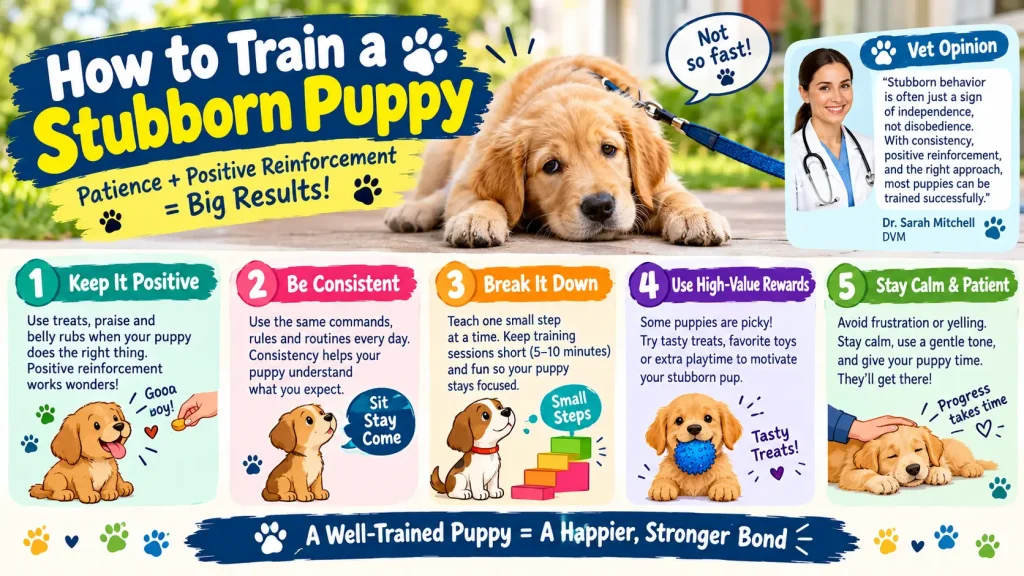
How to Train a Stubborn Puppy
Puppies are not small adult dogs. Their attention spans are short, their bodies tire quickly, and they are still learning how the world works.
- Keep sessions very short. A minute or two, several times a day, often works better than one long session.
- Reward quickly. Puppies connect actions and treats best when the reward comes right away.
- Build toilet routines. Take puppies out after waking, eating, playing, and at regular intervals, and reward success outside.
- Teach bite inhibition gently. Redirect mouthing to a toy and pause play when teeth hit skin, without scaring the puppy.
- Start name recognition. Say the name once, reward eye contact, and make it always mean something good.
- Socialize carefully. Offer positive, low-pressure exposure to new people, sounds, and surfaces. Ask your veterinarian what is safe at each stage of vaccination.
- Protect sleep. Puppies need plenty of rest, and a tired puppy often behaves like a “stubborn” one.
Expect mistakes. A puppy who forgets a cue is usually a puppy who is still learning, not a puppy who is misbehaving on purpose.
How to Train a Stubborn Adult or Rescue Dog
An adult or rescue dog comes with a history you may not know. Previous training (or lack of it), fear, unfamiliar surroundings, and a sudden change in routine can all affect how they respond.
- Build trust first. Calm, predictable interactions matter more than perfect obedience in the first days.
- Set predictable routines. Regular meals, walks, and rest times help a dog feel safe.
- Reward small successes. Looking at you, taking a treat gently, or relaxing on a bed all count.
- Give the dog time to settle. Some dogs need weeks, not days, to feel comfortable in a new home.
Adult dogs can absolutely learn new behaviors. The pace just needs to match the individual dog, especially one who is shy or cautious.
Common Mistakes That Make Dog Training Harder
| Mistake | Better Alternative |
|---|---|
| Repeating commands without changing the training setup | Change the setup: move closer, reduce distractions, or improve the reward |
| Training for too long | Keep sessions short and end on a success |
| Using rewards the dog does not value | Test treats, toys, and praise to find what works right now |
| Expecting immediate results | Track small improvements and celebrate progress |
| Introducing distractions too early | Add one distraction at a time after success in a quiet place |
| Changing commands between family members | Agree on cue words and reward rules for the whole household |
| Punishing growling or fear signals | Treat growling as communication, back off, and seek help to address the cause |
| Comparing one dog’s progress with another’s | Measure your dog against their own starting point |
Punishing a growl can be especially risky. A dog who is punished for warning signals may stop warning you and skip straight to biting, which makes the underlying fear harder to spot and treat.
Should You Punish a Stubborn Dog?
In general, no. Reward-based training is preferred over methods that rely on pain, intimidation, or fear. The American Veterinary Society of Animal Behavior (AVSAB) has published a position statement recommending reward-based methods over aversive ones, and many professional trainers follow the same approach.
Physical corrections, yelling, and frightening equipment can damage trust and may make fear-related behavior worse. A dog who is afraid of you is not learning what you want. They are learning to avoid trouble.
Instead, reinforce the behavior you want and adjust the environment so success is easier. This does not mean allowing unwanted behavior. You can set clear boundaries, such as keeping the trash can closed or using a gate to block the kitchen, while teaching your dog humane alternatives.
When to Seek Professional Help
Training takes patience, but some situations call for expert support. Contact a veterinarian or a qualified, reward-based dog trainer if you notice:
- A sudden behavior change
- Signs of pain, such as limping, flinching when touched, or reluctance to jump
- Possible hearing problems
- Severe fear or persistent anxiety
- Aggression toward people or other animals
- Repeated training difficulties despite consistent effort
If a previously responsive dog suddenly stops listening, or shows other unusual changes, schedule a veterinary check first. Pain, illness, or sensory changes can look like stubbornness.
For serious aggression or safety concerns, avoid forcing interactions or “testing” your dog. Seek individualized guidance from a veterinarian, a veterinary behaviorist, or a certified professional dog trainer who uses reward-based methods. Check credentials before hiring.
Unique Training Tips Most Dog Owners Overlook
The 3-Question Training Check
Before deciding your dog is stubborn, ask:
- Does my dog understand what I am asking?
- Can my dog succeed in this environment?
- Is the reward valuable enough right now?
If the answer to any of these is “no,” fix that first.
The Distraction Budget
A dog may handle one challenge at a time but struggle when noise, movement, unfamiliar people, and other dogs all appear together. Think of your dog’s focus as a budget. Reduce competing distractions before increasing difficulty.
The First-Response Journal
Record how often your dog responds to a cue on the first attempt in a familiar setting. For example, note “6 out of 10 first-try sits” this week. Use this record to see progress and decide when it is time to raise difficulty.
The Reinforcement Menu
Do not assume food is always the best motivator. Create a menu of suitable rewards: different treats, a short game of tug, praise, or access to a favorite activity like sniffing or going through a door. Test them and use the best one for each situation.
The Reset Rule
If your dog fails repeatedly, pause and make the next repetition easier. Changing the setup (more distance, fewer distractions, better reward) is often more productive than repeating the same unsuccessful command.
Frequently Asked Questions
How do you train a stubborn dog quickly?
There is no reliable shortcut, but you can speed up progress by training one behavior at a time, using high-value rewards, keeping sessions short, and practicing daily. Rushing into distractions often slows things down. Focus on setting your dog up to succeed.
Can a stubborn dog still be trained?
Yes. Most dogs that seem stubborn can learn when training is clear, consistent, and motivating. Progress depends on the dog’s history, health, and temperament. If you are stuck, a certified reward-based trainer can help you adjust your plan.
Why does my dog listen at home but not outside?
Outdoors has far more smells, sights, and sounds competing for attention, and dogs do not automatically carry skills across locations. Practice in new places gradually, start with low distractions, and use higher-value rewards when the environment is more exciting.
How long does it take to train a stubborn dog?
It varies widely. Some dogs show improvement within days, while others need weeks or months of steady practice. Age, past experiences, health, and consistency all matter. Measure progress by small wins instead of a fixed deadline.
What is the best way to motivate a stubborn dog?
Find out what your dog loves most. Test different treats, toys, praise, and activities, and use the best option for the situation. Keep rewards small and quick, and save the most exciting rewards for harder tasks.
Should I repeat a command if my dog ignores me?
Usually not. Repeating teaches your dog that the first cue is optional. Instead, check whether your dog understands, reduce distractions, move closer, or make the task easier, then give the cue once and reward success.
Can older dogs learn obedience?
Yes. Adult and senior dogs can learn new behaviors, often with great focus. Keep sessions short, use rewards they enjoy, and consider physical comfort. If an older dog suddenly stops responding, check with your veterinarian.
Is my dog stubborn or anxious?
Signs such as panting, trembling, lip licking, avoiding eye contact, or freezing may suggest stress or anxiety rather than stubbornness. You cannot diagnose a dog from a few behaviors, so talk with your veterinarian or a qualified behavior professional.
What should I do if my dog refuses treats during training?
First check for stress, nausea, or illness, and talk to your vet if refusal is new. Otherwise, try softer, smellier treats, train before meals, or use toys and praise. Reduce distractions if your dog is too excited or nervous to eat.
When should I hire a professional dog trainer?
Consider hiring a trainer if you are making little progress despite consistent effort, or if your dog shows fear, anxiety, or aggression. Choose a certified, reward-based professional. For sudden changes or signs of pain, see your veterinarian first.
Final Thoughts
When you learn how to train stubborn dogs, the biggest lesson is this: a dog who seems stubborn may need clearer communication, more suitable rewards, fewer distractions, or help with an underlying issue. Stubbornness is often a signal, not a character flaw.
Start with one manageable behavior. Reward small improvements and practice consistently, in short, happy sessions.Your next step: Pick one cue, such as “sit” or your dog’s name, and do three 3-minute sessions today in your quietest room. Write down how many times your dog responds on the first try, then use that number as your starting point.
Female Dog losing Hair On Tail? Causes and Fixes!
Why Does My Dog Eat His Treats on Me: A Powerful Sign of Love and Comfort!