If your dog just ate chocolate, you don’t have time to read a long article — so here’s the short answer first: symptoms of chocolate poisoning usually appear within 2 to 12 hours, and in severe cases, death from cardiac failure or seizures can occur within 24 hours of ingestion. The exact speed depends on the type of chocolate, how much was eaten, and your dog’s size.
Now let’s break down exactly what happens, hour by hour, and what you need to do next.How fast does chocolate kill dogs? In severe cases, chocolate poisoning in dogs can turn life-threatening within a matter of hours early symptoms like vomiting and restlessness may show up in as little as 2–4 hours, while the most dangerous signs (seizures, abnormal heart rhythms, and collapse) typically develop between 6 and 24 hours after ingestion.

Why Is Chocolate Dangerous for Dogs?
Chocolate contains two stimulant compounds, theobromine and caffeine, that belong to a class of chemicals called methylxanthines. Humans metabolise and clear these compounds fairly quickly, but dogs process them much more slowly.
That slow clearance is exactly why theobromine poisoning in dogs is so dangerous: the compound builds up in the bloodstream and keeps overstimulating the heart and central nervous system long after ingestion.
As theobromine and caffeine accumulate, they:
- Overstimulate the central nervous system
- Increase heart rate and can trigger irregular rhythms
- Act as diuretics, increasing the risk of dehydration
- Trigger the release of stress hormones that can raise body temperature
Why Chocolate Is Toxic to Dogs in the First Place
How fast does chocolate kill dogs? Chocolate contains two stimulant compounds called methylxanthines: theobromine and caffeine. Humans metabolise and clear these compounds quickly. Dogs can’t. Their bodies process theobromine slowly, which means it builds up in the bloodstream.
It keeps stimulating the heart and central nervous system long after a human would have cleared it out. Theobromine is the bigger threat of the two. It’s what turns an upset stomach into a cardiac emergency.
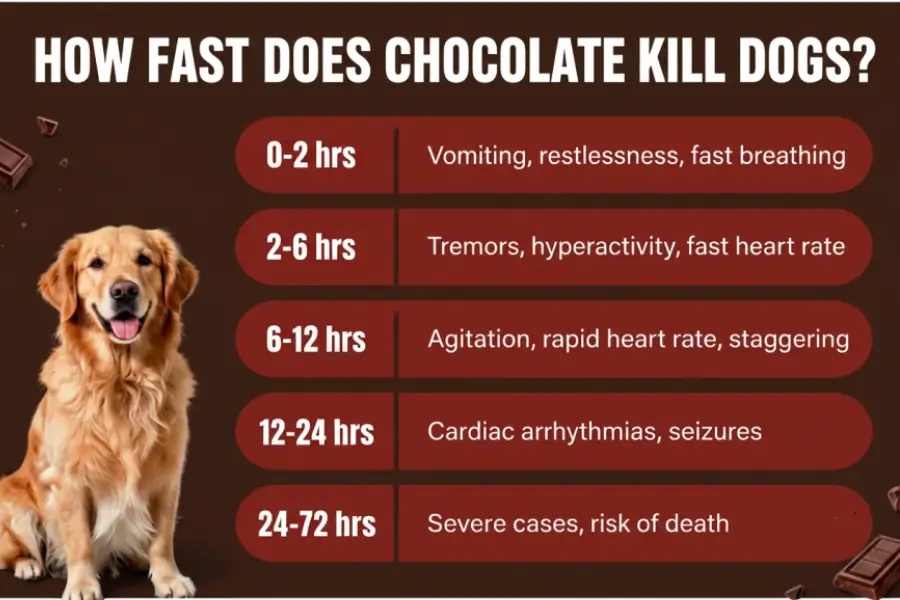
How Fast Does Chocolate Affect Dogs? Timeline of Symptoms
Because every case is different, think of this as a general symptom timeline rather than a guarantee.
Within 2–4 Hours
- Vomiting
- Restlessness
- Panting
- Mild drooling
Within 6–12 Hours
- Rapid heart rate
- Diarrhea
- Tremors
- Hyperactivity or agitation
Within 12–24 Hours
- Muscle rigidity
- Seizures
- Abnormal heart rhythms (arrhythmias)
Severe, Untreated Cases
- Collapse
- Coma
- Death
How long chocolate stays in a dog’s system and how quickly symptoms progress depends on the amount eaten, the type of chocolate, and the individual dog’s size, age, and health. In milder cases, clinical signs can also be delayed up to 24 hours before appearing, and effects may linger for several days as the body slowly clears the toxin.
How Much Chocolate Is Dangerous? Toxicity by Chocolate Type
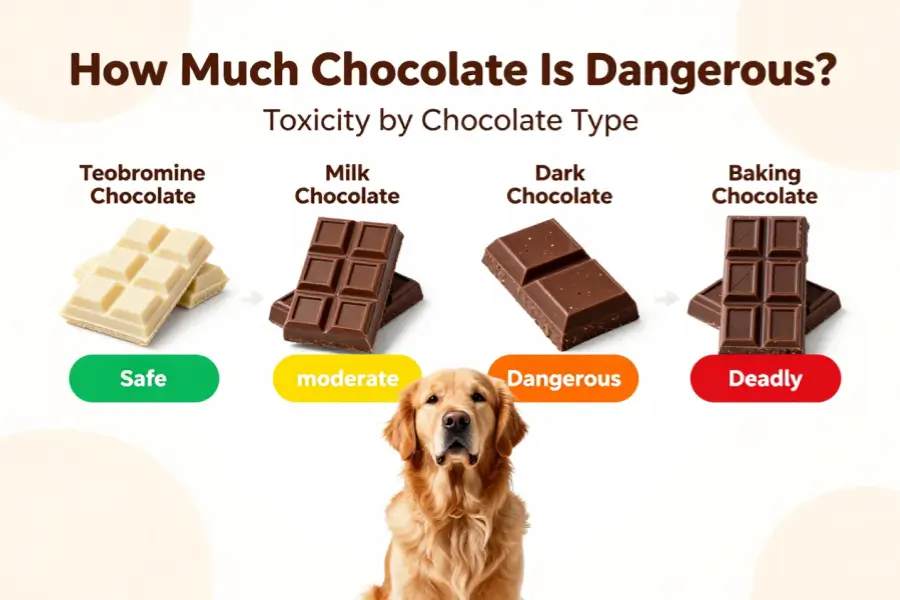
Not all chocolate is equally toxic. The general rule: the darker and more concentrated the chocolate, the higher the theobromine content, and the greater the danger.
| Chocolate Type | Theobromine Concentration | Toxicity Level | Risk |
|---|---|---|---|
| White chocolate | Minimal | Very Low | Mostly causes stomach upset from fat/sugar, rarely life-threatening |
| Milk chocolate | Low–Moderate | Moderate | Can be toxic in large amounts, especially for small dogs |
| Semisweet chocolate | Moderate | High | Toxic in relatively small amounts |
| Dark chocolate | High | Very High | Small amounts can cause serious poisoning |
| Baking chocolate (unsweetened) | Very High | Severe | One of the most dangerous forms; small amounts can be lethal |
| Cocoa powder | Highest | Most Severe | Extremely concentrated; even small quantities are dangerous |
Chocolate Toxicity by Dog Size

Because toxicity is dose-dependent (based on body weight), the same amount of chocolate that barely affects a large dog could be a medical emergency for a small one.
| Dog Weight | Approximate Amount That May Cause Toxicity* |
|---|---|
| Small dogs (under 20 lbs) | A small amount of dark chocolate or baking chocolate can be dangerous |
| Medium dogs (20–50 lbs) | Moderate amounts of milk chocolate or small amounts of dark chocolate pose risk |
| Large dogs (50–90 lbs) | Larger quantities of milk chocolate or moderate dark chocolate can be toxic |
| Extra-large dogs (90+ lbs) | Generally requires larger amounts, but concentrated cocoa products remain high risk. |
These are general estimates only. Toxicity always depends on the specific chocolate type, the exact amount eaten, and the individual dog. A chocolate toxicity calculator (offered by many veterinary clinics and poison control services) can give a more precise risk estimate, but it does not replace professional veterinary guidance.
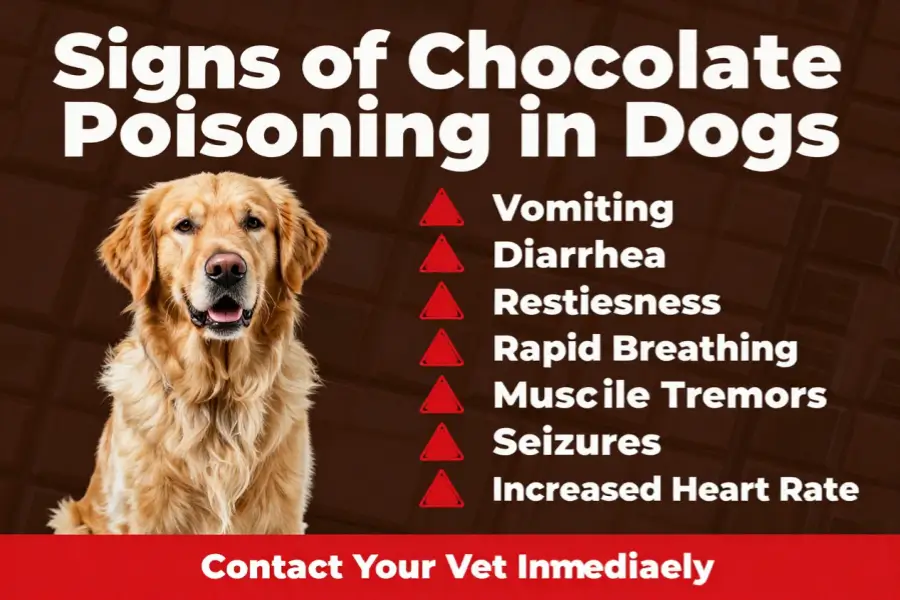
Symptoms of Chocolate Poisoning to Watch For
Symptoms typically progress in this order:
- Vomiting and diarrhea (sometimes with blood)
- Restlessness and excessive drooling
- Increased thirst and urination
- Rapid or irregular heart rate
- Muscle tremors or rigidity
- High body temperature
- Bluish gums (cyanosis)
- Seizures or collapse
If you notice any signs beyond mild stomach upset, especially tremors, a racing heart, or disorientation, treat it as an emergency, not a “watch and wait” situation.
What to Do in the First 30 Minutes
- Figure out the details. How much chocolate, what type, and roughly how long ago. Save any wrappers or packaging — they help the vet estimate the dose.
- Call a vet or poison control immediately. Don’t wait for symptoms to appear. Early treatment (within 1–2 hours) gives the best chance of inducing vomiting before absorption.
- Do not induce vomiting yourself without guidance. Some home remedies circulating online can cause more harm, especially if your dog is already showing neurological symptoms.
- Follow professional instructions. Depending on timing and dose, your vet may recommend inducing vomiting, administering activated charcoal, or bringing the dog in for IV fluids and monitoring.
Factors That Affect How Fast Chocolate Poisoning Happens
Several variables influence both the speed of onset and the severity of chocolate poisoning in dogs:
- Dog’s weight — smaller dogs reach a toxic dose with far less chocolate
- Dog’s age — puppies and senior dogs may be more vulnerable
- Existing medical conditions — dogs with heart disease or seizure disorders are at higher risk at lower doses
- Type of chocolate — darker, more concentrated chocolate acts faster and more severely
- Amount eaten — larger quantities mean higher theobromine load
- Whether food was eaten at the same time — a full stomach can slow absorption slightly
- Individual sensitivity — some dogs react more strongly than others to the same dose
Signs of Chocolate Poisoning in Dogs
Early Symptoms
- Vomiting
- Diarrhea
- Drooling
- Increased thirst
- Hyperactivity
Moderate Symptoms
- Fast heartbeat
- Elevated blood pressure
- Tremors
- Restlessness or agitation
Severe Symptoms
- Seizures
- Collapse
- Irregular heartbeat
- Coma
If your dog shows any moderate or severe symptoms, this is a dog poisoning emergency go to an emergency veterinarian immediately rather than waiting to see if symptoms worsen.
What Should You Do Immediately If Your Dog Ate Chocolate?
- Stay calm. Panicking wastes time you need for gathering information.
- Remove remaining chocolate so no more can be eaten.
- Estimate how much was eaten as closely as you can.
- Check the type of chocolate (white, milk, dark, baking chocolate, or cocoa powder) — check the wrapper or packaging if possible.
- Weigh your dog, or use a recent known weight.
- Contact your veterinarian or an animal poison control service immediately — don’t wait for symptoms to appear.
- Follow professional instructions exactly as given.
- Do not attempt home treatments — including inducing vomiting — unless a veterinary professional specifically directs you to.
Veterinary Treatment for Chocolate Poisoning
Once you reach a veterinarian, emergency treatment for dogs that eat chocolate typically includes the following:
- Physical examination to assess heart rate, temperature, and neurological status
- Inducing vomiting, if the ingestion was recent and the dog is not already showing neurological symptoms
- Activated charcoal to bind remaining toxin in the digestive tract and limit further absorption
- IV fluids to support hydration and help flush theobromine from the system
- Heart monitoring to catch and manage arrhythmias
- Anti-seizure medication, if needed
- Hospitalization for observation in moderate to severe cases
Prognosis: Can Dogs Recover From Chocolate Poisoning?
Yes — many dogs recover fully from chocolate poisoning, especially with prompt treatment. Recovery depends on:
- How quickly treatment was started
- The type of chocolate consumed
- The total amount eaten relative to body weight
- The dog’s overall health and any pre-existing conditions
Mild cases often resolve within 24–48 hours. More severe chocolate overdose cases may require several days of hospitalisation and monitoring, and it can take up to a few days for the toxin to fully clear the dog’s system.
When Is Chocolate Poisoning an Emergency?
Treat the situation as an emergency any time:
- Your dog ate baking chocolate or cocoa powder
- A large amount of any chocolate was consumed
- The dog is small or a puppy
- Your dog has pre-existing heart disease or a seizure disorder
- Your dog is already showing seizures, collapse, or severe tremors
When in doubt, call — a quick phone call to your vet or a poison control hotline costs far less than waiting too long.
Can One Piece of Chocolate Kill a Dog?
Usually not — a single small piece of milk or white chocolate is unlikely to be fatal for most dogs. However, this depends heavily on:
- The chocolate’s concentration (a single square of baking chocolate is very different from a milk chocolate chip)
- The dog’s size (a small dog is at much higher risk than a large one)
- The exact quantity eaten
Even when death is unlikely, any chocolate ingestion is worth a call to your vet, since only they can assess the actual risk for your specific dog.
Can Puppies Die Faster From Chocolate?
Puppies are at elevated risk because of the following:
- Smaller body size, which lowers the total amount of chocolate needed to reach a toxic dose
- Lower toxic dose thresholds relative to their weight
- Greater dehydration risk, since puppies have less physiological reserve to handle the diuretic effects of theobromine and caffeine
Any chocolate ingestion in a puppy should be treated as urgent.
How to Prevent Chocolate Poisoning in Dogs
- Store chocolate and cocoa products in sealed containers, out of reach and out of smell range
- Teach family members, including children, never to leave chocolate accessible to pets
- Avoid leaving desserts or baking ingredients unattended on counters
- Be extra cautious during holidays (Halloween, Christmas, Easter, Valentine’s Day), when chocolate is more abundant in the home
- Offer dog-safe treats as an alternative so pets aren’t tempted by human snacks
Foods Besides Chocolate That Are Toxic to Dogs
Chocolate isn’t the only common household toxin. Others to keep away from dogs include:
| Food | Why It’s Dangerous |
|---|---|
| Grapes & raisins | Can cause sudden kidney failure, even in small amounts |
| Xylitol (in gum, candy, baked goods) | Causes rapid insulin release, leading to dangerous blood sugar drops and liver damage |
| Onions | Damages red blood cells, potentially causing anemia |
| Garlic | More concentrated than onions; same red blood cell damage risk |
| Alcohol | Can cause severe CNS depression, dangerously low blood sugar, and organ damage |
| Macadamia nuts | Causes weakness, tremors, and hyperthermia in dogs |
| Caffeine (coffee, energy drinks) | Same methylxanthine toxicity mechanism as chocolate |
Frequently Asked Questions
How fast does chocolate poisoning start in dogs?
Early symptoms like vomiting and restlessness can begin within 2–4 hours, with more serious signs developing between 6 and 24 hours after ingestion.
Can a dog survive chocolate poisoning?
Yes, most dogs survive chocolate poisoning, especially with prompt veterinary treatment. Severity depends on the chocolate type, amount eaten, and the dog’s size and health.
Will one chocolate bar kill my dog?
It’s possible, particularly for small dogs or if the bar is dark chocolate or baking chocolate. For most medium-to-large dogs, a single milk chocolate bar is less likely to be fatal, but a vet should still be contacted.
How long should I watch my dog after eating chocolate?
Monitor closely for at least 24–36 hours, since symptoms can be delayed and clinical signs can persist for that long or more in moderate-to-severe cases.
Can dogs recover without treatment?
Very mild exposures may resolve on their own, but this is not something to guess at — toxicity depends on factors you may not be able to accurately judge at home, so veterinary guidance is always recommended.
Which chocolate is the most toxic?
Cocoa powder and unsweetened baking chocolate are the most toxic due to their highest theobromine concentration, followed by dark and semisweet chocolate.
What if my dog ate chocolate yesterday?
Contact your veterinarian right away and describe the timeline and any symptoms you’ve observed. Even a day later, monitoring and possibly treatment may still be necessary depending on the amount and type consumed.
Should I make my dog vomit?
Only if directed to do so by a veterinary professional. Inducing vomiting incorrectly, or when it’s not appropriate (such as if your dog is already showing neurological symptoms), can cause additional harm.
Final Thoughts
How fast does chocolate kill dogs? Chocolate poisoning in dogs is a medical emergency, but it is not automatically fatal. How fast chocolate kills dogs, if it does at all, depends on the dog’s size, the amount eaten, and the type of chocolate involved.
If you suspect your dog has eaten a potentially toxic amount of chocolate, don’t wait for symptoms; contact your veterinarian or an animal poison control service immediately.