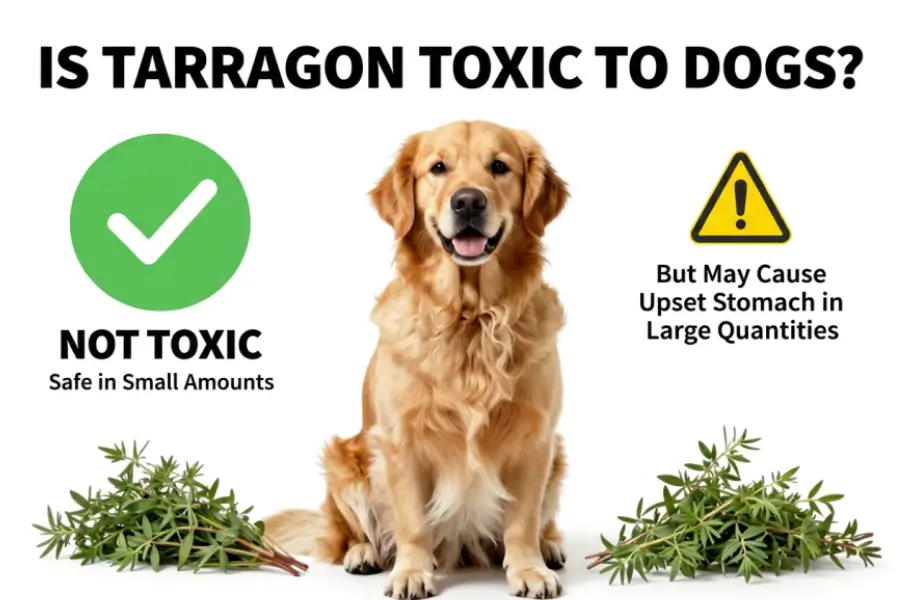
Can dogs eat tarragon? No, tarragon is not recommended for dogs. The ASPCA lists tarragon as toxic to dogs because of compounds in its essential oils, which can cause mild vomiting and diarrhea if eaten. A single accidental nibble of fresh tarragon usually isn’t an emergency.
Tarragon should never be added to your dog’s food on purpose, and concentrated forms like tarragon essential oil are genuinely dangerous. Below, we break down exactly why, how much is too much, and what to do if your dog already ate some.
Why Dog Owners Ask This Question
Tarragon shows up in roast chicken, vinaigrettes, béarnaise sauce, and French-inspired home cooking, so it’s easy for a curious dog to snag a dropped leaf or lick a plate. Because tarragon smells appealing and isn’t as widely discussed as garlic or onion toxicity, many owners simply don’t know it’s on the ASPCA’s toxic plant list, which is exactly why this question trends so often in pet-safety searches.
Can Dogs Eat Tarragon?
No. Veterinary and toxicology sources, including the ASPCA Animal Poison Control Center, classify tarragon as toxic to dogs, cats, and horses. The toxic principle is its essential oil content, and the expected clinical signs are mild, typically vomiting and diarrhea rather than anything life-threatening in most everyday exposures.
That said, “toxic” doesn’t mean every exposure is a crisis. Tarragon sits at the milder end of the toxicity spectrum compared to something like grapes or xylitol. Vets generally don’t recommend feeding it on purpose, but they also don’t panic over a single small accidental taste.
Small amount vs. large amount: the key distinction
| Exposure level | Likely outcome |
|---|---|
| A few leaves or a small lick off a plate | Usually mild or no symptoms; monitor at home |
| A meaningful serving (e.g., a seasoned dish eaten intentionally) | Possible vomiting, diarrhea, drooling, lethargy |
| Repeated or regular feeding over time | Higher risk of digestive and liver irritation |
| Tarragon essential oil, in any amount | Always a concern concentrated oils are far more potent than the whole herb |
Veterinary takeaway: If your dog ate a tiny bit by accident, don’t panic — just watch them. If you’re considering tarragon as a regular addition to homemade dog food, don’t; choose one of the dog-safe herbs further down this article instead.
What Is Tarragon, Exactly?
Tarragon is a slender, green, leafy herb with a flavor often described as a cross between anise, fennel, and mild licorice. It’s a defining ingredient in French cuisine, used in:
- Béarnaise and tartar sauces
- Roast chicken and fish
- Vinaigrettes and Dijon-style dressings
- Herb butters and soups
Nutritional profile (per typical culinary use): Tarragon does contain some vitamins, minerals, and antioxidant plant compounds — but only in the tiny quantities used for seasoning. It’s not used as a meaningful nutrition source for humans or animals; its job in the kitchen is flavor, not nutrition.
Types of Tarragon
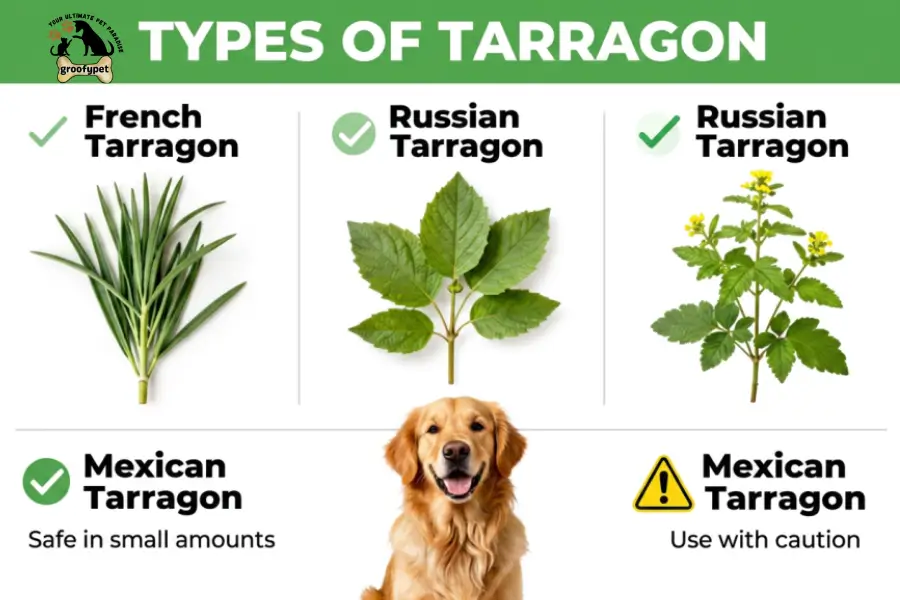
| Type | Common Use | Dog Safety |
|---|---|---|
| French Tarragon | Most common culinary variety, strong anise flavor | Not recommended — same essential oil concerns |
| Russian Tarragon | Milder, less aromatic, often used in home gardens | Not recommended — lower oil concentration, but still listed under the same toxic species when culinary tarragon is referenced |
| Mexican Tarragon (Tagetes lucida, a marigold relative used as a tarragon substitute) | Used as a heat-tolerant tarragon stand-in | Different plant species entirely; not well-studied for dogs, so it should be treated with the same caution and kept away from pets |
The takeaway: regardless of variety, none of these are herbs you should intentionally feed your dog.
Is Tarragon Toxic to Dogs?
The main concern with tarragon is its essential oil content, which the ASPCA identifies as the toxic principle. Tarragon’s aromatic oil contains a compound called estragole.
Toxic Compounds
Can dogs eat tarragon? In simple terms, estragole is the chemical responsible for tarragon’s anise-like scent. This doesn’t mean a dog who licks a seasoned plate will develop liver disease; the doses used in those studies are far higher and more concentrated than what a dog would get from a kitchen accident, but it’s the underlying reason vets advise against making tarragon a regular part of a dog’s diet.
Essential Oils and Concentrated Products
This is the area that deserves the most caution. Tarragon essential oil should never be given to or applied to dogs. Essential oils are highly concentrated extracts; a single drop can contain the aromatic compounds of dozens of fresh leaves. In concentrated form, these oils can cause the following:
- Vomiting and diarrhea
- Drooling and oral irritation
- Skin irritation if applied topically
- More serious liver-related effects with repeated or high-dose exposure
The same caution applies to tarragon-based supplements, tinctures, or “natural remedy” products marketed for humans; none of these are formulated with canine safety in mind.
Types of Tarragon and Dog Safety, In Detail
- French tarragon for dogs: The most commonly available type in grocery stores; should be avoided as an intentional food additive.
- Russian tarragon for dogs: Milder in flavor and lower in essential oil concentration but not established as a “safe” alternative. There isn’t separate veterinary guidance distinguishing it from French tarragon, so it’s best treated the same way.
- Mexican tarragon for dogs: Botanically unrelated to true tarragon (it’s actually a marigold relative), but since it isn’t a well-studied plant in canine toxicology, the safest approach is to keep it out of reach just like the others.
- Fresh tarragon for dogs: Fresh leaves contain the full essential oil profile. A small accidental taste is typically low-risk; intentional feeding is not recommended.
- Dried tarragon for dogs: Drying concentrates the herb, meaning dried tarragon can contain a stronger dose of aromatic compounds per teaspoon than the fresh equivalent. A pinch in a cooked dish a dog steals isn’t usually an emergency, but dried tarragon shouldn’t be sprinkled onto dog food.
- Tarragon essential oil: Never recommended for dogs under any circumstance, ingested or topical.
Can Puppies Eat Tarragon?
No, puppies should be kept away from tarragon, and they carry extra risk.
Puppies have:
- Smaller body weight, so the same amount of tarragon represents a proportionally larger dose
- Immature liver and kidney function, which affects how efficiently they process plant compounds and essential oils
- More sensitive digestive systems that are prone to upset from new foods of any kind
If a puppy eats tarragon, even a small amount, it’s worth a call to your veterinarian for guidance specific to their age and weight, rather than waiting to see what happens.
What Happens If a Dog Eats Tarragon?
| Exposure type | What to expect |
|---|---|
| Mild exposure (a leaf, a lick of sauce) | Often no symptoms, or very mild, short-lived stomach upset |
| Moderate exposure (a seasoned portion of food) | Vomiting, diarrhea, drooling, mild lethargy possible within a few hours |
| Severe exposure (large quantity, essential oil, or repeated feeding) | More pronounced GI symptoms, possible liver irritation, greater need for veterinary evaluation |
Pros and Cons of Tarragon for Dogs
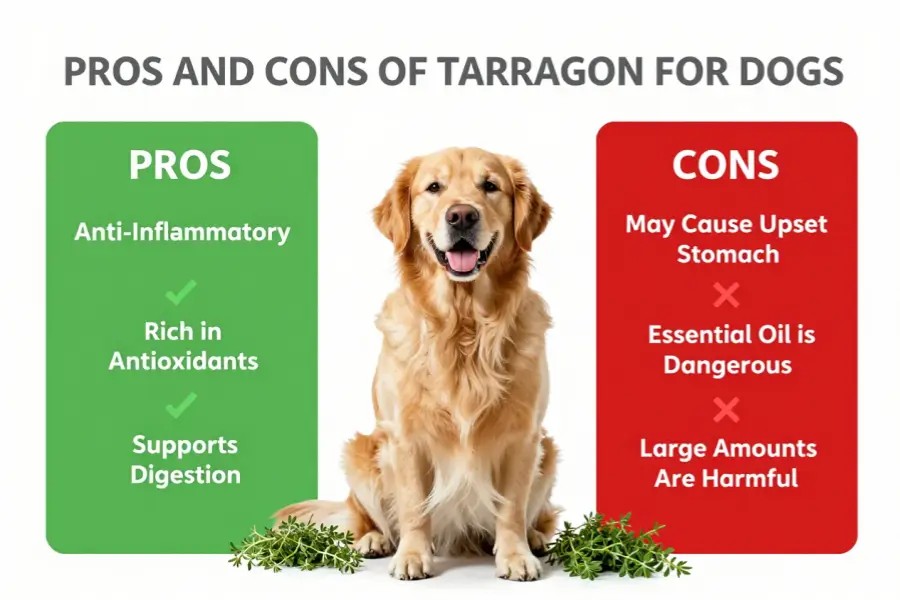
- Contains some antioxidants and trace vitamins
- A naturally derived plant compound, not a synthetic additive
- Aromatic, which is mainly relevant to human cooking, not dog nutrition
- A single small accidental taste rarely causes serious illness
- Listed as toxic by the ASPCA for dogs, cats, and horses
- Essential oils can cause real harm in concentrated form
- Larger or repeated amounts raise the risk of GI and liver irritation
- Offers no nutritional benefit dogs can’t get from genuinely safe herbs
- Not recommended by veterinary or toxicology authorities for canine use
Signs and Symptoms of Tarragon Poisoning in Dogs
Watch for any of the following after a known or suspected exposure:
- Vomiting
- Diarrhea
- Excessive drooling
- Loss of appetite
- Weakness or unusual lethargy
- Abdominal discomfort or a hunched posture
- Tremors (uncommon, associated with larger ingestions)
- Difficulty walking or coordination issues (uncommon)
- Seizures (rare, and generally only reported with very large or concentrated exposures)
Most dogs that get into a small amount of tarragon will show mild GI signs at most. Tremors, coordination problems, or seizures are not typical reactions to ordinary kitchen-level tarragon exposure and should be treated as a sign to seek veterinary care immediately, regardless of the suspected cause.
What Should You Do If Your Dog Eats Tarragon?
- Step 1 — Estimate how much was eaten. Was it a single leaf, a pinch of seasoning, or a whole seasoned dish? Check whether the dish also contained garlic, onions, or chives; these are far more dangerous to dogs than tarragon itself and change the urgency considerably.
- Step 2 — Watch for symptoms. Keep an eye on your dog for the next several hours. Vomiting, diarrhea, drooling, and lethargy are the signs to track.
- Step 3 — Call your veterinarian or a poison control hotline. If you’re unsure or your dog is symptomatic, contact your vet.
- Step 4 — Do not induce vomiting unless instructed. Making a dog vomit at home is sometimes unnecessary or even unsafe depending on what and how much was eaten. Only do this if a veterinarian or poison control specialist tells you to.
- Step 5 — Monitor your dog for 24–48 hours. Make sure they’re drinking water, eating normally once any GI upset settles, and behaving like themselves. If symptoms persist beyond a day, worsen, or new symptoms appear, see your vet promptly.
Are There Any Health Benefits of Tarragon for Dogs?
Tarragon does contain some antioxidant compounds, trace vitamins, and minerals and has historically been used in small culinary and herbal-remedy amounts in humans for digestive support. On paper, that sounds like it could offer something.
In practice, none of this outweighs the risk for dogs.Can dogs eat tarragon? The amount of tarragon needed to deliver any meaningful nutritional benefit is well beyond what’s considered a safe dose, and dogs can get the same categories of benefit (antioxidants, vitamins, digestive support) from herbs that don’t carry any toxicity concern at all (see the next section). There’s no scenario in canine nutrition where tarragon is the best or only source of these benefits.
Risks and Side Effects of Tarragon for Dogs
- Digestive upset: The most common and expected reaction — vomiting and diarrhea.
- Toxic essential oils: The concentrated aromatic compounds are the core safety issue.
- Allergic reactions: Less common, but possible — watch for itching, swelling, or skin irritation.
- Liver irritation: Associated mainly with regular or excessive consumption, tied to estragole exposure.
- Neurological effects: Rare, and generally only reported with large or concentrated exposures.
- Medication interactions: Herbal compounds can theoretically interact with liver-metabolized medications, which is relevant mainly for dogs already on long-term prescriptions.
- Stomach irritation: Even without “poisoning,” tarragon’s strong aromatic oils can simply upset a dog’s stomach.
- Overconsumption risk: Risk scales with amount — an occasional accidental taste is very different from regular feeding.
Special-Risk Groups
| Group | Why They’re More Vulnerable |
|---|---|
| Puppies | Smaller body size, immature liver/kidney function |
| Senior dogs | Often have reduced organ function and may be managing chronic conditions |
| Dogs with liver disease | Estragole metabolism is liver-dependent; added strain is unwise |
| Dogs with kidney disease | Reduced capacity to process and clear plant compounds |
| Dogs with epilepsy or seizure history | Any new compound with potential neurological effects warrants extra caution |
| Dogs with known food sensitivities | More likely to react to a new herb with GI upset |
Can Dogs Eat Foods Containing Tarragon?
This is often the more realistic real-world scenario than a dog eating raw tarragon on its own.
- Tarragon chicken: Risk depends heavily on other ingredients. Butter, salt, garlic, and onion in the recipe are usually bigger concerns than the tarragon itself.
- Tarragon sauce (béarnaise, vinaigrette): Often high in butter, oil, vinegar, or mustard; not dog-appropriate regardless of the tarragon.
- Tarragon seasoning blends: Frequently combined with garlic powder or onion powder, which are genuinely toxic to dogs in much smaller amounts than tarragon.
- Salad dressing: Typically high in oil, sugar, or vinegar — not recommended for dogs.
- Soup: Watch for onion, garlic, and high sodium content.
- Cooked meals generally: Always check the full ingredient list, not just the herb.
Bottom line: even if tarragon alone is the milder concern, tarragon-seasoned dishes often contain other ingredients that are more urgently dangerous to dogs.
Safe Herbs Dogs Can Eat Instead
If you want to add a flavorful, dog-safe herb boost to home-cooked meals or treats, these are well-regarded alternatives:
| Herb | Safe for Dogs? | Benefits |
|---|---|---|
| Parsley (curly-leaf only) | Yes, in small amounts | Freshens breath, contains vitamins A, C, K |
| Basil | Yes, in small amounts | Antioxidants, anti-inflammatory compounds |
| Cilantro/Coriander | Yes, in small amounts | Vitamins A and K, may support digestion |
| Dill | Yes, in small amounts | Aids digestion, may help reduce gas |
| Rosemary | Yes, in small amounts | Antioxidants, but moderation matters for dogs with seizure disorders |
| Thyme | Yes, in small amounts | Mild immune-supportive compounds |
| Sage | Yes, in small amounts | Vitamins A and K support skin and coat health |
Always introduce any new herb gradually and in small quantities, finely chopped, and skip flat-leaf parsley (it can cause photosensitivity in large amounts and isn’t recommended for pregnant dogs or those with kidney issues).
Herbs Dogs Should Avoid
- Tarragon
- Garlic
- Onion (and onion powder)
- Chives
- Nutmeg
- Pennyroyal (mint family)
- Tea tree (especially as oil)
- Wormwood
- Marjoram (in large amounts)
When Should You Visit a Veterinarian?
Seek veterinary care if your dog shows any of the following after eating tarragon:
- Vomiting or diarrhea that doesn’t stop within a few hours, or that recurs
- Continuous or worsening diarrhea
- Tremors or shaking
- Unusual weakness or collapse
- Trouble breathing
- Seizures of any kind
- A large ingestion (a whole seasoned dish, an essential oil bottle, etc.)
- Any symptoms in puppies or senior dogs
- Any symptoms in dogs with pre-existing liver, kidney, or seizure conditions
When in doubt, a quick call to your vet or a pet poison hotline is always the safer choice over waiting it out.
Frequently Asked Questions
Can dogs eat fresh tarragon?
No, not intentionally. A small accidental taste of fresh tarragon is usually low-risk, but it shouldn’t be added to a dog’s food on purpose.
Can dogs eat dried tarragon?
No. Dried tarragon is more concentrated than fresh, so it carries the same or slightly higher risk per pinch. It’s not recommended for dogs.
Is French tarragon toxic to dogs?
French tarragon is the most common culinary variety and falls under the same ASPCA toxicity listing as tarragon in general; it’s not recommended for dogs.
Can dogs eat foods cooked with tarragon?
It depends on the full recipe. The tarragon itself is usually the milder concern compared to ingredients like garlic, onion, butter, or high sodium content that are often cooked alongside it.
Can puppies eat tarragon?
No. Puppies are more sensitive to tarragon than adult dogs due to their smaller size and immature liver and kidney function. Contact your vet if a puppy eats any amount.
Is tarragon essential oil safe for dogs?
No. Tarragon essential oil is highly concentrated and should never be given to or applied on dogs, ingested or topically.
What herbs are safer than tarragon for dogs?
Parsley (curly-leaf), basil, cilantro, dill, rosemary, thyme, and sage are all considered dog-safe in small amounts and are good substitutes.
What should I do if my dog accidentally ate tarragon?
Estimate how much was eaten, check for other risky ingredients in the dish, monitor for vomiting or diarrhea, and call your veterinarian or a pet poison helpline.
Final Thoughts
Can dogs eat tarragon? No. Tarragon is classified as toxic to dogs by the ASPCA due to its essential oil content, and while ordinary kitchen-level accidents usually cause nothing worse than mild, short-lived vomiting or diarrhea, there’s no upside to feeding it on purpose.
Every type, French, Russian, fresh, or dried, falls under the same caution, and tarragon essential oil should never come anywhere near your dog. If you want to add herbal variety to your dog’s diet, reach for parsley, basil, dill, or another herb from the dog-safe list instead; you’ll get flavor and potential nutritional perks without the risk.
Can Dogs Eat Collard Greens? Benefits, Side Effects, and Safe Portions