Grooming your dog at home is one of the most rewarding things you can do as a pet owner. It strengthens the bond between you and your companion, saves money on salon appointments, and — perhaps most importantly lets you spot health issues early.
But if you’ve ever Googled a grooming tutorial and found yourself lost in a sea of professional jargon, you’re not alone.Terms like de-shedding, line brushing, mat splitting, and feathering can feel overwhelming. This comprehensive guide demystifies every major dog grooming term you’ll encounter, explains the right tools for each job and gives you a practical routine you can start using today no professional training required.
When you go into a grooming salon for your pet it is important to be familiar with the Dog Grooming Terms spoken by professional groomers. As a dog owner you’ll often hear phrases like puppy cut, lamb trim, or even references to a dog’s pants and skirt.
Regular grooming sessions even just 10–15 minutes a few times a week — can dramatically reduce shedding, skin issues, and matting, keeping your dog healthier and your home cleaner year-round.
These terms might be confusing at first, but they’re part of the everyday language used by groomers to describe specific haircuts and coat trims. Understanding this grooming terminology will help you feel more confident during your grooming consultation.
You’ll be able to speak the same language and ask the right questions when deciding on a style for your pet. In some cases, groomers might use their own expressions or terms, like “Groomlish,” to describe certain procedures. For instance, phrases like “doggie fashions” or “dog’s pants” refer to specific areas of the dog’s coat that are being trimmed. It’s also common for a groomer to have their personal preference in terms of speed and training techniques, which they might refer to in different ways.
Having a basic explanation of these terms not only ensures a smooth process but also gives you the chance to clarify your pet’s needs with the groomer. Don’t hesitate to ask for more details, especially when dealing with interpretational terms like lamb trim or puppy cut, as they can mean slightly different things depending on the salon or even the groomer.
Is Dog Grooming a Specialized Skill? The Best Answer
Dog groomers do much more than just clean pets; they use specialized techniques to maintain a dog’s appearance and health. This includes tasks like bathing, haircuts, nail trimming, and ear cleaning. Regular grooming helps prevent infections and matting, making it essential for a pet’s overall well-being.
Core grooming terms explained A–Z
Below is your complete glossary of dog grooming terms.
| Term | What it means |
|---|---|
| Blow-out | Using a high-velocity dryer to blast loose fur, debris, and water from the coat after bathing — essential for double-coated breeds like Huskies and Golden Retrievers. |
| Coat stripping | Manually removing dead outer coat hairs by hand or with a stripping knife, common in wire-haired terriers (e.g., Airedale, Schnauzer). |
| Cording | Intentionally separating and training the coat to form long, rope-like strands called cords — characteristic of the Puli and Komondor breeds. |
| De-matting | The process of carefully working through tangled, knotted fur (mats) using a dematting comb, rake, or detangling spray without cutting unless necessary. |
| De-shedding | Removing loose undercoat hair using a de-shedding tool (like the Furminator) to reduce shedding around the home and prevent hot spots. |
| Double coat | A coat structure with two layers: a dense, woolly undercoat for insulation and a longer, coarser topcoat (guard hairs) for weather protection. |
| Feathering | The longer, silky fur found on the legs, ears, chest, and tail of breeds like Setters and Spaniels — often trimmed to neaten edges. |
| Finishing spray | A conditioning mist applied after drying to add shine, reduce static, and protect the coat between baths. |
| Guard hairs | The long, coarse outer coat hairs that repel water and dirt, protecting the softer undercoat beneath. |
| Hand-stripping | Plucking dead topcoat hairs by hand to encourage new coat growth — maintains texture in wire-haired breeds better than clipping. |
| Hot spot | A localised area of moist, inflamed skin (acute moist dermatitis) often caused by moisture trapped under a matted coat, allergies, or excessive licking. |
| Knot | A small tangle in the coat; if left unaddressed, multiple knots merge into a mat. |
| Line brushing | A technique of lifting fur in sections and brushing from root to tip, one line at a time — ensures the entire coat is brushed through, not just the surface. |
| Mat | A dense, compacted tangle of fur that pulls on the skin, causes discomfort, traps moisture, and can harbour parasites if left untreated. |
| Mat splitter | A small blade tool used to cut through the centre of a mat, dividing it into smaller sections that are easier to brush out. |
| Puppy cut | A uniform, short trim (typically 1–2 inches) applied all over the body, giving a neat, low-maintenance look — popular for Poodles and Doodles. |
| Quick (nail) | The blood vessel and nerve running inside the nail. Cutting into the quick causes bleeding and pain — always trim nails gradually to avoid it. |
| Raking | Using an undercoat rake to reach deep into the undercoat and remove loose, dead fur — particularly useful during seasonal shedding. |
| Scissoring | Using grooming scissors to trim, shape, or neaten the coat — includes straight, thinning, and curved scissors for different effects. |
| Single coat | A coat with only one layer — no undercoat. Common in breeds like Greyhounds, Boxers, and Maltese. |
| Slicker brush | A flat or slightly curved brush with fine, short wire pins — the most common brush for removing loose fur, light tangles, and debris from most coat types. |
| Stripping knife | A serrated blade tool used in coat stripping to grip and pull dead outer coat hairs — used on wire-haired terriers, not typical smooth or long-coated breeds. |
| Thinning shears | Scissors with one serrated blade that remove bulk without creating a blunt line — ideal for blending and softening transitions between trimmed areas. |
| Topknot | The fur on the top of the head, often tied up or trimmed on breeds like Shih Tzus and Yorkshire Terriers to keep it out of the eyes. |
| Undercoat | The soft, dense layer of fur beneath the guard hairs that provides insulation — prone to matting if not regularly brushed out. |
When thinking about dog groomers, many people often underestimate their work, assuming it’s a simple task. However, skilled professionals in the grooming field know that maintaining a dog’s physical appearance and hygiene requires more than basic understanding.
Grooming involves a variety of specialized techniques that are essential to keep pets healthy and looking their best. From bathing and brushing to more intricate tasks like haircuts, nail trimming, and ear cleaning, dog groomers handle a range of duties that go beyond mere aesthetics. Their expertise ensures that a dog’s coat, skin, and nails remain in top condition, which directly impacts their overall health.
Many people overlook the importance of regular grooming, not realizing how much professional grooming helps prevent potential issues such as infections or matting. A dog groomer’s job is much more than cleaning – it’s about offering comprehensive services that keep a pet feeling and looking its best. Knowing how to perform each task correctly is what separates a skilled groomer from someone who simply grooms as a hobby.
What qualification is best for dog grooming?
The best qualification for dog grooming is a certified grooming course from a reputable institution, which provides hands-on training and industry-recognized credentials.
Level 2 Certificate for Dog Grooming Assistants: Offers a basic understanding of dog grooming, perfect for beginners.
Level 3 Diploma in Dog Grooming: Prepares you for a professional career in grooming, with in-depth skills for handling different breeds.
Level 4 Higher Professional Diploma in Dog Grooming: Provides advanced training and specialized knowledge for higher-level roles in the dog grooming industry.
Essential Grooming Procedures and Terminology
Here are some common grooming procedures and terminology you may come across when grooming a dog:
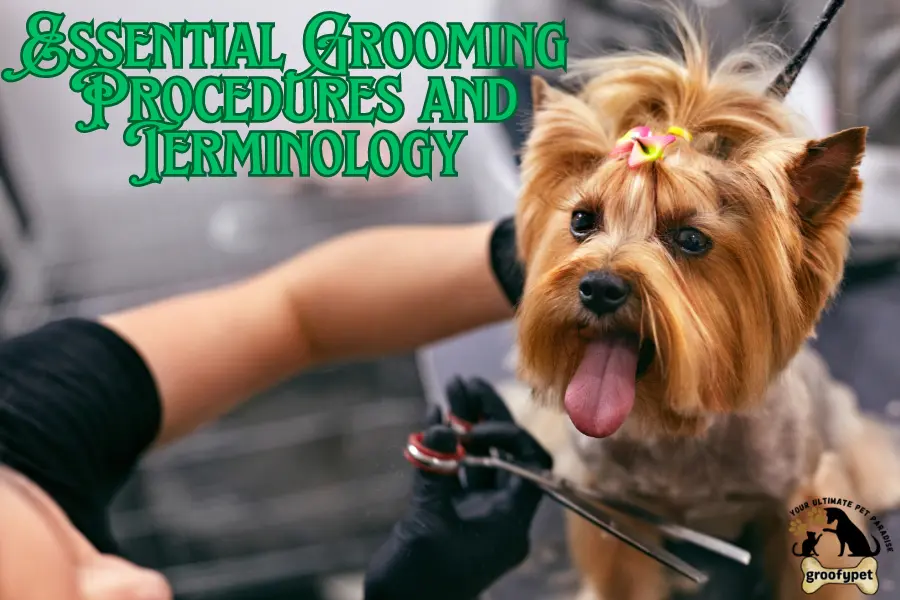
- Clippers/Blades: Clippers are essential tools for trimming a dog’s coat, and blades attach to them for specific lengths. People may use both terms to refer to the trimming tool as a whole.
- Undercoat removal (Carding): This is a method to gently remove the loose, dead undercoat using a special tool with a blunt edge.
- Trimmed toes (Cat feet): The fur between the toes is carefully trimmed to match the top of the feet, revealing the nails slightly.
- Face trim (Clean face): The process of closely shaving the face, muzzle, and cheeks for a sleek look.
- Shaved feet (Clean feet): The feet are shaved entirely, showing the nails and full foot up to the ankle area.
- Blade guide: Clipper blades come in various sizes to control fur length. Lower numbers leave more fur; for example, a 4F blade leaves about ½-inch of hair, while a 7F cuts down to ⅛-inch.
- Tangle removal (Demitting): Removing knots and tangled hair that have formed into mats.
- High-velocity dryer (Forced-air dryer): Used to fully dry a dog’s coat after initial towel drying, leaving the fur soft and fluffy.
- Coat hand-stripping: A technique to strip the dead outer coat from wire-haired breeds, using fingers or a stripping tool for a natural look.
- Leg fur (Pants): The long fur that grows on the back of a dog’s legs.
- Pom trim (Pom-pom): A rounded, puffy ball of fur, often styled on poodles, above the paws or on the tail.
- Round paw trim: Feet are carefully trimmed to create a rounded, fluffy appearance without exposing the nails.
- Finishing trim (Scissoring): Using scissors to trim areas where clippers don’t reach or when a longer cut is requested.
- Reverse shaving: Shaving against the natural direction of hair growth, starting from the back toward the front.
- Skirt fur: The long fur that hangs down the sides of a dog’s body, giving it a skirt-like appearance.
- Topknot (TK): A cute, styled ponytail or bun on top of a dog’s head, usually held with a ribbon or bow.
Common Dog Grooming Styles
Here are some common dog grooming styles:
Face, Feet, and Fanny Trim: This touch-up is done between full haircuts, focusing on the face, paws, and rear to keep these areas neat.
Sanitary Trim (or “The Sanies”): A close shave around the belly and rear, ensuring better hygiene in sensitive areas.
While many breeds follow a typical grooming pattern, a few styles are especially popular in grooming salons:
- Schnauzer Cut: The body is clipped or hand-stripped, with longer hair left on the legs, knees, and lower back for a skirted look. The eyebrows are sharply defined, and the cheeks and ears are shaved.
- Cocker Cut: The back is clipped short while the legs and skirt are left fuller. The head is clipped short with a rounded dome, and the ears are trimmed to retain some length at the ends.
- Poodle Cut: Poodles have various trims, but the standard approach involves straightening their naturally curly coat for a smooth finish. Typically, the face and feet are clipped short, with a rounded topknot on the head. This style is also common for similar breeds like Goldendoodles.
Pet Grooming Terms and Guidelines
| Term | Description | Frequency | Special Instructions |
| Bathing | Cleaning the pet using pet-safe shampoo | Every 4-6 weeks | Use lukewarm water; avoid eyes and ears. |
| Brushing | Detangling and removing loose fur | Daily/Weekly | Use a suitable brush for coat type. |
| Nail Trimming | Clipping the pet’s nails to a safe length | Every 4-6 weeks | Be cautious of the quick in the nails. |
| Ear Cleaning | Cleaning wax and debris from ears | Every 2-4 weeks | Use ear cleaner and cotton pads, avoid deep cleaning. |
| Teeth Brushing | Cleaning the pet’s teeth and gums | 2-3 times a week | Use pet-safe toothpaste only. |
| Hair Trimming | Cutting the pet’s fur to a manageable length | Every 6-8 weeks | Be mindful of sensitive areas. |
| De-shedding | Removing excess undercoat fur | Seasonal | Use specialized de-shedding tools. |
| Anal Gland Expression | Clearing anal glands to avoid blockage | As needed | Consult a vet or professional groomer. |
| Flea/Tick Treatment | Removing or preventing parasites | Monthly | Apply vet-recommended treatments. |
Common Grooming Terms You Might Hear
The Quick
When trimming your dog’s nails, especially with white nails, you might notice a pink line. That’s the Quick – the blood supply running through the nail. It shows the shortest point a nail can be safely cut. For dogs with dark or black nails, the Quick isn’t visible, so trimming must be done gradually.
If a small black dot appears after trimming, that’s a sign you’re nearing the Quick. Accidental trimming too close, causing a bit of bleeding, is very common and easy to treat, so don’t worry if your groomer encounters this. Some dogs, after all, aren’t the most cooperative during nail trims!
Matting
Matting is a more serious version of knots. A simple knot is tangled hair, but when left alone, it becomes a mat. These mats can tighten over time, causing discomfort and sometimes even skin issues underneath.
Regular brushing helps prevent them, especially in areas where friction, water, or dirt play a role. If mats get out of hand, they may need to be shaved off to avoid any further harm to your dog.
Anal Glands
These scent glands are located near your dog’s bottom and can be expressed naturally during bathroom trips. However, if they can’t handle it themselves, you may see signs like scooting or licking. While some groomers can express these glands for relief, it’s often best to involve a vet to address the underlying cause if the problem is recurring.
Dew Claw
This is your dog’s version of a thumb, found slightly higher on the leg. Dew claws can also appear on hind legs, depending on the breed.
Always feel free to ask your groomer for clarification if something is unclear, but hopefully, this guide helps bridge some common gaps!
Frequently Asked Questions
How do you explain Dog Grooming?
Regular grooming keeps your pet looking and smelling clean while maintaining a healthy coat by removing old, damaged hair through brushing. The grooming process also allows the groomer to physically check for bumps, lumps, and skin irritations, helping to detect issues early. These benefits ensure your pet stays healthy and comfortable, preventing potential problems from arising.
What does FFF mean in dog grooming?
Grooming a dog’s face, paws, and rear end is essential for maintaining a tidy appearance. Using proper techniques ensures the hair is carefully trimmed, keeping your dog clean and comfortable. Regular attention to these areas not only improves their overall look but also contributes to their hygiene.
What is tidy in dog grooming?
A tidy in dog grooming involves a service that includes a face trim, feet trim, tail trim, nail trim, ear cleaning, and even gland expression for the dog’s comfort. The process typically uses shampoo, conditioner, and sometimes a brightening facial, followed by a hand dry, brush out, and deshedding to address any matting or excess fur. Additional options like ear hair removal and a light haircut may be included, with grooming fees usually lower than full grooming sessions.
How To Crate Train A goldendoodle? Do’s Don’ts With Powerful Tips!
What Is Board And Train For Dogs? The Ultimate Training Solution!