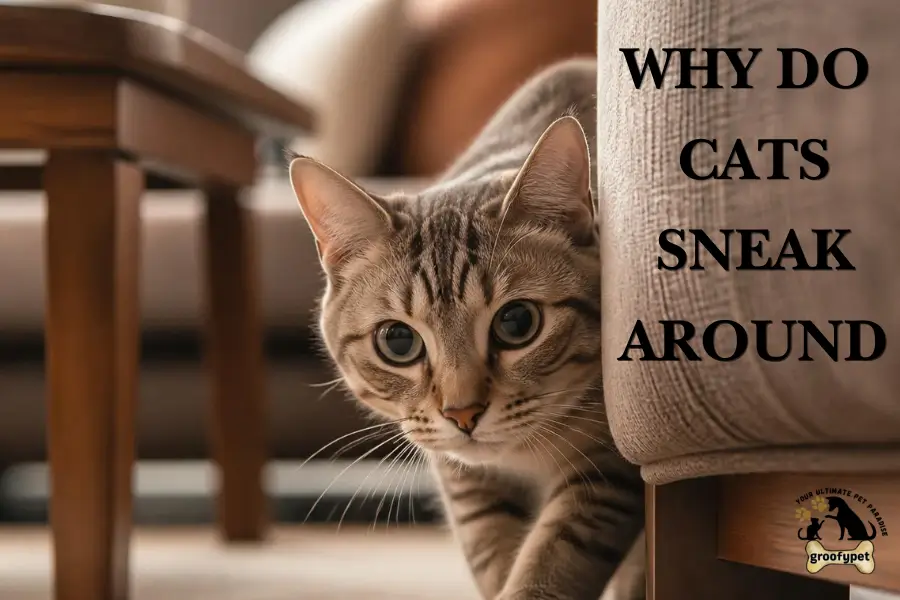
You’re sitting on the couch, half paying attention to the TV, when you catch a flash of movement out of the corner of your eye. Your cat is crouched low behind the armchair, belly nearly touching the floor, eyes locked on your ankle. A second later, nothing happens. She’s just watching. Then, just as quietly as she appeared, she slinks off toward the hallway and vanishes around the corner.
If this sounds familiar, you’ve probably asked yourself why do cats sneak around in the first place. The short answer is that it’s usually completely normal. Cats are built to move quietly, and that instinct doesn’t disappear just because they sleep on a heated bed and eat from a ceramic bowl instead of hunting for their dinner. But the reason behind any specific bout of sneaking can vary quite a bit depending on your cat’s body language, the situation, and what’s going on around them.
Some sneaking is playful. Some is cautious. Some is just a cat being a cat. And in certain cases, sneaking around can be a signal that something is bothering your cat, whether that’s a new noise in the house or something going on with their health. This article walks through the most common reasons cats sneak, how to read what your cat is actually telling you, and when it might be worth paying closer attention.
Why Do Cats Sneak Around?
Cats sneak around mainly because of instinct. Sneaking combines their hunting drive, natural caution, and curiosity into one quiet, low-to-the-ground movement style. It can show up during play, while investigating something new, while avoiding a perceived threat, or simply while patrolling their territory. In most cases, it’s a normal expression of feline behavior rather than something to worry about.
That said, sneaking isn’t a single behavior with a single meaning. A cat creeping toward a toy mouse is telling a very different story than a cat crouched behind the couch with flattened ears and dilated pupils. Understanding the context is the key to understanding the cat.
9 Reasons Why Cats Sneak Around
1. Their Hunting Instincts
Even a cat who has never seen a live mouse in their life still carries the wiring of a predator. Domestic cats are close relatives of solitary hunters that relied on stealth, not speed or size, to catch prey. That instinct didn’t get bred out of them just because dinner now comes from a bag.
This is why you’ll often see your cat crouch low, move in slow, deliberate steps, and pause completely still before continuing forward. Their body flattens out, their tail may twitch or flick at the tip, and their ears rotate forward, locked onto whatever has caught their attention. Then comes the pounce, sudden and explosive, a total contrast to the slow approach that came before it.
This pattern is called stalk-and-pounce, and it’s one of the clearest examples of cat hunting instincts at work. It doesn’t require an actual prey animal. A moving shoelace, a rustling bag, or even a shadow on the wall can trigger the exact same sequence.
2. Your Cat Is Playing
A lot of sneaking is really just play stalking in cats dressed up to look like something more serious. Your cat creeping toward a toy, another pet, or even your feet under a blanket is often just their version of a game.
Watch the tail. During play, it tends to swish or flick playfully rather than lash back and forth in irritation. Ears are usually forward and relaxed, not pinned back. The crouch might look intense, but the energy afterward, a pounce followed by rolling around or darting off, has a light, almost bouncy quality to it.
Kittens are especially prone to this kind of play stalking, often practicing on siblings, humans, or unsuspecting dogs. Adult cats do it too, particularly if they don’t get much outlet for their hunting instincts elsewhere in the day. Sneaking up on you and then immediately running away is a common version of this game, and it usually means your cat wants interaction, not confrontation.
3. Cats Are Naturally Curious
Cats investigate their world through careful, quiet movement, and a lot of what looks like sneaking is really just cautious curiosity. A new box in the living room, an unfamiliar smell drifting in from outside, or a sound coming from another room can all send a cat into slow, deliberate investigation mode.
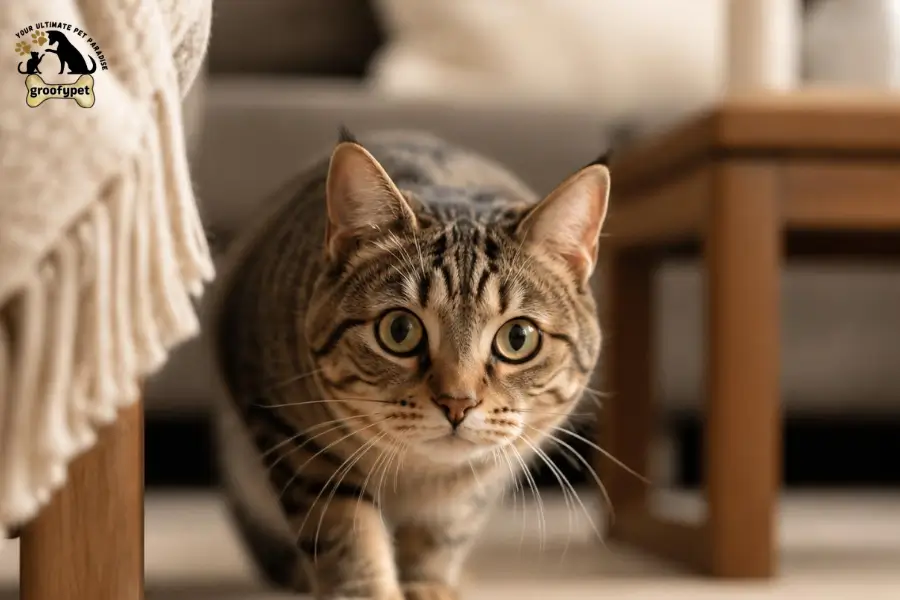
Rather than walking straight up to something unfamiliar, cats tend to approach in stages. They might circle wide, pause, sniff the air, then get slightly closer before repeating the process. From a distance, this looks a lot like sneaking, but it’s really just careful information-gathering.
This kind of behavior is part of why cats sneak around corners so often. Peeking around a doorway or the edge of a couch lets them see what’s happening in a room before committing to walking into it fully. It’s less about secrecy and more about gathering information before making a decision.
4. Your Cat Wants to Watch Without Being Seen
Cats like control over their environment, and part of that control comes from being able to observe without being observed. Many cats prefer positions where they can see a room, a doorway, or a window while staying tucked out of the main line of sight themselves.
This explains why you’ll often find your cat perched under a bed, behind a curtain, or on top of a bookshelf, watching everything that happens below. It’s not that they’re avoiding you specifically. It’s more that this vantage point feels safer and gives them a sense of awareness over their surroundings.
Sneaking into a spot like this, then staying still and watching, is a completely normal expression of a cat’s need to feel secure. It taps into the same instinct that would help a wild cat avoid larger predators while still keeping an eye on potential prey or threats.
5. Your Cat Is Trying to Avoid Something
Not all sneaking is about approaching something. Sometimes it’s about avoiding it. A loud vacuum, an unfamiliar guest, a boisterous dog, or even a rowdy toddler can all send a cat into quiet retreat mode.
In these situations, the cat isn’t stalking so much as escaping attention. They might slink along walls, stay low to the ground, and choose routes that keep them out of sight as they move from one room to another. This is a normal cat body language response to something they’d rather not deal with directly.
If you notice your cat consistently sneaking away from a specific person, sound, or situation, it’s worth paying attention to that pattern. It doesn’t necessarily mean anything is wrong, but it does tell you what your cat finds stressful or unpleasant, which can help you make small adjustments around the house.
6. Territorial Behavior
Cats are territorial animals, and part of maintaining that territory involves quietly checking in on it. A cat sneaking from room to room, pausing at windows, sniffing along baseboards, or investigating doorways is often just doing a routine patrol of their space.
This kind of movement tends to happen at consistent points during the day, often after something has changed in the environment. New groceries in the kitchen, a guest who recently left, or another pet moving through the house can all prompt a cat to go check things out.
Scent plays a big role here too. Cats have scent glands on their face, paws, and body, and rubbing against furniture or walking a familiar path helps them reinforce their sense of ownership over the space. Quiet, methodical movement through the house is often less about sneaking and more about maintaining a mental map of their territory.
7. Your Cat May Be Trying to Get Your Attention
Some cats figure out fairly quickly that sneaking up on their owner, or disappearing and then suddenly reappearing, gets a reaction. If that reaction includes petting, a laugh, a chase, or even just you saying their name, it can become a repeated behavior.
This is especially common in cats who don’t have another cat or pet to play with regularly. Sneaking up on a person’s feet, hiding behind a doorway and popping out, or crouching near a hallway to ambush someone walking by can all become part of a cat’s daily routine simply because it works as a way to start interaction.
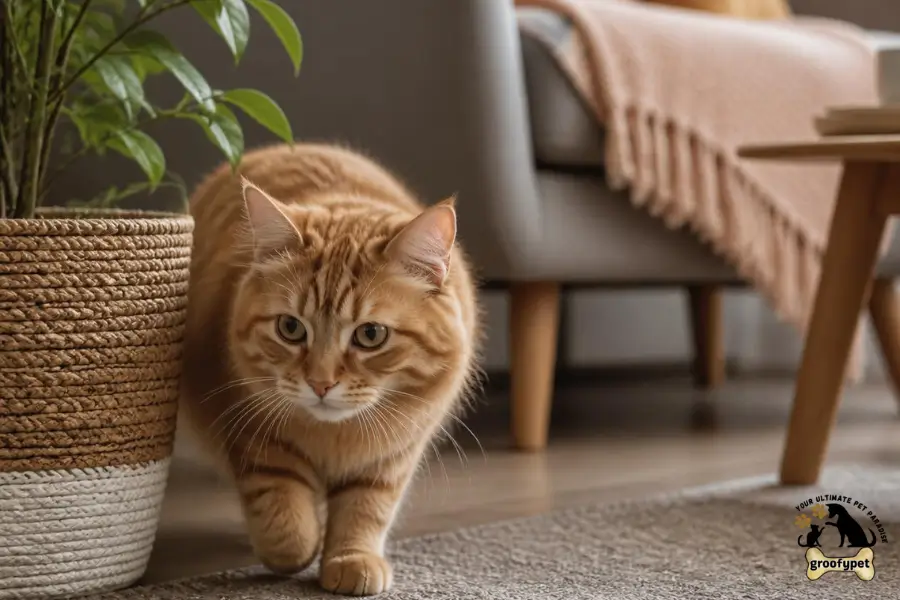
If this is the reason behind your cat’s sneaking, you’ll usually notice it happens most when you’re moving around the house, especially during times when your cat is used to getting attention, like right before feeding time or in the evening.
Must Read : Why Is My Cat So Jumpy? A Caring Guide To Help Your Nervous Cat Feel Safe!
8. Fear, Stress, or Anxiety
This is the reason that deserves the most attention, because it’s where sneaking crosses over from playful or curious into something that might reflect cat anxiety or cat stress. The tricky part is that fearful sneaking can look similar to hunting or curious sneaking at first glance, so body language matters a lot here.
Signs that point toward fear or stress rather than play include flattened or sideways ears, dilated pupils, a tucked or puffed-up tail, crouching low with tense muscles rather than a relaxed slink, and hissing or growling if approached. A stressed cat may also avoid people more than usual, eat less, or show changes in litter box habits around the same time as the sneaking increases.
The difference often comes down to what happens next. Playful sneaking usually ends in a pounce, a chase, or the cat approaching you or a toy. Fearful sneaking usually ends in the cat retreating further away, staying hidden for long stretches, or bolting the moment they’re noticed. If sneaking seems to be driven by fear rather than curiosity or play, it’s worth thinking about what might have changed recently in your cat’s environment.
9. It May Simply Be Your Cat’s Personality
Just like people, cats have individual personalities, and some are naturally more cautious, observant, or quietly mischievous than others. A cat who has always preferred to watch from the shadows before joining in isn’t necessarily anxious. They might just be wired that way.
Breed tendencies, early life experiences, and age can all shape how much a cat sneaks compared to others. A cat who was a stray before being adopted may retain more cautious, watchful habits even years into a safe, stable home. Older cats sometimes sneak less as they become more confident and settled, while others become quieter and more deliberate in their movement as they age.
This is a good reminder that normal cat behavior doesn’t look identical from one cat to the next. Getting to know your own cat’s typical patterns is often more useful than comparing them to a general standard.
How Can You Tell Why Your Cat Is Sneaking Around?
Context and body language are everything when it comes to reading sneaking behavior. The table below breaks down some common scenarios and what they usually indicate.
| Behavior | What It May Mean | What to Look For |
|---|---|---|
| Sneaks up and pounces on toys | Play or hunting instinct | Relaxed ears, twitching tail, bouncy energy after the pounce |
| Hides and watches visitors | Caution around unfamiliar people | Staying at a distance, slow blinking, willingness to come out later |
| Crouches low with flattened ears | Fear or stress | Dilated pupils, tucked tail, reluctance to be approached |
| Quietly patrols rooms | Territorial behavior | Sniffing along walls, rubbing on furniture, consistent daily routine |
| Sneaks up on owner and runs away | Play or attention-seeking | Repeated pattern, playful body language, interaction afterward |
| Peeks around corners before entering a room | Curiosity or caution | Slow approach, sniffing the air, pausing before committing |
Is It Normal for Cats to Sneak Around?
In most cases, yes. Sneaking is a natural expression of instincts that have been part of the feline species for a very long time. Whether your cat is stalking a toy, checking out a new smell, or quietly making their rounds through the house, this kind of movement is simply how cats interact with their environment.
Owners should start paying closer attention when sneaking behavior changes suddenly or becomes more frequent without an obvious cause, especially if it’s paired with other shifts in behavior. A cat who has always been fairly bold but suddenly starts sneaking and hiding much more than usual is telling you something is different, even if it’s not immediately clear what that something is.
Also Read : Can Cats See Fire? A Friendly Guide for Pet Parents!
When Should You Worry About Your Cat’s Sneaking Behavior?
While sneaking itself is rarely a problem on its own, certain accompanying signs are worth taking seriously. These include:
- A sudden increase in hiding, especially if your cat is avoiding areas they used to enjoy
- Refusing food or water for more than a day
- Changes in litter box habits, including accidents outside the box or straining
- Aggression that wasn’t there before
- Excessive fear or startling in response to normal household activity
- Weakness, limping, or unusual movement
- Excessive vocalization, particularly at night
- Significant personality changes, such as a social cat becoming withdrawn
- Any signs of pain, including flinching when touched in certain areas
None of these signs are meant to serve as a diagnosis on their own, and sneaking behavior by itself shouldn’t be treated as proof of a medical issue. But behavioral changes can sometimes have medical causes, and a veterinarian is the right person to evaluate anything that seems sudden, severe, or persistent. If your cat’s sneaking is paired with any of the signs above, a vet visit is a reasonable next step rather than something to wait out.
How to Make Your Cat Feel Safe at Home
Whether your cat sneaks around out of playfulness or caution, there are simple ways to support their sense of security at home.
Give your cat access to safe hiding places, such as a covered bed, a box, or a quiet corner where they can retreat without being disturbed. Try to maintain a predictable daily routine, since consistent feeding times and consistent household patterns tend to reduce stress. Avoid forcing a frightened cat out of hiding, as this usually increases anxiety rather than resolving it.
Interactive toys, especially wand toys that mimic prey movement, give cats a healthy outlet for their hunting instincts and can reduce excessive stalking behavior directed at people or other pets. Vertical spaces like cat trees, shelves, or window perches let cats observe their environment from a position that feels safe to them.
Quiet areas away from heavy foot traffic can help cats who are more easily overwhelmed by household activity. When introducing new pets, do it gradually rather than all at once, giving your current cat time to adjust. Keep an eye on potential household stressors, such as construction noise, new furniture, or changes in routine, since these can all influence how much a cat sneaks or hides. Finally, rewarding calm, confident behavior with gentle praise or treats can help reinforce a sense of safety over time.
Frequently Asked Questions
Why does my cat sneak up on me?
This is usually a form of play or an attempt to get your attention. Many cats treat their owners as playmates, especially if there isn’t another pet in the house to practice stalking behavior on.
Why does my cat sneak around at night?
Cats are naturally more active during dawn and dusk due to their evolutionary history as crepuscular hunters. Nighttime sneaking is often just increased activity during hours when the house is quiet and there’s less competition for space.
Why do cats sneak around corners?
Peeking around corners lets a cat assess a room before fully committing to entering it. This cautious approach helps them gather information about their environment while minimizing risk.
Why does my cat hide and then suddenly appear?
This pattern is common in cats who enjoy the element of surprise as part of play. It can also happen when a cat is observing from a hidden spot and then decides to investigate or interact once they feel comfortable.
Is sneaking around normal for cats?
Yes, in most situations. Sneaking draws on natural instincts related to hunting, curiosity, and caution, all of which are considered normal cat behavior.
Why does my cat sneak up on other cats?
This is often related to play, especially between cats who get along well. It can also be a way of testing social boundaries or asserting confidence within a shared territory.
Why does my cat crouch and sneak toward me?
A low crouch combined with slow, deliberate movement toward you is typically playful stalking behavior. Watch the tail and ears for confirmation, since relaxed body language usually points to play rather than fear.
How do I know if my cat is sneaking because it is scared?
Look for flattened ears, dilated pupils, a tucked tail, and a tendency to retreat rather than approach. Fearful sneaking tends to end in the cat hiding further away, while playful sneaking usually ends in a pounce or interaction.
Should I be worried if my cat suddenly starts hiding?
A sudden change in hiding behavior is worth noting, especially if it’s paired with other symptoms like appetite changes or altered litter box habits. If the change is significant or ongoing, a veterinary evaluation is a sensible step.
Final Thoughts
So, why do cats sneak around? Most of the time, it comes down to a mix of natural instincts: hunting drive, curiosity, play, a desire to observe safely, and territorial awareness. These behaviors have been part of the feline playbook for thousands of years, and your house cat still carries that same wiring even if the closest thing to prey in their life is a feather wand.
The key to understanding any individual bout of sneaking lies in body language and context. A relaxed tail, forward ears, and a playful pounce point toward fun and instinct at work. Flattened ears, dilated pupils, and a tendency to retreat point toward fear or stress. And a sudden shift away from your cat’s usual patterns, especially alongside other changes in appetite, litter box habits, or energy level, is worth mentioning to a veterinarian.
In the vast majority of cases, though, that quiet creep behind the couch or that sudden ambush on your ankle is just your cat being exactly what they’ve always been: a small, curious predator who happens to also want a cozy spot on the couch and dinner served on time.
Why Does My Cat Hug My Arm? 10 Vet Reviewed Reasons Explained!
Cat Crying When Pooping A Painful Sign Every Pet Owner Knows!