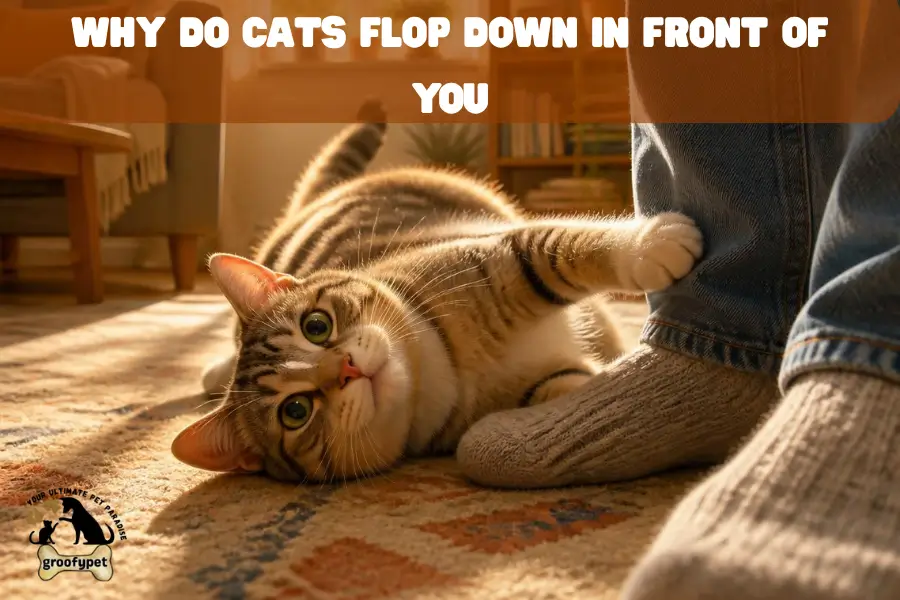
You’re walking through the living room, minding your own business, when your cat suddenly drops onto the floor right in your path. Legs sprawled, belly exposed, eyes half-closed, it’s as if she planned the whole performance just for you. It’s adorable, a little dramatic, and more than a little confusing. So what’s actually going on?
Quick answer: Cats flop down in front of you mainly because they feel comfortable and safe, want your attention, are greeting you, or are inviting you to play. This behavior, sometimes called a “cat flop” or “social roll” is a normal part of cat body language, and in most cases it’s a compliment. It usually means your cat trusts you enough to expose one of the most vulnerable parts of its body: the belly.
That said, not every flop means the same thing. The full story depends on your cat’s body language, the situation, and what happens right before and after the flop. In this guide, we’ll walk through the nine most common reasons cats flop down in front of you, how to read what your cat is really asking for, and, importantly, how to tell a normal, happy flop apart from something that might need a vet’s attention.
Why Do Cats Flop Down in Front of You?
In short: cats flop down because it feels good to do it around someone they trust. A relaxed cat that flops in front of you is usually signaling comfort, affection, or a desire to interact through play, attention, or a simple hello.
Cats communicate mostly through body language rather than sound, and a flop is one of the clearest, most visible signals in their toolkit. It’s also worth noting that flopping is not a single, fixed behavior with one meaning. It’s more like a shared “word” in cat body language that changes meaning depending on the rest of the sentence, your cat’s tail position, ear posture, vocalizations, and what she does immediately afterward.
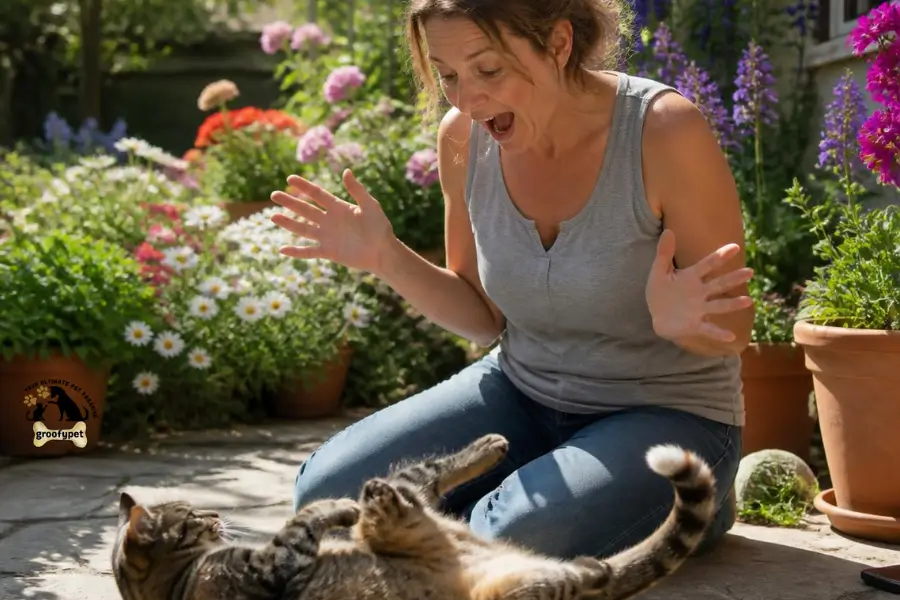
A flop followed by rolling and playful pawing means something different from a flop followed by a slow blink and stillness. Below, we’ll break down the most common explanations, roughly in order of how often they show up in everyday cat behavior.
1. Your Cat Wants Your Attention
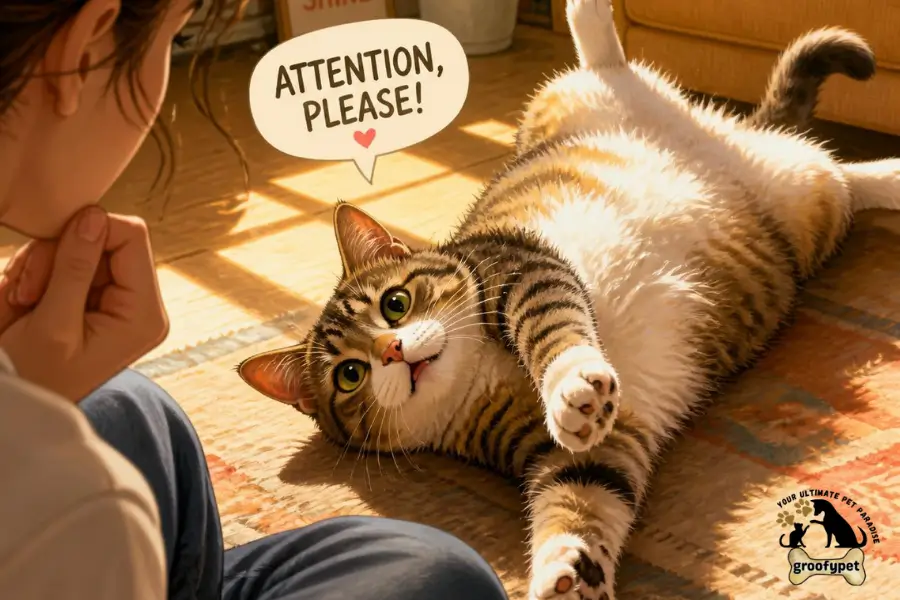
For a lot of cats, flopping down in front of you is simply the feline version of waving your arms and shouting “notice me.” Cats are smart, and they quickly learn which behaviors reliably get a reaction from their favorite human.
If your cat flops down and then follows up with rubbing against your legs, meowing, or staying close and watching your face, attention-seeking is a strong possibility. This is especially common right when you walk in the door after being away for a while. Your cat may have spent hours alone, and a dramatic flop is an efficient way to say, “I’m here, please look at me.”
Cats that flop for attention often repeat the behavior if it works. If petting, talking to them, or picking them up follows every flop, don’t be surprised if the flopping becomes a regular part of your homecoming routine.
2. Your Cat Feels Safe Around You
At its core, flopping is a vulnerability signal. A cat’s belly protects some of its most important organs, and instinct tells cats to keep it covered, especially around anyone or anything they don’t fully trust. So when a cat flops down and exposes its belly in front of you, it’s often making a quiet but meaningful statement: it feels safe.
A relaxed body, soft eyes, and slow blinking alongside the flop all reinforce this idea of comfort and trust. This kind of relaxed cat behavior tends to build up over time, as your cat learns that you’re not a threat and that being near you is a good, low-stress place to be.
It’s a nice thing to notice, because trust isn’t something cats give away for free. If your cat is comfortable enough to flop and expose its belly around you, that’s a meaningful sign of the bond you two share even if she still isn’t interested in an actual belly rub (more on that below).
3. Your Cat Is Greeting You
Not every cat meows hello. Some cats greet familiar people almost entirely through body language, and a flop can be part of that greeting ritual. If your cat tends to flop down specifically when you walk into a room, come home, or wake up in the morning, this could simply be her way of saying hello.
This greeting behavior often overlaps with attention-seeking and trust, which is part of why cat communication can feel layered. A greeting flop typically happens at predictable moments arrivals, wake-ups, or when you first sit down rather than randomly throughout the day.
4. Your Cat Wants to Play
Playful cat behavior often includes flopping, rolling, batting at your feet or hands, and a generally loose, bouncy body. If your cat flops down and then rolls side to side, paws at the air, or dashes off and comes back, she’s probably inviting you into a game.
The key is telling playful behavior apart from defensive behavior, since both can involve rolling onto the back. A playful flop usually comes with relaxed ears, a gently moving or upright tail, and an inviting posture. A defensive roll, on the other hand, tends to come with flattened ears, a tense body, and claws or teeth ready to react if you get too close. If you’re not sure which one you’re seeing, it’s safest to offer a toy or a finger wiggle from a short distance rather than reaching straight for the belly.
5. Your Cat Wants Belly Rubs — Or Maybe Not!
This is one of the most common misunderstandings in cat behavior, so it’s worth its own section. When a cat flops down and shows its belly, plenty of owners assume this is an open invitation for a belly rub. Often, it isn’t.
Showing the belly is primarily a trust signal, not necessarily a request for touch. The belly remains a sensitive, vulnerable area even for cats that feel completely safe with you, and touching it can trigger an instinctive, defensive reaction — a quick grab with claws or a nip — even from a cat who was perfectly relaxed a second earlier.
Before you reach for that fluffy belly, watch your cat’s body language closely:
- Soft, relaxed eyes and ears usually mean she’s open to gentle contact.
- A stiffening body, flicking tail, or ears turning back are signs to stop or pull back.
- If she grabs your hand with her paws, that’s often play rather than an invitation for more petting.
When in doubt, it’s generally safer to let your cat initiate contact with her belly herself nudging your hand toward it rather than reaching in first. If she doesn’t invite it, stick to areas most cats prefer, like the cheeks, chin, or the base of the ears.
6. Your Cat Is Asking for Something
Sometimes a flop isn’t really about affection at all; it’s a request. Cats often use flopping as an attention-grabbing opener before asking for something specific, whether that’s food, treats, access to a room, a lap to sit on, or simply more interaction than they’ve been getting.
If your cat’s flop is quickly followed by walking toward the food bowl, meowing at a closed door, or pawing at you insistently, she’s likely using the flop as a way to get your attention before making her actual request known. This is a good example of how flexible and layered cat communication can be; the same basic action can serve very different purposes depending on what follows it.
7. Your Cat Is Marking or Claiming Your Space
Cats have scent glands on their cheeks, chins, paws, and along their sides, and rolling or rubbing against surfaces, including you and the floor, helps deposit their scent. When a cat flops down and rolls around near you, she may be reinforcing her scent in a space she considers hers or blending her scent with yours.
This kind of scent marking is a normal part of how cats build a shared “family scent” with the people and animals they live with. It’s less about ownership in a territorial, aggressive sense and more about creating a familiar, comforting environment that smells like home.
8. Your Cat Is Relaxed
Sometimes the explanation really is this simple: your cat is comfortable, and flopping down happens to be a comfortable way to rest. Not every flop has a deeper social meaning attached to it. If your cat flops down in a sunny spot, a favorite corner of the room, or somewhere she often naps, she may just be settling in for some rest, and it happens to be near you because she enjoys your company.
A relaxed flop like this often comes with slow, sleepy blinking, a loose tail, and general stillness rather than active rolling or playful movement.
9. Your Cat Has Learned That Flopping Gets a Reaction
Cats are quick learners, and behavior that consistently earns a reward tends to stick around. If flopping down has reliably gotten your cat attention, petting, treats, or playtime in the past, she may simply be repeating a behavior that works.
This doesn’t take away from the affection or trust behind the original behavior; it just means the flop has become part of her learned routine for getting what she wants from you. Many “quirky” cat behaviors start as instinct and become habits once a cat notices the pattern of cause and effect.
How to Tell What Your Cat Means
Because a single flop can mean several different things, the surrounding body language is where the real answer lives. Here’s a quick reference table to help you read the signals.
| Cat’s Body Language | What It May Mean |
|---|---|
| Relaxed body and slow blinking | Trust and comfort |
| Tail held normally or gently moving | Calm or curious |
| Rolling and playful movements | Playfulness |
| Rubbing against you | Affection or scent marking |
| Meowing after flopping | Wants attention |
| Ears forward and relaxed | Comfortable |
| Ears flattened and tense body | Fear, stress, or irritation |
| Swishing tail with tense posture | Possible annoyance |
No single cue tells the whole story on its own it’s the combination that matters. A flop with relaxed ears and a soft tail is a very different message than a flop with flattened ears and a stiff, swishing tail, even though both technically involve the cat lying down and rolling.
Why Does My Cat Flop Down in Front of Me and Show Its Belly?
This specific version of the behavior deserves its own explanation because it’s so commonly misread. When a cat flops down and shows its belly, it’s generally a sign of trust and relaxation. Cats don’t expose this vulnerable area casually, so doing it around you is a meaningful gesture.
However, showing the belly does not automatically mean your cat wants it touched. Think of it more like an open door than an invitation to walk straight in. Some cats genuinely enjoy belly rubs, but many others see a hand reaching for their stomach as an unwelcome surprise, even moments after flopping down affectionately. Watching her body language in the moment — rather than assuming based on the belly alone — is the safest approach.
Why Does My Cat Flop Down in Front of Me When I Walk?
If your cat has a habit of flopping down right in your path as you walk through the house, a few explanations are likely at play. It could be a greeting, especially if it happens right after you enter a room. It could also be attention-seeking, since flopping directly in front of your feet is an effective way to make sure you notice her.
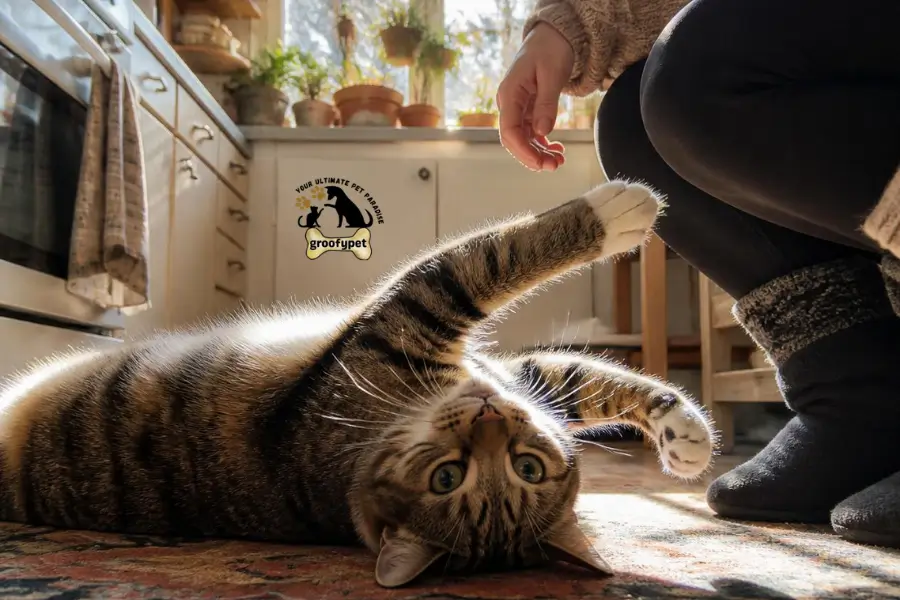
For some cats, this becomes part of a learned daily routine. She’s discovered that flopping in your walking path reliably gets you to slow down, talk to her, or bend down to say hello, so she repeats it. It’s rarely cause for concern, though it’s a good idea to watch your step so you don’t trip over an enthusiastic flopper.
Why Does My Cat Flop Down in Front of Me and Roll Around?
Rolling after a flop usually points to playfulness, comfort, or an especially enthusiastic greeting. Cats that roll from side to side, paw at the air, or wiggle their whole body tend to be in a relaxed, happy state of mind.
Rolling can also be part of attention-seeking behavior, especially if your cat glances at you between rolls to check whether you’re watching. As always, pair this with her overall body language: relaxed rolling with soft eyes and ears is very different from tense, rigid rolling paired with flattened ears.
Should I Pet My Cat When It Flops Down?
It depends entirely on what your cat’s body language is telling you in that moment. A flop isn’t a universal green light for petting, and every cat has her own preferences.
Before petting a flopped-down cat, look for relaxed signals: soft eyes, ears facing forward, a loose body, and slow blinking. These generally suggest she’s open to gentle contact. If you see tension flattened ears, a stiff body, or a tail that starts swishing, it’s better to pause and let her settle rather than reaching in.
When it comes to where to pet, the cheeks, chin, and the top of the head are safer bets for most cats than the belly, even during a flop. If your cat nudges your hand toward her stomach herself, that’s usually a clearer invitation than the flop alone. Every cat is an individual, though, so pay attention to what your own cat specifically seems to enjoy and stop if she shows any sign of discomfort.
When Is Flopping Behavior a Cause for Concern?
In the vast majority of cases, flopping is a completely normal, healthy behavior. But it’s worth knowing the difference between a happy, relaxed flop and something that could signal a medical issue, since the two can look superficially similar at a glance.
Contact your veterinarian if flopping is accompanied by any of the following:
- Sudden weakness
- Difficulty standing or walking normally afterward
- Trouble breathing
- Loss of balance or coordination
- Crying out or other signs of obvious pain
- Repeated collapsing throughout the day
- Extreme lethargy that doesn’t match her usual energy level
- Any unusual behavior that appears suddenly and doesn’t fit her normal patterns
This isn’t a diagnosis of any specific condition, and there are many possible explanations for these kinds of symptoms some serious, some not. The safest approach is always to have a veterinarian evaluate your cat directly if something feels off, rather than trying to guess the cause at home.
Cat Flopping vs. Cat Collapsing: What’s the Difference?
Since both behaviors can look similar for a split second, it helps to know what separates a normal flop from a genuine collapse.
| Normal Flopping | Concerning Collapse |
|---|---|
| Cat remains alert | Cat appears unresponsive |
| Gets up normally | Struggles to stand |
| Relaxed body | Weak or limp body |
| Normal breathing | Abnormal or difficult breathing |
| Responds to you | Poor response |
| Happens during normal interaction | Happens suddenly or repeatedly |
If you notice signs from the “concerning collapse” column, especially more than once, treat it as a reason to call your veterinarian promptly rather than waiting to see if it happens again.
Frequently Asked Questions
Why does my cat flop down in front of me?
Most often it’s a sign of comfort, trust, or a desire for attention, play, or a greeting. The exact reason depends on her surrounding body language and what she does next.
Why does my cat throw itself on the floor when it sees me?
This is usually an enthusiastic greeting or attention-seeking behavior, especially if it happens right when you walk in or she notices you across the room.
Does a cat flopping in front of you mean it trusts you?
Often, yes. Exposing the belly is a vulnerable position, so a cat that does this around you is generally signaling that she feels safe in your presence.
Why does my cat show me its belly?
Showing the belly is typically a sign of relaxation and trust rather than a request for a belly rub, though some individual cats do enjoy the touch.
Does my cat want a belly rub when it rolls over?
Not necessarily. Watch her body language before petting her stomach — relaxed signals suggest she may welcome it, while tension suggests it’s best to avoid that area.
Why does my cat flop down and then bite me?
This can happen when petting — especially on the belly — becomes overstimulating or unwelcome. It’s often a startled or defensive reaction rather than aggression, and it’s a good cue to pet elsewhere or give her space.
Why does my cat flop down in front of my feet?
This is commonly attention-seeking or a greeting, and some cats simply enjoy flopping in high-traffic spots where they know they’ll be noticed.
Why does my cat flop down when I come home?
This is a classic homecoming greeting, often combined with attention-seeking after time spent alone.
Why does my cat roll around on the floor?
Rolling can indicate playfulness, comfort, scent marking, or an eager greeting, depending on the rest of her body language.
When should I worry about my cat suddenly falling over?
If a “flop” looks more like a genuine collapse with weakness, difficulty standing, abnormal breathing, or lack of responsiveness, it’s time to contact your veterinarian rather than assuming it’s normal behavior.
Final Thoughts
Why do cats flop down in front of you? In most cases, the answer comes down to comfort, trust, attention, greeting, or play and the specific reason usually reveals itself through the rest of your cat’s body language. A relaxed flop, especially paired with soft eyes, gentle ears, and easy movement, is generally a compliment: your cat feels safe enough around you to let her guard down completely.
That said, it’s worth remembering that every cat is an individual, and what a flop means for one cat might be slightly different for another. Pay attention to your own cat’s patterns over time, and you’ll get better at reading exactly what she’s asking for.
The one distinction worth keeping in mind is the difference between a happy, harmless flop and a genuine collapse. If your cat ever shows signs of weakness, difficulty breathing, or sudden unresponsiveness, don’t wait it out; a trip to the veterinarian is always the safer choice. Outside of that, though, enjoy the flop. It’s one of the more charming ways your cat has of saying she’s glad you’re around.
Why Do Cats Bite When Grooming? Shocking Truth!
Why Does My Cat Hug My Arm? 10 Vet Reviewed Reasons Explained!