If you’ve ever lived with a cat that seems to have an opinion about everything, your work-from-home schedule, the empty food bowl, or the bird outside the window, you already know that some cats are simply more chatty than others. While every cat can meow, a handful of breeds are famous for taking it to the next level with a whole vocabulary of chirps, trills, yowls, and conversational meows.
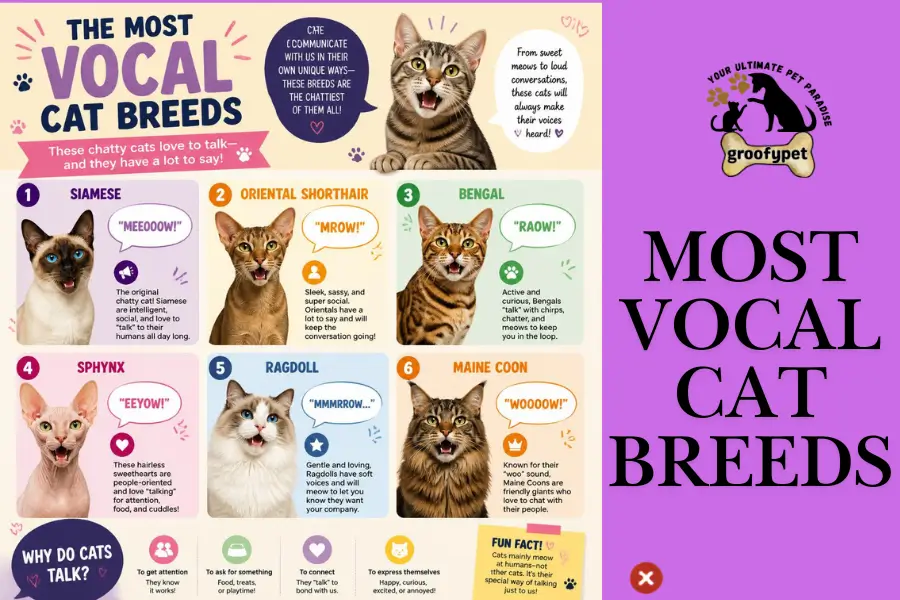
The most vocal cat breeds include the Siamese, Oriental Shorthair, Balinese, Burmese, Tonkinese, Bengal, and Sphynx. Siamese cats top nearly every list of talkative cat breeds, known for their loud, frequent, and remarkably expressive vocalizations that can sound almost like a conversation or a human baby crying.
This guide breaks down the most chatty cat breeds, explains why some cats talk more than others, and helps you decide whether a vocal cat breed is the right fit for your home.
What Makes a Cat Breed Vocal?
Not all meows are created equal, and not every cat inherits the same drive to “talk.” Several factors combine to determine how vocal a particular cat or cat breed tends to be.
Genetics and breed traits:
Genetics and breed traits play the biggest role. Breeds like the Siamese were selectively developed over generations, and their strong social instincts and vocal tendencies were passed down along the way. This is why entire bloodlines share similar cat communication styles.
Personality
Personality also matters enormously. Just like people, individual cats vary. Some Siamese cats are quieter than average, while an otherwise “quiet” breed might produce one exceptionally talkative kitten.
Social needs
Social needs drive a lot of vocal behavior. Cats that crave near-constant companionship, sometimes called “Velcro cats,” often vocalize to stay connected with their favorite humans throughout the day.
Attention-seeking behavior
Attention-seeking behavior is a major factor too. Cats quickly learn that meowing gets a response, whether that’s food, playtime, or simply a scratch behind the ears. Breeds with high intelligence and social drive tend to lean on vocalization as their go-to attention-getting tool.
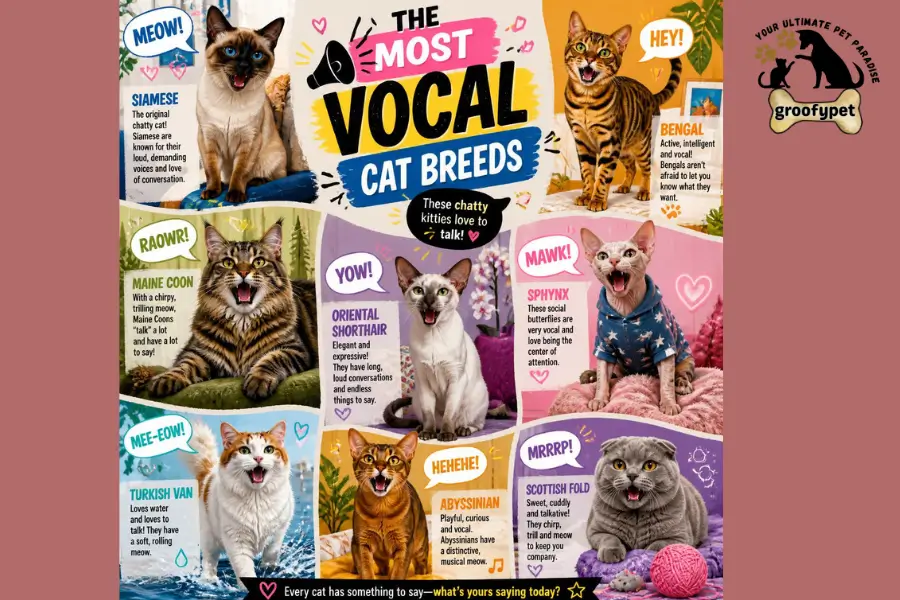
Communication style
Communication style differs from cat to cat. Some breeds favor short, punchy meows, while others rely on trills, chirps, or long, drawn-out yowls to get their point across.
Finally, environment shapes vocal habits. A cat living in a quiet, low-stimulation household may vocalize more out of boredom, while a cat with plenty of enrichment might “talk” mostly during play or mealtime routines.
It’s also worth noting that early socialization plays a role. Kittens raised in homes where people talk to them frequently often grow up more vocal themselves, since they learn early on that “talking back” gets a response. This is one reason breeders of naturally chatty breeds, like the Siamese, often note that kittens raised in interactive, hands-on environments tend to develop even stronger vocal habits than those raised with minimal human contact.
Most Vocal Cat Breeds
Here’s a closer look at the breeds most commonly recognized as the most vocal cat breeds, along with what makes each one so chatty.
1. Siamese
Vocality level: Extremely high
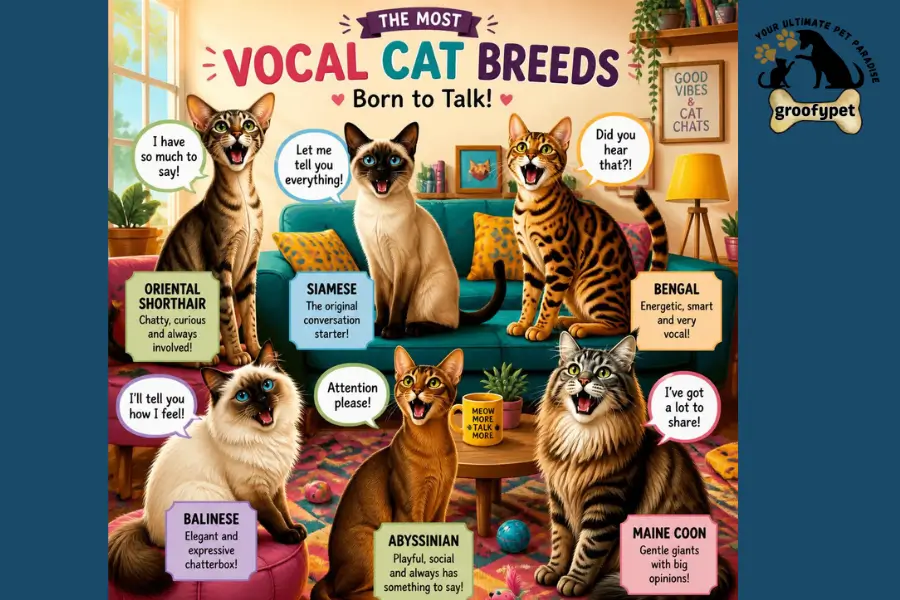
The Siamese is, without question, the most iconic of all talkative cat breeds. Typical sounds range from loud, insistent meows to a distinctive, raspy yowl that many owners compare to a human baby’s cry. Siamese cats are highly social, intelligent, and deeply attached to their people, which fuels their near-constant need to communicate.
Their energy level is high, and their social needs are equally demanding they don’t do well being ignored for long stretches. This breed is not ideal for households seeking peace and quiet, but for owners who want a cat that genuinely seems to “talk back,” the Siamese delivers. Because they crave interaction, Siamese cats do best with owners who have time to engage with them daily.
2. Oriental Shorthair
Vocality level: Very high
Closely related to the Siamese, the Oriental Shorthair shares nearly identical vocal tendencies, loud meows, persistent chatter, and a strong desire to be heard. Personality-wise, Orientals are affectionate, curious, and highly bonded to their favorite humans. Their vocal nature stems largely from their close genetic ties to the Siamese line.
They have high energy and strong social needs, making them a poor match for quiet households or owners who work long hours away from home. Owners should be prepared for an interactive, demanding companion that thrives on conversation and play.
3. Balinese
Vocality level: High
Often described as the “long-haired Siamese,” the Balinese inherited much of the Siamese’s chatty personality along with its silky coat. Typical sounds include soft trills and conversational meows, generally a bit gentler than the classic Siamese yowl. Balinese cats are intelligent, affectionate, and people-oriented, and their vocal habits are closely tied to their desire for interaction and mental stimulation.
They have moderate-to-high energy and strong social needs. A quiet household with an absent owner isn’t the best fit. Balinese cats want engagement and will let you know when they’re not getting enough of it. Regular grooming is also an important care consideration for this longer-coated breed.
4. Burmese
Vocality level: Moderate to high
Burmese cats are known for a softer, sweeter vocal style compared to the Siamese’s sharper yowl. Typical sounds include gentle meows, cooing, and soft trills. Personality-wise, Burmese cats are affectionate, people-focused, and often described as “dog-like” in how closely they follow their owners around the house. Their vocal nature comes from a genuine desire for closeness rather than pure demand.
They have moderate-to-high energy and thrive on companionship, making them a good option for families or multi-pet households as long as someone is usually around. Burmese cats aren’t the best choice for a completely quiet household, but they’re less overwhelming than a Siamese for first-time owners of a vocal cat breed.
5. Tonkinese
Vocality level: Moderate to high
The Tonkinese is a deliberate cross between the Siamese and Burmese, and it shows in both temperament and voice. Typical sounds fall between the two parent breeds, louder than a Burmese and softer than a Siamese. Tonkinese cats are playful, intelligent, and highly social, often described as having a “dog-like” willingness to interact and even fetch.
Their vocal tendencies stem from strong social needs and a habit of “narrating” daily activities. Energy levels run high, and this breed does best with plenty of playtime and company. Tonkinese cats can adapt reasonably well to busy households, though they’re not suited to being left alone for long periods.
6. Bengal
Vocality level: Moderate to high
Bengal cats bring a wild-looking coat and an equally bold personality, including a vocal streak that surprises many new owners. Typical sounds include loud meows, chirps that echo their exotic ancestry, and even occasional yowling when they want something. Bengals are highly intelligent, athletic, and easily bored, and their vocal habits are closely tied to a need for mental and physical stimulation.
This breed has very high energy and requires significant enrichment, puzzle feeders, climbing structures, and interactive play to stay content. Bengals are not a good match for quiet households or owners who can’t commit to daily activity, since boredom often shows up as louder, more persistent vocalization.
7. Sphynx
Vocality level: Moderate to high
The hairless Sphynx is famous for its affectionate, attention-craving nature, and its voice is part of that package. Typical sounds include frequent meows and soft chatter, often used to stay close to their favorite people. Sphynx cats are known as “Velcro cats” because of how tightly they bond with their households, and their vocal habits reflect a strong need for social contact.
Energy levels are moderate to high, and they generally don’t do well in isolation. Because Sphynx cats lack a protective coat, care considerations include regular skin cleaning, temperature regulation, and sun protection on top of managing their chatty personality.
8. Maine Coon
Vocality level: Moderate
The gentle giant of the cat world, the Maine Coon is talkative in a distinctive way. Instead of loud yowls, Maine Coons are known for soft, musical trills and chirps, often with a rising inflection that sounds almost like a question. Personality-wise, they’re friendly, easygoing, and good with children, dogs, and other cats. Their vocal style comes across as conversational rather than demanding.
Energy levels are moderate, and social needs are moderate as well Maine Coons enjoy company but are more independent than a Siamese or Bengal. This makes them one of the better options for households that want some chatter without constant noise. Regular grooming is an important care consideration due to their long, thick coats.
9. Turkish Angora
Vocality level: Moderate
Elegant and social, the Turkish Angora is known for a chatty, kitten-like personality that persists well into adulthood. Typical sounds include frequent meows and soft vocalizations used to express curiosity or seek attention. This breed is intelligent, affectionate, and enjoys interacting with people, which drives much of its vocal behavior.
Energy levels run moderate to high, and Turkish Angoras generally want an engaged household rather than a purely quiet one. They tend to do well with attentive owners who enjoy a cat that “comments” on daily life.
10. Japanese Bobtail
Vocality level: Moderate
The Japanese Bobtail is playful and social and known for cheerful, non-yowling meows that many owners describe as inviting rather than demanding. This ancient breed developed naturally in Japan and has long been valued for its friendly, communicative nature. Its vocal tendencies come from genuine sociability rather than pushiness.
Energy levels are moderate to high, and social needs are strong, making this a good fit for families and multi-pet homes. The Japanese Bobtail suits households that want an interactive cat without the intensity of a full-on Siamese yowl.
Vocal Cat Breeds Comparison Table
| Cat Breed | Vocality Level | Common Sounds | Personality | Energy Level | Best For |
|---|---|---|---|---|---|
| Siamese | ⭐⭐⭐⭐⭐ Very High | Meows, yowls, chirps | Social, affectionate, demanding | High | Families and active owners |
| Oriental Shorthair | ⭐⭐⭐⭐⭐ Very High | Meows, trills, chatter | Intelligent, playful, social | High | Experienced cat owners |
| Balinese | ⭐⭐⭐⭐ High | Soft meows, chirps, trills | Affectionate, intelligent | High | Families and companions |
| Burmese | ⭐⭐⭐⭐ High | Meows, purrs, chirps | Loving, people-oriented | Medium–High | Families |
| Tonkinese | ⭐⭐⭐⭐ High | Meows, chirps, trills | Playful, outgoing | High | Active households |
| Bengal | ⭐⭐⭐⭐ High | Chirps, meows, yowls | Energetic, curious, confident | Very High | Active owners |
| Sphynx | ⭐⭐⭐⭐ High | Meows, chirps, trills | Affectionate, attention-seeking | High | People wanting a social cat |
| Maine Coon | ⭐⭐⭐ Medium–High | Trills, chirps, soft meows | Gentle, friendly, relaxed | Medium | Families |
| Turkish Angora | ⭐⭐⭐ Medium–High | Meows, chirps | Active, intelligent, confident | High | Active families |
| Japanese Bobtail | ⭐⭐⭐ Medium–High | Meows, chirps, trills | Playful, social, curious | High | Families and multi-pet homes |
Which Cat Breed Is the Most Talkative?
If you’re looking for a single, direct answer: the Siamese cat is widely considered the most talkative cat breed. Siamese cats combine high intelligence, strong social bonds, and a genetic predisposition toward vocalization, resulting in a breed that meows, yowls, and chirps more frequently and more loudly than almost any other.
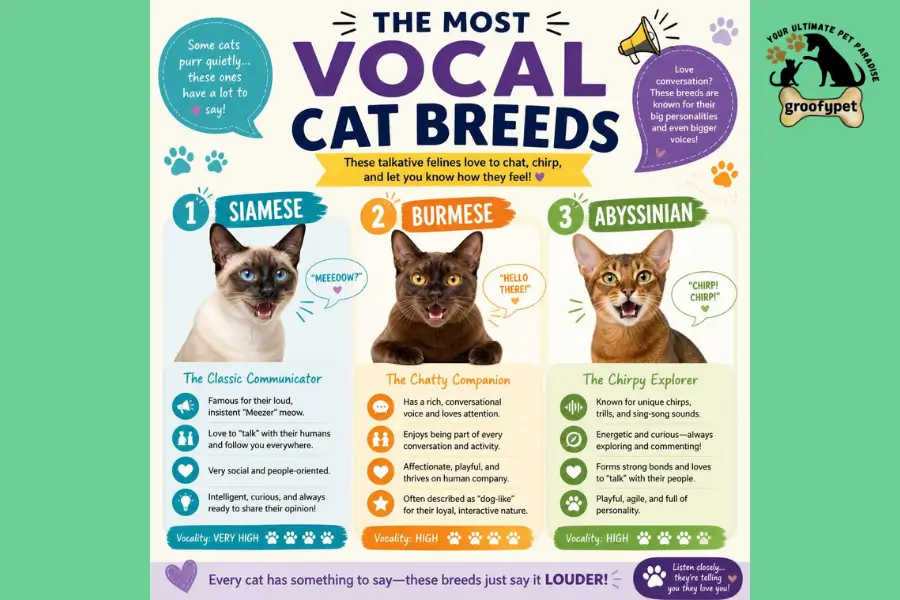
Their distinctive, raspy voice has earned comparisons to a human baby’s cry, and many owners describe living with a Siamese as having an ongoing conversation. While the Oriental Shorthair comes close due to its shared ancestry, the Siamese remains the benchmark against which other vocal cat breeds are measured.
Why Do Vocal Cats Meow So Much?
Cats don’t meow at random. Vocalization is a form of cat communication, and understanding the reasons behind it can help you respond appropriately.
- Hunger is one of the most common triggers. Many cats have learned that a well-timed meow near the food bowl gets quick results.
- Attention is another major driver. Social breeds especially will vocalize simply to be noticed, petted, or included in whatever you’re doing.
- Greeting behavior explains why some cats meow the moment you walk in the door. This is especially common in highly social breeds like the Siamese and Burmese.
- Boredom can lead to excessive meowing, particularly in intelligent, high-energy breeds like the Bengal that need consistent mental stimulation.
- Stress sometimes shows up as increased vocalization, especially after a move, a new pet, or a change in routine.
- Desire for interaction is closely tied to social needs. Cats bred for close human bonds, Tonkinese, Sphynx, and Balinese among them often vocalize simply because they want company.
- Mating behavior can cause loud, persistent yowling in unspayed or unneutered cats, particularly females in heat.
- Discomfort or illness is an important reason to watch for. A sudden increase in meowing, especially paired with other symptoms, may signal an underlying health issue rather than typical breed behavior.
Are Vocal Cat Breeds Good for Families?
Talkative cat breeds can absolutely thrive in family settings, but the right fit depends on the household’s rhythm and needs.
For children, vocal breeds like the Burmese, Tonkinese, and Japanese Bobtail tend to do well, since their communicative nature often translates into playful, interactive behavior that kids enjoy.
With other cats, social breeds generally adapt smoothly, especially Tonkinese and Burmese cats, which are known for getting along well in multi-cat homes.
Around dogs, breeds like the Maine Coon and Japanese Bobtail often integrate easily thanks to their easygoing temperaments.
For first-time cat owners, a moderately vocal breed such as the Maine Coon or Turkish Angora may be easier to manage than an intensely demanding Siamese, since the learning curve for responding to vocal cues is gentler.
In busy households, highly social and vocal breeds can actually thrive, since there’s usually someone around to interact with. However, in homes where everyone is gone most of the day, a very vocal breed may become louder and more insistent out of loneliness or boredom.
Most Vocal vs. Quiet Cat Breeds
While breeds like the Siamese, Oriental Shorthair, and Bengal are known for constant chatter, other breeds lean toward the quiet end of the spectrum. Breeds often described as quiet cat breeds include the Russian Blue, British Shorthair, and Persian, which tend to communicate more through body language than vocalization.
That said, breed tendencies are generalizations, not guarantees. An individual Russian Blue might turn out to be surprisingly chatty, while a Siamese kitten could grow into a relatively quiet adult. Genetics set a baseline tendency, but personality, upbringing, and environment ultimately shape how much any single cat “talks.”
If you’re choosing between a talkative cat breed and a quiet cat breed, think about your own tolerance for noise, your schedule, and how much interaction you can realistically offer. A vocal breed left alone for long stretches may become louder and more insistent, while a quiet breed in a busy household may simply keep its thoughts to itself rather than compete for attention. Neither temperament is better than the other; it’s about matching a cat’s communication style to your lifestyle.
How to Live With a Very Vocal Cat
If you’ve brought home one of the most vocal cat breeds, a few simple strategies can help keep the chatter manageable and meaningful.
- Providing daily play helps burn off energy and reduces boredom-driven meowing, especially in high-energy breeds like the Bengal.
- Offering mental stimulation — puzzle feeders, climbing towers, and rotating toys — keeps intelligent breeds like the Siamese and Oriental Shorthair engaged.
- Maintaining a routine for feeding, play, and attention helps reduce anxious or demanding vocalization tied to unpredictability.
- Responding appropriately to vocalization means acknowledging your cat without always giving in to every demand, which helps prevent excessive attention-seeking behavior from escalating.
- Providing companionship, whether through more one-on-one time or a compatible feline companion, can ease loneliness-driven chatter in highly social breeds.
- Scheduling veterinary checks when vocalization suddenly changes is essential. A cat that becomes noticeably louder, quieter, or more distressed than usual may be communicating discomfort rather than simply “being talkative.”
When Excessive Meowing May Be a Problem
Breed-related chattiness is normal, but a sudden shift in vocal behavior deserves attention. Increased meowing that appears out of nowhere, especially alongside changes in appetite, litter box habits, weight, sleep patterns, mobility, or general behavior, can point to an underlying health issue rather than typical personality quirks.
This is especially important to watch for in senior cats, since vocal changes are sometimes linked to age-related conditions. If you notice these changes, it’s best to contact a veterinarian for a proper evaluation rather than assuming it’s just breed behavior.
Frequently Asked Questions
What is the most vocal cat breed?
The Siamese is generally recognized as the most vocal cat breed, known for loud, frequent, and highly expressive vocalizations.
Are Siamese cats really talkative?
Yes. Siamese cats are famous for their raspy, persistent voices and strong desire to communicate with their owners throughout the day.
Which cat breeds meow the most?
Siamese, Oriental Shorthair, Balinese, Bengal, and Tonkinese cats are among the breeds most known for frequent meowing and vocal chatter.
What is the quietest cat breed?
Breeds like the Russian Blue, British Shorthair, and Persian are often considered among the quieter cat breeds, though individual personality still varies.
Why are some cats more vocal than others?
Vocalization is shaped by genetics, personality, social needs, environment, and how a cat has learned to communicate with its owners over time.
Are vocal cats harder to care for?
Not necessarily harder, but they do require more interaction, mental stimulation, and responsiveness to keep them content and prevent excessive attention-seeking.
Do male or female cats talk more?
Vocal tendencies are influenced more by breed and individual personality than by sex, though unspayed or unneutered cats may vocalize more during mating-related behavior.
Can a quiet cat become more vocal?
Yes. Changes in environment, age, health, or routine can all cause a normally quiet cat to become more vocal, which is worth monitoring if the shift is sudden.
Final Thoughts
The most vocal cat breeds, from the iconic Siamese to the musically inclined Maine Coon, each bring their own style of “conversation” into a household. Some breeds favor loud, insistent yowls, while others communicate through gentle trills and soft chirps. What they share is a strong drive toward cat communication, whether that’s rooted in social bonding, attention-seeking, or simple personality.
When choosing a breed based on vocal tendencies, remember that personality, activity level, social needs, grooming requirements, and overall care should factor into the decision just as much as how much a cat “talks.” A chatty breed can be a wonderful companion for the right owner, but it’s worth being honest about your lifestyle and how much daily interaction you can realistically provide.
Ultimately, whether you end up with a demonstrative Siamese or a quieter Russian Blue, paying attention to your cat’s unique voice and any changes in it is one of the best ways to understand what they need and keep them healthy and happy for years to come.