
Dogs stretch when they see you for a mix of reasons that often overlap. It can be part of a greeting, a way to loosen up after resting, or a small habit your dog picked up because it gets your attention. The real meaning depends on your dog’s overall body language and what happens right before and after the stretch.
Why Do Dogs Stretch When They See You?
A dog may stretch when it sees you because it is greeting you, moving from rest into activity, or seeking interaction. Stretching often blends with friendly body language like a loose tail or soft eyes. Context matters more than the stretch itself, so look at the whole picture before deciding what it means.
Why Do Dogs Stretch When They See You?
1. They May Be Greeting You
Many dogs fold, stretching into their hello routine. This dog greeting behavior often shows up right when you walk through the door or step into a room your dog is in.
A relaxed greeting usually includes more than just the stretch. Watch for:
- A loose, wiggly body
- A relaxed tail, often moving in a wide, easy wag
- A soft facial expression, not tense or wide-eyed
- Relaxed ears, not pinned back
- Willingness to walk toward you on their own
Stretching alone does not prove your dog is excited or affectionate. It’s one piece of a bigger pattern, so pair it with these other signals before you read too much into it.
2. They Are Getting Ready to Move
Dogs stretch after lying down for the same reason you might stretch after sitting at a desk all day. A dog morning stretch, or any stretch after a nap, helps loosen stiff muscles and joints before movement.
If your dog was resting on the couch or floor and stretches the moment they see you, part of that stretch may simply be their body preparing to get up and walk over, not a reaction to you specifically.
3. They Associate You With Positive Interaction
Dogs are quick to link people with routines. If your dog has learned that seeing you usually leads to a walk, playtime, petting, food, time outside, or attention, they may become more active as soon as they spot you.
That burst of activity can include a stretch, since it’s a natural way to transition from resting to moving. This doesn’t mean the stretch itself proves happiness. It’s more likely a sign that something good is about to happen.
4. They Want Your Attention
Some dogs figure out that certain behaviors reliably get a response from their owner. If stretching near you has led to petting, talking, or eye contact in the past, your dog may repeat it on purpose.
This is a normal part of how dogs learn. Dog stretches when I approach or dog stretches in front of me are common questions owners ask, and often the answer is simple: the behavior worked before, so the dog tries it again.
5. They Are Combining a Stretch With a Greeting
There’s a difference between a plain physical stretch and a social greeting stretch, though the two frequently blend together. Some dogs naturally stretch while walking toward a familiar person, especially right after getting up from a nap.
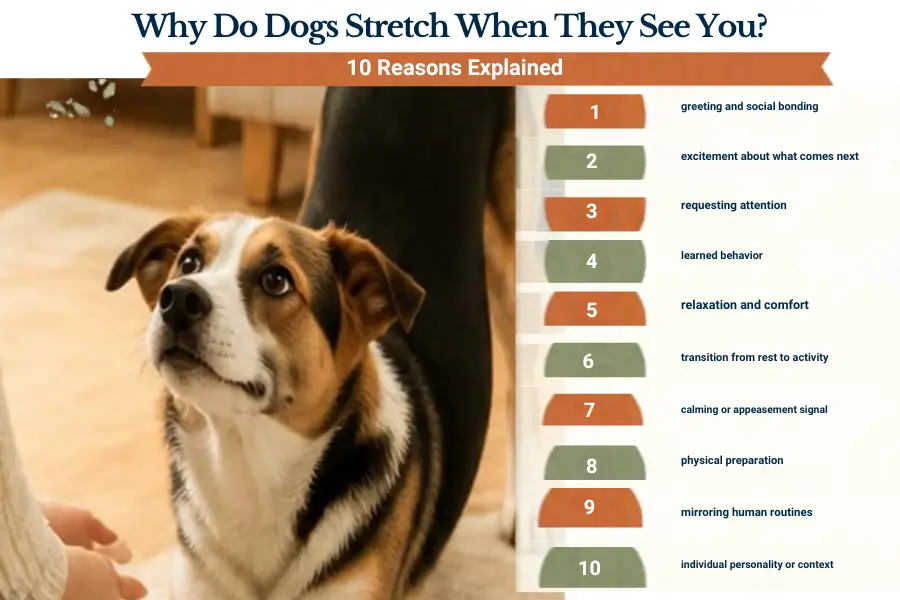
6. Your Dog Feels Comfortable Around You
A relaxed stretch can also show that your dog feels comfortable in your presence.Dogs are less likely to remain tense when they feel safe. A slow stretch followed by relaxed body language may simply mean your dog is comfortable enough to relax around you.
Look at the whole body rather than the stretch alone.
7. Your Dog Is Copying the Situation
Dogs are highly observant animals. They pay attention to what people and other animals around them are doing.Sometimes your dog may stretch simply because it is transitioning from resting to activity after noticing that you have arrived.
It does not necessarily have a complicated meaning.
8. Your Dog Is Ready to Move
Your arrival may signal that something interesting is about to happen.Perhaps you normally take your dog outside, prepare dinner, or start a walk after entering the room.Your dog may stretch because it is preparing to get moving.The stretch can be followed by walking toward the door, bringing you a toy, or waiting near its leash.
9. Your Dog Is Showing Relaxed Body Language
Not every stretch is a message directed specifically at you.Sometimes your dog simply happens to stretch when it sees you.If its body looks loose, its tail is relaxed, and its facial expression appears calm, there may be nothing unusual happening.The timing may just make it seem like the stretch has a special meaning.
10. Your Dog May Be Communicating With You
Dogs use their bodies to communicate constantly. A stretch can be one small part of that communication.The meaning depends on what happens before and after the stretch.A happy dog may stretch, wag its tail, approach you, and invite play. Another dog may stretch after waking up and then calmly walk away.
That’s why it is important to consider the entire body language rather than interpreting one movement by itself.This combination is common and usually harmless. It just means your dog’s body and their social instincts are working at the same time.
Is It a Greeting Stretch or a Play Bow?
This distinction trips up a lot of owners, so it’s worth breaking down clearly.
Normal stretch:
- Front legs extended
- Rear end may stay raised or level
- Often happens right after resting
Play bow:
- Front legs lowered close to the ground
- Chest dips lower than the rear
- Rear end raised higher
- Tail often active and moving
- Usually followed by bouncy, playful movement
A dog play bow is generally an invitation to play, but no single posture should be read on its own. Always check what the dog does right after.
| Behavior | What It May Mean | Other Signs |
|---|---|---|
| Normal stretch | Waking up or preparing to move | Relaxed body |
| Play bow | Invitation to play | Bouncy movement |
| Greeting stretch | Social interaction | Loose, friendly posture |
| Stiff stretch | Possible discomfort | Stiffness or reluctance |
| Repeated stretching | Possible physical issue | Other unusual symptoms |
What Does a Dog’s Body Language Tell You?
The stretch is just one signal. Reading dog body language as a whole gives you a much clearer picture.
- Tail: A relaxed, loose wag usually points to comfort. A stiff, high, rapid wag or a tucked tail can signal tension instead.
- Ears: Relaxed, natural ear position often means your dog feels at ease. Ears pinned tightly back or held rigid can mean stress or discomfort.
- Eyes: Soft eyes with a relaxed blink rate usually mean a calm dog. Hard staring or wide, tense eyes can mean something else is going on.
- Mouth: A relaxed, slightly open mouth is a good sign. A tightly closed mouth or pulled-back lips can point to stress.
- Body posture: Loose, wiggly movement generally means comfort. Stiffness, freezing, or leaning away can mean the opposite.
- Movement after the stretch: Does your dog move normally afterward, or do they seem hesitant, slow, or reluctant? This tells you a lot about whether the stretch was just routine or tied to discomfort.
Context, body language, and what happens after the stretch give you far more useful information than the stretch by itself.
Must Read : Why Does My Dog Scratch the Carpet?Reasons and Tips to Stop It!
Why Does My Dog Stretch When I Come Home?
This is one of the most common versions of this question, and it usually comes down to timing. Your dog was likely resting while you were gone, and your arrival triggers a shift from rest to activity.
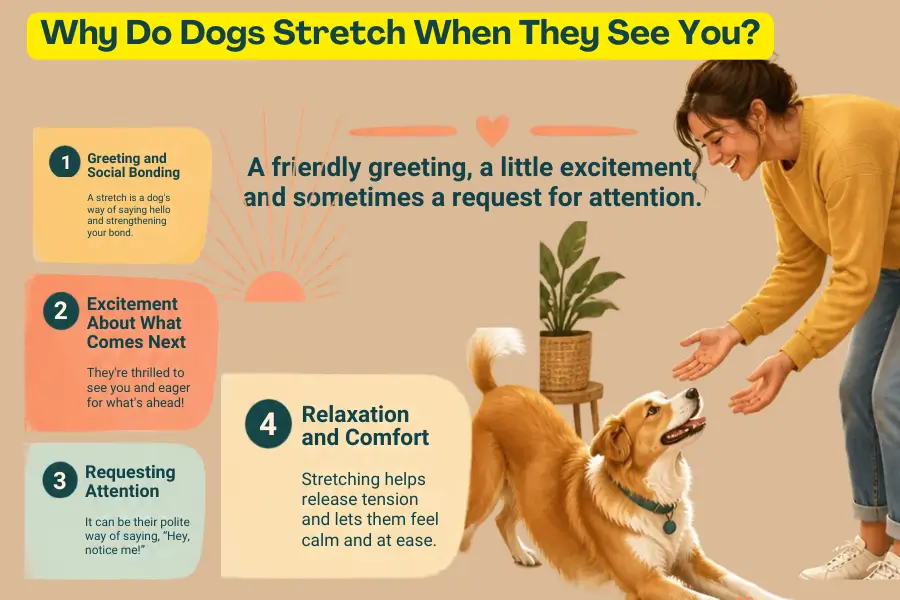
A few things are probably happening at once:
- A learned greeting routine tied to your arrival
- Anticipation of attention, play, or a walk
- General excitement about you being back
- Simple movement after a period of lying down
- Attention-seeking behavior that has worked before
It’s tempting to say the stretch means your dog missed you, and that may be part of it. But it’s more accurate to say the stretch reflects a mix of physical and social factors rather than one single emotion.
Why Does My Dog Stretch in Front of Me?
Dogs may stretch in front of people for ordinary physical reasons, or because the behavior has become part of their social routine with that person. Proximity matters here. A dog that stretches specifically when a familiar person is nearby, rather than randomly throughout the day, is often using the stretch as part of a social exchange.
Watch the body language around it. A loose, relaxed stretch paired with a soft posture usually points to comfort. A stiff or hesitant stretch paired with tension is worth watching more closely.
Also Read : Why Does My Dog Lick My Nose So Gently?
Why Does My Dog Stretch When I Pet Him?
There are several ordinary explanations here:
- Relaxing into the physical contact
- Shifting position to get comfortable
- Preparing to move or reposition
- Simply enjoying the attention
- A normal stretch that happens to line up with petting
That said, not every stretch during petting means enjoyment. Watch for signs your dog may not be comfortable, such as moving away, becoming stiff, repeated lip licking, frequent yawning outside of tiredness, or avoiding further contact. These are sometimes called calming signals, but they don’t automatically mean anxiety. They’re worth noticing, not panicking over.
Why Do Dogs Stretch After Sleeping?
This one is straightforward. Dogs stretch after resting to loosen muscles and joints that have been still for a while. It’s a normal physical reset before getting up and moving around, similar to what people do after sitting or lying down for a long stretch of time.
You’ll often see this stretch happen on its own, separate from any greeting, especially if your dog wakes up while you’re already in the room.
Do Dogs Stretch When They Are Happy?
Stretching can happen during positive social moments, but it isn’t a reliable happiness test on its own. A dog can stretch out of habit, boredom, or plain physical need, none of which are tied to emotion.
A better approach is to look for a combination of signals: a loose body, relaxed tail, soft eyes, and normal, easy movement. When several of these show up together with the stretch, it’s a much stronger sign that your dog is genuinely comfortable and glad to see you.
Can Stretching Mean My Dog Wants to Play?
Sometimes, yes, especially when the stretch looks more like a play bow. Other signals that point to play rather than a simple greeting include:
- Bouncing or hopping in place
- Playful running, sometimes in short bursts
- Bringing you a toy
- Loose, relaxed tail wagging
- Repeated attempts to get you to interact
Keep in mind that individual dogs have their own communication styles. One dog’s play invitation might look slightly different from another’s, so it helps to learn your own dog’s specific patterns over time.
When Stretching May Be a Sign of a Problem
Ordinary stretching is usually nothing to worry about. But frequent or unusual stretching, especially when paired with other symptoms, deserves closer attention.
Watch for:
- Repeated stretching that looks uncomfortable rather than casual
- Reluctance to move afterward
- Noticeable stiffness
- Difficulty getting up
- Crying or whining during the stretch
- Vomiting
- Diarrhea
- Reduced appetite
- A swollen or painful-looking abdomen
- Unusual or strained posture
- General weakness
- Sudden changes in behavior
A repeated “prayer position,” where the front legs stay stretched forward while the rear stays up for longer than normal, combined with signs of illness, can sometimes point to abdominal discomfort. This should not be assumed to be a simple greeting if it comes with other symptoms.
This article can’t diagnose your dog, and it shouldn’t try to. If you notice these warning signs, especially if they appear suddenly or get worse, contact your veterinarian rather than waiting to see if it resolves on its own.
How to Tell What Your Dog’s Stretch Means
A short mental checklist can help you sort through what you’re seeing:
- Was my dog sleeping or resting just before this?
- Did the stretch happen right after getting up?
- Is my dog’s body relaxed overall?
- Is the tail loose and easy, not stiff?
- Does my dog walk toward me on their own?
- Does my dog seem ready to play afterward?
- Does my dog move normally once the stretch is done?
- Are there any signs of pain or illness?
- Does this happen regularly, or is it new?
- Is anything else about my dog’s behavior different lately?
Running through these questions helps you interpret the behavior without jumping straight to a conclusion in either direction.
Common Situations and What They May Mean
| Situation | Possible Explanation |
|---|---|
| Dog stretches when you enter the room | Greeting or getting ready to move |
| Dog stretches after waking | Normal post-rest movement |
| Dog stretches before play | Preparing for activity or play behavior |
| Dog stretches while approaching you | Social interaction or normal movement |
| Dog stretches repeatedly | Could be normal, but context matters |
| Dog stretches with pain signs | Possible discomfort; veterinary advice may be needed |
Do Dogs Know They Are Greeting Their Owners?
Dogs recognize familiar people through a combination of cues, not just sight. Scent, visual recognition, the sound of your voice, and learned routines all play a part. Over time, dogs build strong associations between specific people and specific outcomes, which shapes how they react when someone familiar appears.
It’s reasonable to say dogs recognize you as someone specific and meaningful to them. It’s less accurate to assume they experience a greeting the exact same way a person would, since we can’t fully confirm what’s happening emotionally inside a dog’s mind. The safest approach is to describe what we can observe rather than assume more than the behavior actually shows.
Frequently Asked Questions
Why do dogs stretch when they see you?
Dogs often stretch when they see you as part of a greeting routine, a transition from rest to activity, or a learned habit that gets your attention. The exact reason depends on the individual dog and the situation, so it helps to look at their whole body language rather than the stretch alone.
Why does my dog stretch when I come home?
Your dog was likely resting while you were away, and your arrival triggers movement and excitement at the same time. The stretch may combine physical readiness with anticipation of attention, play, or a walk, rather than reflecting one single cause.
Why does my dog stretch in front of me?
This can be an ordinary physical stretch that happens to occur near you, or a behavior your dog has learned to use socially. Proximity and body language both matter when figuring out which one it is.
Does a dog stretching mean it is happy?
Not on its own. Stretching can happen for many reasons unrelated to emotion. Look for a combination of a loose body, relaxed tail, and calm behavior alongside the stretch before concluding your dog is happy.
Why does my dog stretch when I pet him?
This is often a sign of relaxing into the contact or simply repositioning. If your dog moves away, stiffens, or avoids further touch, that may signal they aren’t fully comfortable, rather than enjoying the moment.
Is a dog stretch the same as a play bow?
No. A regular stretch usually involves the front legs extending with the rear staying level or raised. A play bow lowers the chest closer to the ground with the rear end higher and often leads into playful movement.
Why does my dog stretch after sleeping?
This is a normal physical response. Muscles and joints stiffen during rest, and stretching helps loosen them before your dog gets up and moves around.
Can stretching mean my dog wants attention?
Yes, in some cases. If stretching has led to petting or interaction in the past, your dog may repeat the behavior specifically to get a response from you.
When is stretching a sign of pain?
If stretching looks stiff, happens repeatedly in an uncomfortable way, or comes with symptoms like vomiting, reduced appetite, or reluctance to move, it may point to discomfort rather than a simple greeting.
Should I worry if my dog keeps stretching?
Occasional stretching is normal and usually not a concern. Frequent, unusual, or uncomfortable-looking stretching, especially with other symptoms, is worth discussing with your veterinarian.
Key Takeaways
- Dogs may stretch when they see you for several normal, overlapping reasons.
- Greeting behavior and simple physical movement often happen at the same time.
- A stretch by itself doesn’t prove happiness or affection.
- A play bow is a distinct posture, different from an ordinary stretch.
- Whole-body language gives far more insight than the stretch alone.
- Sudden or repeated stretching combined with illness signs deserves veterinary attention.
- Every dog has its own communication style, so patterns matter more than one single behavior.
Final Thoughts
There’s no single answer that fits every dog when it comes to stretching. For most dogs, it’s a mix of physical habit and social routine, something that happens naturally when rest, excitement, and familiarity overlap. Paying attention to your dog’s full body language, not just the stretch, gives you a much better read on what’s actually going on. If the stretching ever looks uncomfortable or comes with other unusual symptoms, that’s the moment to loop in your veterinarian rather than guessing on your own.
Why Is My Dog Shedding So Much Real Reasons!
Why Is My Dog Itchy But Has No Fleas?Hidden Causes You Must Know!