
Cats Synesthesia is a remarkable phenomenon where sensory experiences intertwine, creating unique ways for them to interact with their surroundings. Unlike humans, who rely on separate senses, cats may associate sounds with visual images or smells with tactile sensations. This enhanced sensory processing allows them to perceive their environment in a dynamic and multi-sensory bond, improving their navigation skills and overall environmental awareness.
Have you ever wondered why your cat notices things you can’t? This heightened sensitivity might stem from synesthetic-like abilities, enabling them to detect sounds as visual cues or recognize familiar voices through subtle vibrations. Imagine your cat using these perceptions to locate hidden treats or understand you by tone alone. For pet parents, recognizing these traits can inspire sensory-friendly activities, such as toys with varied textures and sounds, to enrich their sensory experiences.
Cats’ sensory integration doesn’t just make them great hunters but also responsive companions. For example, their ability to perceive musical sounds as visual sensations might explain quirky reactions to your playlist. Understanding synesthesia in cats offers deeper insights into their behavioral aspects and emotional well-being. To create a stimulating environment, incorporate activities like sound-based games or calming spaces to minimize sensory overload. Explore this fascinating world to improve your bond and support your cat’s unique perception of life.
Synesthesia is a condition where senses blend, like “seeing” colours when hearing music or “tasting” words. Common types include grapheme colour (colored numbers) and chromesthesia (sounds evoke colours). It’s rare, affecting 2–4% of people, often enriching their perception. This unique experience stems from heightened brain connectivity.Synesthesia is a fascinating neurological condition where one sense involuntarily triggers another. For instance, some people can “hear” colours or “taste” sounds. Imagine listening to a symphony and seeing waves of vibrant colours that correspond to each note. Wild, right? While it might sound like something out of a sci-fi movie, it’s a real phenomenon for about 4% of humans.
Can Animals Experience Synesthesia?
If synesthesia is so extraordinary in humans, could animals, like cats, experience it too? Some researchers believe that since animals process sensory information differently, they might experience a form of sensory overlap. Cats, being naturally curious and perceptive, are prime candidates for exploring this possibility. Let’s dive deeper into their unique sensory world.
How Cats Perceive the World ? A Journey of Cat synesthesia
Cats experience the world in ways that humans can only imagine. Their perception is a mix of sharp sight, heightened senses, and a unique sensory overlap that might seem like synesthesia.
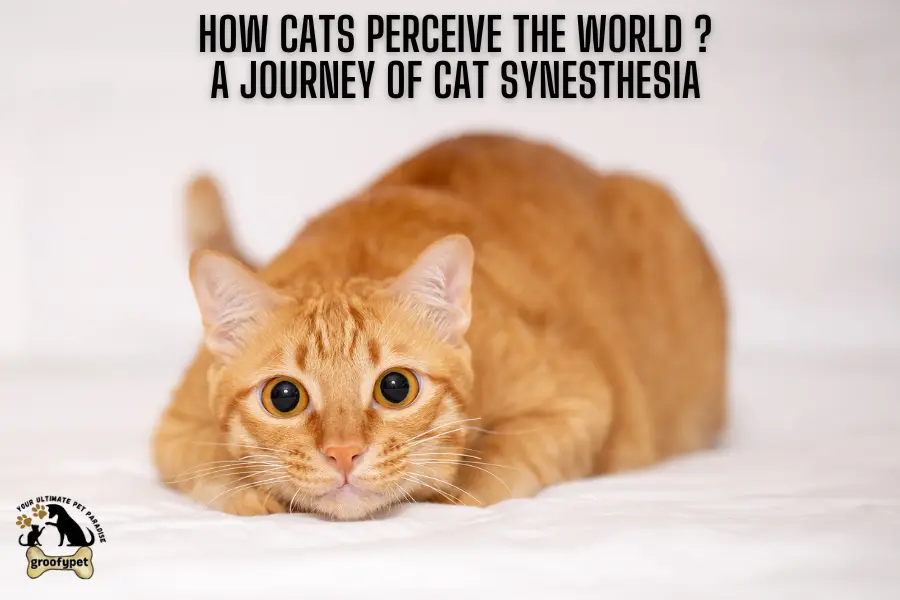
Cats eyes see fewer colors than we do, mostly perceiving shades of blue and green, but their vision is incredibly sharp in low light, allowing them to spot even the smallest movement in the dark
1-Vision: Seeing Beyond What We Can
Cats’ vision operates in a different spectrum than ours. They see well in low light and can detect subtle movements. While their color perception is limited compared to humans, they might link colors to certain experiences—possibly even sounds or smells.
2-Hearing: A Symphony of Subtle Sounds
With hearing so acute it makes humans seem practically deaf, cats pick up high-pitched frequencies we can’t even imagine. Could a specific sound trigger a visual or tactile sensation for them? It’s an intriguing thought.
3-Smell and Taste: A Multi-Sensory Bond
Cats rely heavily on their sense of smell and taste, often using them together. This overlap could hint at how sensory integration, or synesthesia, might play a role in their daily lives.
The Science Behind Cats Synesthesia
Cats experience a form of synesthesia, where their senses overlap, allowing them to associate sounds with colors or shapes. This intriguing phenomenon offers a glimpse into how their brains process sensory information in unique ways.
Research on Cats’ Sensory Integration
Scientists have yet to definitively prove synesthesia in cats, but studies on their sensory systems show an incredible level of integration. Cats don’t experience the world in isolated sensory pockets—they combine input from all their senses.
How Synesthesia Might Manifest in Cats
Imagine a cat hearing a high-pitched sound and “seeing” a flash of light or associating a specific sound with a texture. While we can’t ask them directly, their behaviors might give us subtle clues.
Theories Supporting Synesthesia in Cats
Some neuroscientists argue that synesthesia might be more common in animals than humans due to their instinctive reliance on multi-sensory information. Cats, in particular, could use this trait to navigate their environments or enhance their hunting skills.
Also Read : why is my male cat kneading and biting me
Signs Your Cat Experience Synesthesia
Cats synesthesia exhibit unusual reactions to sounds, such as “seeing” colors or shapes when they hear certain noises. They also show signs of cross-sensory experiences, like associating specific scents with colors or textures.

Unusual Reactions to Sounds or Colors
Ever noticed your cat acting strangely when exposed to certain sounds or bright colors? They might squint, paw at the air, or even vocalize. This could be a sign of sensory overlap at play.
Behavioral Clues of Sensory Overlap
Look out for repetitive behaviors linked to specific stimuli, like a cat consistently rubbing against an object whenever they hear a particular tone. These quirks might be a window into their sensory world.
Why Understanding Cats’ Synesthesia Matters?
Understanding cats’ synesthesia helps us better grasp their sensory experiences, offering insights into their behavior and communication. This knowledge can improve how we care for and interact with our feline companions.
Enhancing Their Environment
By understanding how cats perceive their world, we can create environments that cater to their sensory needs—whether it’s toys that combine textures with sounds or calming spaces designed to reduce sensory overload.
Strengthening the Human-Cat Bond
When you know your cat’s unique sensory preferences, you can interact with them in ways that feel more meaningful to them. It’s like speaking their language!
Supporting Research and Awareness
The more we explore this topic, the more we can support research that benefits not only cats but our understanding of sensory perception across species.
Fun Ways to Engage Cats Senses
Engage your cat’s senses with interactive toys that stimulate both sight and touch, like feather wands or laser pointers. You also introduce new scents and textures through puzzle feeders or catnip-infused objects to keep them curious and entertained.
Creating a Sensory-Rich Play Environment
Incorporate toys that stimulate multiple senses—like crinkly balls that light up or textured scratching posts with a hint of catnip scent.
Using Colors, Textures, and Sounds
Experiment with colorful objects, gentle sounds, and a variety of materials to see what your cat enjoys most. You might be surprised by what they’re drawn to!
Do cats have synesthesia?
We don’t know. Synesthesia is usually identified by a person’s self-report (e.g., “I hear a sound and see a color”). Since cats can’t report inner experiences, there’s no solid evidence they experience synesthesia. Cats do integrate senses very well (vision, hearing, touch/whiskers, smell), but that’s normal cross‑modal perception—not proven synesthesia.
Hyper synesthesia in cats
Likely a mix‑up with feline hyperesthesia syndrome (FHS), sometimes called “twitchy cat syndrome.” FHS causes episodes of rippling skin over the back, sudden sensitivity to touch, dilated pupils, tail chasing/biting, frantic grooming, and vocalizing. It’s not synesthesia. If you’re seeing these signs, call a vet—FHS can be managed by ruling out pain/skin issues, stress reduction, and sometimes meds.
Can animals have synesthesia?
Unclear. Nonhuman animals can’t describe inner sensory experiences. Many species show cross‑modal correspondences (e.g., matching high‑pitched sounds with smaller or pointier visual shapes), but that’s not the same as synesthesia. No confirmed animal synesthetes so far.
Can cats recognize colors?
Yes, but not like us. Cats are mostly dichromats: they see blues and yellows best, and are poor at reds/greens (similar to red‑green color blindness in humans). They rely more on contrast, motion, and brightness than on color, especially in low light.
Are cats sensitive to sound?
Cats hear a wide range (well into ultrasound), far higher than humans. Sudden or high‑pitched sounds can stress them. Signs of sound sensitivity include ear flicks/flattening, dilated pupils, tail swishing, leaving the room, or vocalizing. Keep volumes moderate and provide quiet retreats.
Cat sixth sense
Mostly myth + amazing ordinary senses. Cats excel at detecting subtle cues—vibrations, barometric changes, scent, body language, and routines. That can look like a “sixth sense” (e.g., predicting your arrival or an oncoming storm), but it’s their regular senses and memory doing work.
Cats music meowing
Some cats vocalize or become alert with certain music—often due to specific frequencies/tempos. Research suggests cats are more responsive to “species‑appropriate” music (tempos and pitch ranges resembling purrs or suckling) than typical human music. If your cat meows with music, it might be arousal (interest) or mild stress; try softer, lower‑frequency, cat‑targeted tracks and moderate volume.
What is emotional synesthesia?
A subtype where emotions trigger automatic sensory concurrents (e.g., feeling an emotion “as” a specific color/shape/texture), or certain stimuli reliably evoke strong, specific emotions. It’s sometimes called affective synesthesia. It’s distinct from simply having strong feelings about things—consistency and automaticity are key.
Cats with their voice
Cats do use their voice (meows, trills, chirps) primarily to communicate with humans, not other adult cats. Studies show they recognize their owners’ voices and can learn their own names, even if they don’t always come when called. Ear and head movements may be their main “reply.”
Can synesthesia be diagnosed
- In humans, yes—via behavioral tests rather than a medical “diagnosis.” Hallmarks are automatic, stable inducer→concurrent pairings over time. Common tools include:
- Consistency tests (e.g., color–grapheme matches repeated weeks later)
- Speed/interference tasks (synesthetic Stroop effects)
- Standardized online batteries (e.g., Eagleman’s Synesthesia Battery)
- Neuroimaging can support but isn’t required
- It’s not a disorder; most synesthetes function normally or even benefit in memory/creativity.
What is sound–color synesthesia?
Also called chromesthesia. Sounds (notes, timbres, voices, everyday noises) automatically and consistently evoke colors, shapes, or movements in the visual mind’s eye. Experiences can be “projector” (seen “out there”) or “associator” (seen in the mind). Not known to occur or be testable in cats.
Why is my cat twitching while awake?
- Normal reflex/overstimulation: A quick ripple along the back (especially when petted) is often the cutaneous trunci reflex—cats’ built‑in “bug flick” response. It’s normal unless intense or frequent.
- Skin problems: Fleas, mite bites, allergies, dry skin/static, or pain along the spine can trigger twitching and sudden grooming/biting.
- Feline hyperesthesia syndrome (FHS): Brief episodes of rippling skin over the lower back, sudden dilated pupils, tail chasing/biting, sprinting, vocalizing, and extreme touch sensitivity. Often triggered by light touch, stress, or nothing obvious.
- Neurologic/seizure activity: Focal seizures can look like repetitive twitching of one area, facial twitches, jaw chomps, or “spacey” behavior.
- Toxins/meds: Permethrin (dog flea products), certain antidepressants, amphetamines, or caffeine/nicotine can cause tremors/twitches.
- Metabolic issues: Electrolyte imbalances (low potassium or calcium), hypoglycemia (esp. diabetics on insulin), liver/kidney disease, or thiamine deficiency can cause tremors.
- Pain/anxiety: Back/hip pain, arthritis, or stress can show up as twitching and reactive grooming.
Why do cats’ skin twitch when you pet them?
- The physiology: Touch activates skin and hair‑follicle receptors that trigger the cutaneous trunci (panniculus) reflex—skin ripples to shoo “irritants.”
- Overstimulation: Some cats get aroused quickly by repetitive petting, especially over the lower back. Warning signs: tail lashing, ears turning sideways, skin rippling, pupils widening—time to stop.
- Static/dryness: Dry winter air or synthetic blankets can make touch feel “prickly,” increasing twitching.
- If the twitching escalates into frantic grooming, biting at the flank/tail, or sprinting, think FHS and talk to your vet.
Feline hyperesthesia life expectancy
- Generally normal. FHS is usually manageable and not life‑shortening. The main risks are self‑injury (skin trauma/tail chewing) and stress. Many cats improve with trigger control, pain/itch management, and—when needed—medication.
Treatment for hyperesthesia in cats
- Step 1: Rule out and treat look‑alikes
- Parasites: Strict flea control for all pets; treat mites if indicated.
- Skin disease: Allergies (food/environmental), dermatitis, fungal infections.
- Pain/neurologic issues: Spinal pain, disc disease—consider exam and imaging if suspicious.
- Metabolic causes: Basic labs (CBC/chemistry, thyroid in adults/seniors) to exclude systemic triggers.
- Step 2: Reduce triggers and stress
- Predictable routine; daily interactive play; vertical space and hiding spots.
- Gentle petting; avoid stroking the lower back if it sets off episodes.
- Manage static (humidifier, lightly damp hand/pet Wipe).
- Pheromones (e.g., Feliway), puzzle feeders, white‑noise if noise‑sensitive.
- Step 3: Medical management (with your vet)
- For pain/neuropathic features: gabapentin or pregabalin.
- For anxiety/compulsive component: fluoxetine or clomipramine; sometimes buspirone.
- If seizure‑like: anti‑seizure meds (e.g., levetiracetam, phenobarbital) in select cases.
- Adjuncts: omega‑3s; address any skin infection; treat secondary wounds.
- Step 4: Track and tweak
- Keep a diary (triggers, time of day, intensity, video). Adjust environment/meds based on patterns.
Elderly cat twitching
- Common senior causes:
- Pain/arthritis or spinal discomfort.
- Hyperthyroidism (can cause restlessness, weight loss, tremors).
- Hypertension (high blood pressure) and kidney disease (electrolyte shifts → twitching).
- Low potassium (esp. with CKD) or low calcium; B12/B1 deficiencies.
- Brain disease (e.g., meningioma) or focal seizures.
- Toxin sensitivity (e.g., pyrethroids) increases with age.
- Vet checkup is wise if your senior cat develops new twitching. Baseline tests often include bloodwork, thyroid level, blood pressure, and urinalysis.
When to call the vet urgently?
- Twitching with collapse, paddling, loss of awareness, or episodes >5–10 minutes.
- Repeated clusters of events in a day.
- Exposure to dog flea products (permethrin), new meds, or toxins.
- Self‑injury, open wounds, dramatic behavior change, poor appetite, or weight loss.
Quick home checklist
- Check for fleas/dander; comb the lower back and tail base.
- Note exactly where/when twitching starts (only when petted? at night? after meals?).
- Reduce back‑petting; try shorter, gentler sessions focused on cheeks/shoulders.
- Add daily play and calm spaces; run a humidifier to cut static.
- Record a 10–20 second video of an episode for your vet.
Frequently Asked Questions
Can cats see colors like humans?
Cats see fewer colors than humans but are better at detecting motion and seeing in dim light.
How can I tell if my cat experiences synesthesia?
Look for unusual reactions to specific stimuli, like colors or sounds, and consistent behaviors tied to sensory input.
What research exists on cats’ synesthesia?
While definitive studies are limited, ongoing research into feline sensory integration suggests they experience overlapping senses.
How can I enrich my cat’s sensory environment?
Use toys and activities that engage multiple senses, such as sound, texture, and scent.
Why is understanding cats’ sensory experiences important?
It helps improve their quality of life, strengthens their bond, and contributes to scientific knowledge about sensory perception.
Final Thoughts
While the concept of synesthesia in cats is still a mystery, the idea opens up a fascinating perspective on how these creatures experience their world. By paying closer attention to their behaviours, we might uncover more about their incredible sensory abilities. So next time your cat does something quirky, it could be their unique sensory wiring at work!
My Cat is a Bit Different: Prepare to Be Absolutely Amazed!