
No, dogs cannot eat hops. Hops are highly toxic to dogs and can trigger a life-threatening condition called malignant hyperthermia, in which a dog’s body temperature spikes uncontrollably. Even small amounts,, fresh, dried, spent, or pelletized, can cause a dangerous reaction. If your dog eats hops in any form, treat it as a veterinary emergency and call a vet or animal poison control immediately.
Can Dogs Eat Hops?
Hops are the cone-shaped flowers of the Humulus lupulus plant, best known as the ingredient that gives beer its bitterness, aroma, and flavor. They’re used both fresh and dried in home and commercial brewing, and they’re increasingly common in backyard gardens as homebrewing has grown in popularity.
Despite their culinary role in beer, hops are not safe for dogs and are not a food dogs should ever be given intentionally. Dogs and hops don’t mix; this isn’t a “safe in moderation” situation the way some human foods are for dogs. Veterinary toxicology sources consistently classify hops as toxic to dogs, regardless of whether the plant material is
- Fresh, straight off the vine
- Dried, as used in brewing supply stores
- Spent (already used in a brew and discarded)
- Pelletized, in the compressed pellet form many homebrewers use
The amount ingested and the size of the dog can influence how severe a reaction is, but there is no dose that veterinary sources consider reliably “safe.” Small dogs may be affected by smaller amounts, but larger dogs have died after ingesting hops too, so size is not a protective factor you should rely on. Because there’s no established safe threshold, the only responsible approach is to keep hops away from dogs entirely and treat any known or suspected ingestion as an emergency, not a wait-and-see situation.
Why Are Hops Toxic to Dogs?
The exact toxic compound in hops that triggers a reaction in dogs isn’t fully understood. What’s well documented is the effect: dogs that ingest hops can develop malignant hyperthermia, a syndrome where the body temperature rises rapidly and uncontrollably, often climbing several degrees within a short window of time.
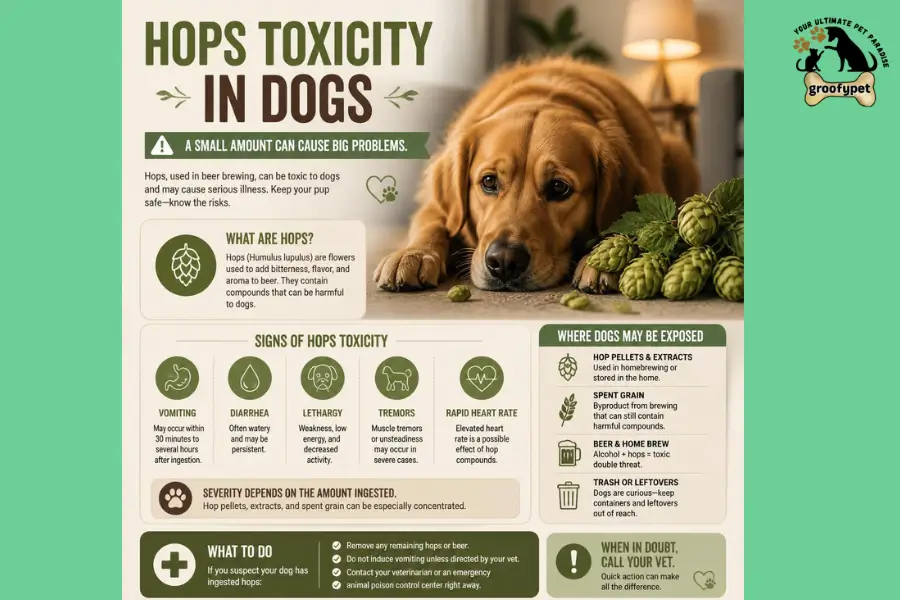
Malignant hyperthermia in dogs isn’t just a fever; it’s a cascading medical emergency. The process is thought to involve uncontrolled release of calcium within skeletal muscle cells, which causes the muscles to contract and generate heat continuously. This drives body temperature up, sometimes to levels incompatible with survival, while also straining the heart and other organs. Left untreated, this progression can lead to organ damage, abnormal heart rhythms, and death.
In simple terms, a dog’s body essentially overheats from the inside, the way an engine might overheat if it couldn’t shut itself off. This is why hop toxicity symptoms can escalate so quickly and why hops poisoning symptoms are treated with such urgency by veterinarians.
Some dog breeds appear more sensitive than others. Greyhounds, in particular, have shown up disproportionately in documented cases and may be at heightened risk, but sighthounds are not the only breeds affected. Labrador Retrievers, Golden Retrievers, Doberman Pinschers, and mixed-breed dogs have all been reported in hop toxicity cases. No breed should be considered safe from the risk.
Symptoms of Hop Poisoning in Dogs
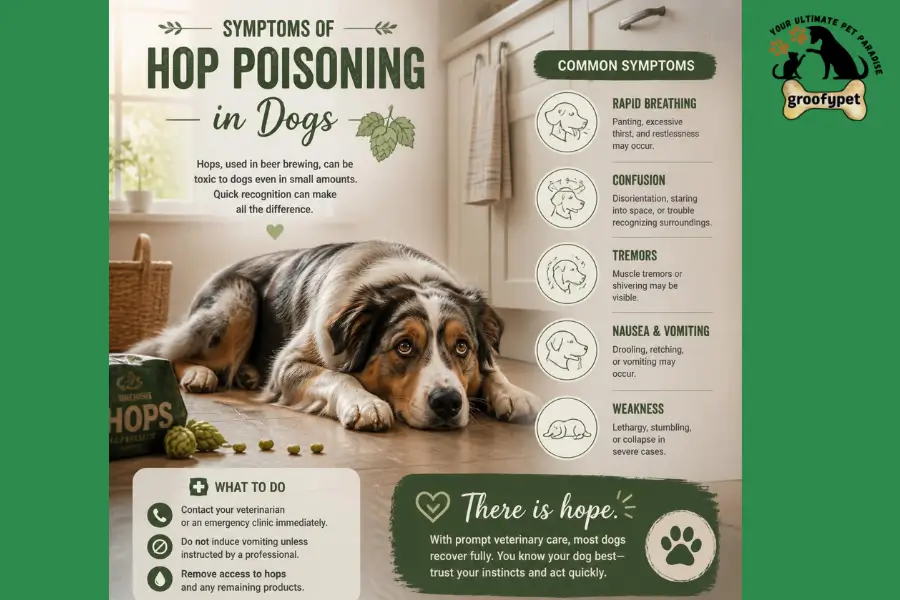
Hop toxicity symptoms often appear quickly, frequently within hours of ingestion, and can worsen rapidly. Recognizing the signs early can make a meaningful difference in outcome.
| Symptom | What It May Look Like |
|---|---|
| Heavy panting | Rapid or excessive breathing |
| Restlessness | Unable to settle or relax |
| High body temperature | Dog feels unusually hot |
| Fast heartbeat | Rapid pulse |
| Vomiting | Repeated vomiting or nausea |
| Seizures | Tremors or uncontrolled movements |
| Collapse | Weakness or loss of consciousness |
Not every dog will show every symptom, and in some documented cases symptoms have been mild or easy to miss at first. This is part of what makes hop toxicity so dangerous — a dog can look only mildly “off” in the early stages while a serious internal process is already underway.
Because these symptoms can escalate within hours, any dog known or suspected to have eaten hops should be evaluated by a veterinarian immediately, even if it currently seems fine. Waiting to see whether symptoms develop is not a safe strategy with this particular toxin.
What Happens If a Dog Eats Hops?
If a dog eats hops, the timeline can move fast. Early signs, panting, restlessness, and a rising body temperature, can appear within a few hours of ingestion. From there, the condition can progress into more severe territory: a rapid heart rate, vomiting, muscle tremors, and in serious cases, seizures or collapse.
The core danger is the uncontrolled rise in body temperature. As the dog’s internal temperature climbs, the risk of complications increases sharply. Prolonged severe hyperthermia can damage internal organs, disrupt normal blood clotting, and place enormous strain on the cardiovascular system. In the most severe cases, this progression has been fatal, even with treatment, though outcomes are generally better when veterinary care is sought quickly.
This is why owners should not simply monitor a dog at home and wait for symptoms to fully develop before acting. By the time obvious, severe symptoms are visible, the underlying process may already be advanced. Prompt veterinary evaluation — ideally before serious symptoms even set in — gives the dog the best chance at a good outcome.
What Should You Do If Your Dog Eats Hops?
If you know or suspect your dog has eaten hops in any form, act quickly and calmly:
- Remove access to the hops. Move your dog away from the plant, brewing area, compost, or trash to prevent further ingestion.
- Determine what type of hops were consumed. Note whether it was fresh plant material, dried hops, hop pellets, or spent hops from a brewing session — this information helps your vet assess risk.
- Estimate how much was eaten and when. Even a rough estimate of quantity and the time of ingestion is useful for treatment planning.
- Contact a veterinarian or emergency veterinary clinic immediately. Don’t wait for symptoms to appear. If your regular vet isn’t available, go to the nearest emergency animal hospital or call an animal poison control hotline.
- Follow professional instructions exactly. Your vet may want you to bring your dog in right away or may give specific guidance based on the situation.
- Do not induce vomiting unless a veterinarian specifically tells you to do so. Inducing vomiting incorrectly, or when it isn’t appropriate, can cause additional harm.
What to do if a dog eats hops ultimately comes down to one principle: treat it as a true emergency and get professional help immediately. Home monitoring, waiting it out, or trying to manage symptoms yourself is not appropriate for a toxin capable of causing rapid, severe hyperthermia.
Are All Forms of Hops Dangerous to Dogs?
Yes. One of the most persistent myths around hops toxicity in dogs is that only certain forms are risky for example, that spent hops from brewing are dangerous but fresh garden hops are fine, or that dried hops are somehow safer than fresh ones. Available evidence doesn’t support drawing that kind of safety line. Toxic reactions have been documented across multiple forms:
- Fresh hops — straight from the vine, including cones and, according to some anecdotal reports, other plant parts. Dogs with access to a backyard hop plant are at risk, especially during harvest when cones may fall to the ground.
- Dried hops — used for brewing or sold as brewing supplies. Dried hops for dogs pose the same fundamental risk as fresh ones; drying does not appear to neutralize the toxic effect.
- Hop pellets — a compressed, concentrated form widely used by homebrewers. Because pellets are compact, a small volume can represent a meaningful quantity of hops.
- Brewing hops (fresh, used in an active brew) — accessible during the brewing process itself if a dog gets into open containers or ingredients left within reach.
- Used/spent brewing hops — hops that have already been used in a brew and discarded. These are frequently implicated in reported cases, likely because dogs are drawn to the residual sweetness of the wort that coats them.
- Hops found in home-brewing materials generally — including compost piles, trash containing spent hops, or brewing waste left in the yard.
Because no form has been established as safe, the responsible approach for anyone who brews at home is to prevent dog access to hops at every stage: growing, brewing, and disposal.
Can Dogs Eat Foods or Drinks Containing Hops?
Dogs should never be given foods or drinks that contain hops, including beer. Beyond the hops itself, alcoholic beverages introduce an entirely separate set of risks for dogs. Alcohol is toxic to dogs even in small amounts and can cause vomiting, disorientation, dangerously low blood sugar, breathing problems, and,, in severe cases, coma or death. A hop-containing beverage like beer effectively combines two hazards in one product, the hops and the alcohol, making it doubly inappropriate for dogs.
Some specialty products, such as hop-flavored items or homebrewing ingredients stored in the kitchen or garage, can also pose a risk if a dog gets into them. As a general rule, any food, drink, or ingredient associated with brewing should be stored well out of a dog’s reach, the same way you would secure any other household toxin.
How Is Hop Poisoning in Dogs Treated?
Hop poisoning in dogs must be treated by a veterinarian; there is no safe or reliable home treatment for this condition. Once a dog is evaluated, veterinary care typically focuses on controlling the dangerous rise in body temperature and supporting the body through the crisis. Depending on the severity of the case, treatment may include the following:
- Temperature monitoring and active cooling to bring dangerously high body temperature down in a controlled way
- IV fluids to support hydration, circulation, and organ function
- Monitoring of heart rate and other vital signs to catch complications like arrhythmias early
- Treatment for seizures or other neurological symptoms, if they occur
- Hospital observation for a period of time to ensure the dog is stabilizing and to watch for delayed complications
The intensity and duration of treatment depends on how much was ingested, how quickly the dog was brought in, and how severe the symptoms are. This is precisely why speed matters so much: dogs treated early tend to have a better chance of recovery than those whose treatment is delayed until symptoms are severe.
How Can You Prevent Hop Poisoning?
Because there’s no safe amount and no reliably safe form of hops for dogs, prevention is the most effective strategy. Practical steps include:
- Keep hops away from dogs entirely — whether growing in the garden, stored as brewing ingredients, or in any other form.
- Store brewing ingredients in sealed, dog-proof containers, out of reach in a secured area of the garage, kitchen, or brewing space.
- Keep brewing waste away from pets, including spent hops and trub left over after a brew session.
- Secure trash containing used hops with a lid your dog can’t access, rather than leaving bags or bins open.
- Avoid composting spent hops where dogs have access, since compost piles are a commonly reported source of accidental ingestion. If you compost, use an enclosed bin your dog cannot get into.
- Supervise dogs around home-brewing areas, especially during active brewing, ingredient prep, and cleanup, when hops are most likely to be dropped or left within reach.
- Fence off or restrict access to garden areas where hops are grown, particularly during harvest season when cones are being handled and may fall to the ground.
Taking these precautions is especially important for households that homebrew, garden with hop plants, or regularly have hop-based ingredients on hand.
Frequently Asked Questions
Can dogs eat hops?
No. Hops are toxic to dogs and can cause a serious, potentially fatal reaction called malignant hyperthermia. Dogs should never be given hops in any form.
Are hops poisonous to dogs?
Yes. Hops are considered toxic to dogs by veterinary sources, and ingestion has been linked to dangerous overheating, rapid heart rate, vomiting, seizures, and in some cases death.
What happens if a dog eats hops?
A dog that eats hops may develop symptoms such as heavy panting, restlessness, and a rapidly rising body temperature within hours. Without prompt treatment, this can progress to severe hyperthermia, organ strain, and other life-threatening complications.
How much hops is toxic to a dog?
There isn’t an established “safe” amount. Toxic reactions have occurred after relatively small quantities, and risk can vary based on the individual dog, its size, and its sensitivity. Any known ingestion should be treated as an emergency regardless of the amount.
What are the symptoms of hop poisoning in dogs?
Common hop toxicity symptoms include heavy panting, restlessness, a high body temperature, a fast heartbeat, vomiting, seizures, and collapse. Symptoms can appear within hours and escalate quickly.
Can dogs eat dried hops?
No. Dried hops for dogs carry the same risk as fresh hops. Drying does not appear to make hops safe for dogs to consume.
Are brewing hops dangerous for dogs?
Yes. Brewing, hops, and dogs are a dangerous combination in any stage of the process fresh, actively brewing, spent, or discarded. Dogs are often drawn to spent hops because of the residual sweet wort coating them.
What should I do if my dog ate hops?
Remove your dog from further access to the hops, note what type and roughly how much was eaten, and contact a veterinarian or emergency animal clinic immediately. Do not wait for symptoms and do not induce vomiting unless a vet instructs you to.
Can hop poisoning be fatal to dogs?
Yes, hop poisoning can be fatal, particularly if treatment is delayed. Prompt veterinary care significantly improves the chances of a good outcome, which is why immediate action is critical.
How long does hop poisoning take to show symptoms?
Symptoms often begin within a few hours of ingestion, though this can vary. Because onset can be fast, any known or suspected ingestion should be treated as an emergency right away rather than waiting to see if symptoms appear.
Conclusion
The answer to “can dogs eat hops” is a clear no. Hop toxicity in dogs is a real and serious risk, capable of triggering malignant hyperthermia, a dangerous, potentially fatal spike in body temperature. This holds true whether the hops are fresh, dried, pelletized, or spent from a brew session, and no dog breed should be assumed safe from the risk.
If your dog eats hops, don’t wait to see whether symptoms develop: contact a veterinarian or emergency animal clinic right away. Quick action gives your dog the best possible chance at a full recovery, while prevention, securing hops, brewing waste, and related materials remain the best way to keep your dog safe in the first place.
Can Dogs Eat Aronia Berries?Benefits, Risks, and Feeding Guide
Can Dogs Eat Bilimbi? Safety, Benefits, Risks, and Feeding Guide