The Siberian Husky is one of the most eye-catching dog breeds around. With its striking blue or multicolored eyes, thick double coat, and wolf-like face, it’s no surprise that so many people fall in love with this breed at first sight. But before you bring one home, it helps to know the full picture. This article covers 10 reasons not to get a Husky, so you can decide honestly whether this breed fits your lifestyle, your home, and your daily routine.
Huskies are not “bad” dogs. They are simply dogs with specific needs, and those needs don’t match every household. Understanding these challenges ahead of time can save you and the dog a lot of stress down the road.
Are Huskies Good Dogs for Everyone?
Huskies can be wonderful, loyal, and entertaining companions, but they are not the right fit for every household. They need a lot of daily exercise, consistent training, regular grooming, and plenty of attention. Owners who can meet these needs often find Huskies to be affectionate, playful, and rewarding pets.
10 Reasons Not to Get a Husky
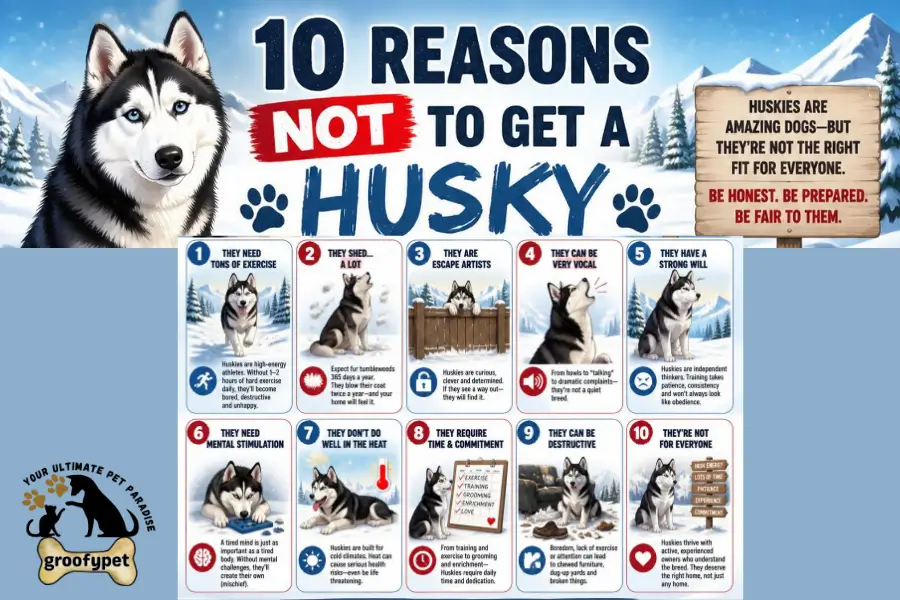
1. Huskies Need a Lot of Exercise
Huskies were bred to pull sleds across long distances in freezing conditions, and that history shows up in their daily exercise needs. A quick walk around the block is not going to cut it for this high-energy dog. Most Huskies need at least 60 to 90 minutes of vigorous activity every day, whether that’s running, hiking, biking alongside their owner, or playing hard in a secure yard.
If a Husky doesn’t get enough physical activity, that pent-up energy has to go somewhere. This often shows up as pacing, restlessness, chewing, or general anxiety. For comparison, lower-energy breeds like Basset Hounds or Bulldogs are usually satisfied with a couple of short walks a day. If your current routine looks more like the second option, a Husky may leave you both frustrated.
Example: Picture a Husky owner who works long hours and only has time for a 15-minute walk in the evening. Within a few weeks, that dog may start digging up the yard, howling out of boredom, or acting out in other ways simply because its physical needs aren’t being met.
2. They Can Be Difficult to Train
Huskies are smart dogs, but their intelligence doesn’t always translate into easy obedience. Unlike breeds that were bred to please their handlers, Huskies were bred to think independently and make quick decisions while pulling a sled. That same independent streak can make dog training more of a challenge.
This doesn’t mean Huskies can’t be trained — it means they need patience, consistency, and the right approach. Positive-reinforcement training, where good behavior is rewarded with treats, praise, or play, tends to work far better than harsh corrections. Short, engaging training sessions usually get better results than long, repetitive drills, since Huskies can lose interest quickly if training feels boring.
First-time dog owners without experience handling a strong-willed breed may find this learning curve frustrating.
3. Huskies Shed A Lot
If you’re not prepared for fur, a Husky might not be your best match. Huskies have a thick double coat built for freezing temperatures, and that coat sheds heavily — especially during seasonal “blowouts” in spring and fall when they lose their undercoat in large clumps.
Regular dog grooming is a must. Brushing several times a week (and daily during shedding season) helps manage loose fur and keeps the coat healthy. Even with consistent brushing, expect to find Husky fur on your clothes, furniture, and floors year-round. Households with allergy concerns or a strong preference for a fur-free home should think carefully before committing to this breed.
4. They Can Be Escape Artists
Huskies have earned a reputation as escape artists, and it’s well deserved. They are capable diggers, skilled jumpers, and surprisingly good climbers when motivated. A yard that seems secure for most dogs may not be secure enough for a determined Husky.
This escape tendency is often driven by their strong prey drive or their instinct to explore and roam — traits tied closely to their working-dog background. Secure fencing that extends underground (to prevent digging) and stands tall enough to prevent jumping is often necessary. Some owners also add fence toppers or supervise all outdoor time closely.
Example: A Husky left alone in a yard with a standard four-foot fence may dig a tunnel underneath it within an hour, especially if something interesting — like a squirrel or a neighbor’s cat catches its attention on the other side.
5. Huskies Can Be Very Vocal
If you’re hoping for a quiet dog, a Husky may test your patience. This is a naturally vocal dog breed, known for howling, “talking,” whining, and making an entire range of dramatic sounds. Huskies often howl to communicate, express excitement, respond to sirens or other dogs, or simply because they feel like it.
This vocal nature isn’t necessarily a sign of a problem it’s part of the breed’s personality. However, it can become an issue in apartments, close-knit neighborhoods, or homes where a quieter dog is a priority. Owners considering a Husky should think about how their neighbors, roommates, or family members might react to regular howling sessions.
6. They Need Plenty of Mental Stimulation
Physical exercise is only half the equation. Huskies also need consistent mental stimulation to stay happy and well-behaved. Without it, even a physically tired Husky can become bored and develop unwanted habits like chewing, digging, or excessive barking.
Enrichment activities can help fill this need, including:
- Puzzle toys and treat-dispensing feeders
- Scent work or “find it” games
- New walking routes or hiking trails
- Short training sessions that challenge their problem-solving skills
- Interactive play with other dogs
Owners who assume a tired Husky is automatically a satisfied Husky are often surprised to learn that mental boredom can cause just as many behavior issues as a lack of exercise.
7. Their Prey Drive Can Be Strong
Huskies have a strong prey drive rooted in their history as working sled dogs bred to survive in harsh Arctic conditions. This instinct can make them prone to chasing smaller animals, including cats, rabbits, squirrels, and even smaller dogs.
While early socialization and consistent training can help manage this behavior, it may never fully disappear. Households with cats, small pets, or frequent wildlife nearby should carefully consider how a Husky might react. Some Huskies can be trained to live peacefully alongside smaller animals, especially if raised together from a young age, but supervision is usually still recommended.
8. They May Not Like Being Left Alone
Huskies are social animals that were historically bred to work and live closely alongside other dogs and people. Because of this, some Huskies struggle with being left alone for long stretches of time. This isn’t the same as a clinical diagnosis of separation anxiety, but many Huskies do show signs of stress, restlessness, or destructive behavior when isolated for extended periods.
Owners who work long hours away from home, travel frequently, or don’t have a plan for daytime companionship (such as doggy daycare, a dog walker, or a second dog) may find that a Husky’s social needs are difficult to meet consistently.
9. They Are Not Ideal for Every Climate or Lifestyle
As a true cold-weather breed, Huskies are built for freezing temperatures — not scorching summers. Their thick double coat, which helps them survive in the Arctic, can make hot climates genuinely uncomfortable and even risky for them. Owners in warm regions need to plan exercise carefully, sticking to early mornings or evenings, providing constant access to shade and water, and watching closely for signs of overheating.
Beyond climate, Huskies also don’t fit every lifestyle. Apartment living, sedentary routines, and households without much outdoor space can all make Husky ownership more difficult than it needs to be.
10. Husky Ownership Requires Time and Commitment
When you add up everything above — exercise, training, grooming, mental stimulation, prey-drive management, and social needs — it becomes clear that Husky ownership requires real time and commitment. This isn’t a breed you can adopt and then leave mostly to its own devices.
Costs matter too. Between food, veterinary care, grooming supplies, secure fencing, and training resources, Husky ownership comes with both a time investment and a financial one. Potential owners should honestly assess whether they can commit to this for the dog’s entire lifetime, which often spans 12 to 14 years.
Comparison Table: Husky Challenges at a Glance
| Challenge | Impact on Daily Life | What Owners Can Do |
|---|---|---|
| High exercise needs | Restlessness, destructive behavior if unmet | 60–90 minutes of daily activity; running, hiking, biking |
| Difficult to train | Slower progress, requires patience | Positive-reinforcement, short consistent sessions |
| Heavy shedding | Frequent cleanup, fur on furniture | Brush several times weekly; more during shedding season |
| Escape artist tendencies | Risk of running off or getting lost | Secure, tall fencing that extends underground |
| Vocal behavior | Noise complaints, disruption at home | Manage expectations; consider neighbors and living space |
| Needs mental stimulation | Boredom-driven bad habits | Puzzle toys, scent games, new routes, enrichment |
| Strong prey drive | Risk to small pets or wildlife | Early socialization, supervised interactions |
| Dislikes being left alone | Stress, destructive behavior when isolated | Daycare, dog walkers, companionship planning |
| Poor fit for hot climates | Overheating risk in summer | Exercise during cooler hours, shade, hydration |
| Requires major time/cost commitment | Ongoing responsibility for 12–14 years | Honest lifestyle assessment before adopting |
Who Should Not Get a Husky?

A Husky may not be the right fit if you:
- Want a low-energy dog that’s content with short walks
- Have very limited time for daily exercise
- Prefer a quiet dog and live somewhere noise is a concern
- Dislike frequent shedding or have allergy sensitivities
- Cannot commit to consistent, patient training
- Regularly leave your dog alone for long stretches
- Don’t have time to provide mental enrichment activities
If several of these apply to you, it may be worth considering a different breed better suited to your lifestyle.
Who Is a Husky a Good Match For?
On the flip side, Huskies can thrive with the right kind of owner. A Husky may be a great match if you:
- Enjoy an active lifestyle with daily running, hiking, or outdoor adventures
- Have a securely fenced yard or access to safe off-leash areas
- Are experienced with — or willing to learn — positive-reinforcement training
- Don’t mind regular brushing and vacuuming
- Can provide companionship or arrange for it during work hours
- Enjoy a dog with a big personality, including vocal “conversations”
- Live in a moderate or cold climate, or can manage heat carefully
For the right owner, a Husky’s energy and personality become a highlight of daily life rather than a source of stress.
What to Consider Before Getting a Husky
Before bringing a Husky home, walk through this checklist honestly:
- Daily exercise — Can you commit to 60+ minutes of vigorous activity every day?
- Training — Do you have the patience and consistency for positive-reinforcement methods?
- Grooming — Are you prepared for regular brushing and heavy seasonal shedding?
- Food and veterinary costs — Have you budgeted for ongoing care over the dog’s lifetime?
- Secure fencing — Is your yard escape-proof, including underground barriers?
- Mental stimulation — Can you provide puzzle toys, games, and enrichment regularly?
- Time commitment — Are you ready for 12–14 years of consistent care?
- Climate — Does your local weather suit a cold-weather breed, or can you manage the heat safely?
- Other pets — Do you have small animals that could be at risk due to prey drive?
- Family lifestyle — Does your household’s pace match a high-energy dog?
Frequently Asked Questions
Why should you not get a Husky?
Huskies require significant daily exercise, consistent training, regular grooming, and mental stimulation. Owners without the time, space, or experience to meet these needs may find Husky ownership more demanding than expected.
Are Huskies difficult to take care of?
Huskies aren’t necessarily difficult, but they are high-maintenance in specific ways — especially regarding exercise, shedding, and mental enrichment. With the right routine, many owners manage these needs successfully.
Are Huskies good for first-time owners?
Huskies can be challenging for first-time owners due to their independent nature and training requirements. That said, first-time owners with plenty of time, patience, and willingness to learn can still succeed with proper research and support.
Do Huskies shed a lot?
Yes. Huskies have a thick double coat and shed heavily, particularly during seasonal coat blowouts in spring and fall. Regular brushing helps manage the shedding but won’t eliminate it.
Are Huskies hard to train?
Huskies are intelligent but independent, which can make traditional obedience training more challenging than with some other breeds. Consistent, positive-reinforcement training tends to work best.
Can Huskies be left alone?
Huskies can be left alone for reasonable periods, but many don’t do well with long stretches of isolation due to their social nature. Planning for companionship, such as daycare or a dog walker, can help.
Are Huskies good family dogs?
Huskies can be great family dogs for active households that can meet their exercise and social needs. They’re often friendly and playful, though supervision is recommended around small children and smaller pets.
Are Huskies high-maintenance dogs?
In terms of exercise, grooming, and mental stimulation, yes Huskies are considered a higher-maintenance breed compared to more low-energy options. This doesn’t make them bad pets, just a bigger commitment.
Final Thoughts
These 10 reasons not to get a Husky aren’t meant to scare anyone away from the breed they’re really considerations every potential owner should think through honestly before making a lifelong commitment. Every dog has its own personality, and not every Husky will show the exact same behaviors described here. Some are calmer, some are quieter, and some adapt more easily to apartment life than others.
That said, understanding the general tendencies of the breed from their exercise needs to their vocal nature to their strong prey drive puts you in a much better position to decide if a Husky truly fits your life. When their needs are met by the right owner, Huskies can be loving, intelligent, and endlessly entertaining companions worth every bit of the effort.
The Dog That Looks Like a Rug – 15 Curly and Cozy Dog Breeds!
How Fast Can a Pitbull Run?The Surprising Facts That Amaze Dog Lovers!